
Upgrading your condo ambient lighting or building a custom gaming setup often leaves you staring at confusing product listings, wondering if the premium price of addressable RGB (ARGB) modules is actually worth it for your space. Addressable RGB LED modules work by using a dedicated integrated circuit (IC) chip on each individual LED node, allowing a single data signal to command every light to display a unique color and brightness level independently and simultaneously. This technology enables complex, fluid multi-color animations that standard RGB strips simply cannot replicate, turning a simple light strip into a dynamic visual canvas.
Understanding how these modules operate is essential before investing in new hardware. Because addressable systems require specific voltages, control interfaces, and software configurations, a mismatched setup can lead to poor performance or even permanent hardware damage. By learning the core differences, signal mechanics, and hardware requirements, you can confidently choose the right lighting system for your aesthetic preferences and technical capabilities.
What Makes Addressable RGB Modules Different from Standard RGB?
The primary difference lies in how many colors the lighting strip or module can display at any single moment. Standard RGB systems apply one uniform color instruction to the entire circuit, whereas addressable RGB (ARGB) systems send unique, localized instructions to each individual LED node. This architectural difference completely changes how the lights behave and integrate into your environment.
Products mentioned in this guide
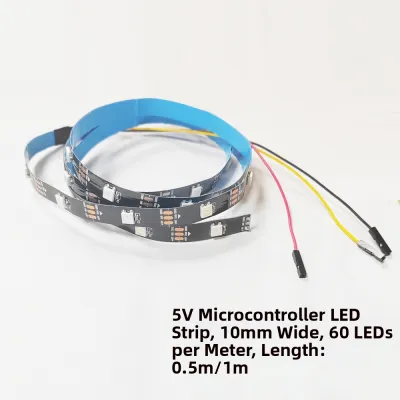
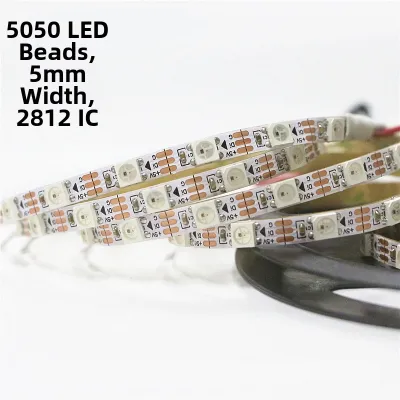
Prices are valid at publication and may change. Please refer to the product page for the latest price.
With standard RGB lighting, all light-emitting diodes on the strip are wired in parallel along shared power and control lines. When you select a color, the controller adjusts the voltage across the red, green, and blue channels uniformly, forcing every LED to turn that exact color simultaneously. If you change the color, the entire strip transitions together, limiting your visual options to solid colors, uniform breathing, or simple whole-strip color cycles.
Addressable RGB modules break this limitation by giving each LED its own identity. Because each node operates independently, one section of the module can glow warm orange while another glows deep purple, creating smooth gradients along a single continuous strip. This makes ARGB highly popular for immersive gaming setups and modern condo ambient lighting, where localized color zones can highlight specific architectural features or sync dynamically with on-screen action.
How Does the Data Signal Control Individual LEDs?
Addressable RGB modules control individual LEDs by routing a digital data stream through a tiny integrated circuit (IC) chip embedded directly inside or next to each LED node. This chip reads its assigned portion of the data packet, updates its LED’s color, and passes the remaining instructions down the line to the next node. This sequential data transmission is what allows a single control wire to manage hundreds of individual light sources with microsecond precision.

To understand how this works physically, you must look at the connector interfaces. Standard RGB modules typically use a 4-pin connector operating at 12V, where the pins are labeled for 12V power, Red, Green, and Blue ground channels. In contrast, addressable RGB modules utilize a 3-pin connector operating at 5V, featuring pins for 5V power, Ground, and a dedicated Data line. The data line carries a high-speed digital signal from your controller, containing a sequence of color values for every single LED in the chain.
This difference in voltage and pin layout creates a critical safety boundary that you must respect during installation. You must never force or adapt a 3-pin 5V ARGB plug into a 4-pin 12V motherboard header. Because the IC chips on ARGB modules are designed strictly for low-voltage 5V signals, exposing them to a 12V power source will immediately overwhelm the delicate circuitry, resulting in permanent hardware failure, melted plastic, or potential fire hazards. Always verify the voltage labels on both your lighting modules and your power source before making any physical connections.
Which Visual Effects Actually Require Addressable RGB Technology?
Dynamic, multi-color animations such as chasing rainbow waves, color-shifting gradients, and real-time audio-reactive visualizers strictly require addressable RGB technology to function. Because these patterns rely on adjacent LEDs displaying different colors at the same instant, standard RGB hardware cannot produce them. If your design goal is to have light physically “travel” down a corridor or mimic the fluid motion of water, addressable modules are an absolute necessity.
These dynamic effects are highly valued in gaming environments, where software can map in-game events—like health depletion or environmental changes—to specific zones on your light strips. For example, a low-health warning can trigger a red pulse that sweeps across your desk, providing intuitive spatial feedback. Similarly, audio-reactive modes can translate the frequency bands of your music into localized bursts of color that bounce along the walls of your condo.
However, if your aesthetic preferences lean toward calm, static, or uniform lighting, addressable technology may be unnecessary. Simple effects like a steady warm white glow, a solid single-color accent, or a slow, uniform breathing pattern that fades the entire room in and out can be achieved with standard RGB. Before purchasing, consider whether your desired spatial effect is a dynamic, high-energy spectacle or a relaxed, single-tone ambient mood, as these preferences dictate which technology is truly justified.
What Hardware Do You Need to Run Addressable RGB Modules Safely?
To operate addressable RGB modules safely, you need a compatible 5V ARGB motherboard header or a dedicated external hardware controller, paired with a power supply that matches the total wattage draw of your setup. Without these control interfaces and proper power management, the modules will either fail to light up or risk overloading your system’s circuitry. Planning your hardware layout beforehand prevents common installation bottlenecks and electrical hazards.
Start by checking your motherboard manual or device specifications to locate dedicated 5V ARGB headers, which are typically three-pin layouts with a physical gap where the missing pin would be. If your motherboard lacks these headers, or if they are already fully occupied, you will need to purchase a standalone ARGB controller or a powered hub box. These external controllers connect to your system via internal USB headers and draw power directly from your power supply unit (PSU) via SATA or Molex connectors, protecting your motherboard from excessive current draw.
When planning a larger installation, such as accent lighting for a condo ceiling cove or a long media console, you must carefully calculate power limits and verify electrical certifications. Daisy-chaining too many addressable modules together can exceed the safe current limit of a single header (usually 3 Amperes or 15 Watts), leading to voltage drops that cause the lights at the end of the chain to flicker, change color inaccurately, or dim. For extensive runs, use a dedicated, certified external power adapter and power injection cables to distribute electricity evenly. Additionally, if you plan to install these modules in damp areas like bathrooms or kitchens, or work at heights for ceiling installations, ensure the power is fully isolated before starting, use moisture-rated enclosures, and consult a qualified professional to guarantee local electrical safety standards are met.
When Is Standard RGB a Better Choice for Your Setup?
Standard RGB is often the better choice when you only require a single, uniform accent color to match your room’s theme and want to avoid the higher costs and complex software configurations of addressable systems. It provides a highly reliable, budget-friendly solution for straightforward ambient lighting where complex animations are not needed. If your primary goal is to wash a wall in a solid, calming hue, standard RGB delivers excellent results with minimal effort.
From a financial perspective, standard RGB components generally cost fewer Pesos ₱ per meter compared to their addressable counterparts, making them highly economical for large-scale installations. Because they do not require complex digital signal processing, the controllers are simpler, less prone to software conflicts, and easier to integrate with basic remote controls or smart home plugs. This simplicity reduces the time spent troubleshooting driver updates or synchronization errors.
Ultimately, standard RGB excels in scenarios where lighting serves as a subtle, non-distracting background element. Under-cabinet kitchen lighting, wardrobe interiors, and behind-the-TV backlights rarely benefit from flashing rainbow patterns or chasing effects. In these spaces, a reliable, single-color warm glow or a static cool white accent provides a clean, sophisticated look without the added complexity, power demands, and cost of addressable technology.

Community discussion
Share your experience or ask a question. Comments are reviewed before publication.