
Selecting the best christmas led projector lights for outdoor use in the Philippines requires a careful balance of festive aesthetics and robust engineering. The Philippine holiday season, while filled with warmth and celebration, also coincides with the tail end of the rainy season and persistent tropical humidity. Standard indoor decorative lights or low-quality outdoor alternatives can quickly fail when subjected to sudden downpours, high ambient moisture, and intense daytime heat. To ensure your outdoor holiday display remains bright, safe, and functional throughout the season, you must evaluate key technical specifications beyond just the patterns projected on your walls. Focusing on water resistance, material durability, and electrical compatibility will help you choose a projector that can withstand the local climate.
Essential Specs for Tropical Weather and Heavy Rain
Understanding Ingress Protection (IP) ratings is the first step in identifying a durable outdoor projector. An IP rating consists of two digits: the first represents protection against solid particles like dust (ranging from 0 to 6), and the second represents protection against liquids (ranging from 0 to 9). For outdoor holiday lighting in the Philippines, never use a device rated below IP44, which only protects against splashing water. Ideally, look for projectors with an IP65 or IP67 rating. An IP65 rating indicates the unit is completely dust-tight and can withstand water jets from any angle, making it highly resilient against typical tropical rainstorms. An IP67 rating offers even greater protection, allowing the unit to survive temporary submersion in water, which is valuable for low-lying yard areas prone to brief flooding. Always verify these ratings on the manufacturer’s official specification sheet or the physical product label, as some generic retail listings may use misleading terms like “waterproof” without official certification.
Material construction is another critical factor in tropical durability. During the day, outdoor projectors are exposed to intense ultraviolet (UV) radiation from the sun, followed by high humidity and cooler temperatures at night. This rapid thermal cycling and UV exposure can cause cheap, non-stabilized plastics to become brittle, fade, and crack over time. When cracks form, the water-resistant seal is compromised, leading to immediate electrical failure when it rains. To prevent this, prioritize projectors constructed from UV-resistant polycarbonate, heavy-duty ABS plastic, or corrosion-resistant die-cast aluminum. Rust-proof metals and high-quality polymers are especially important in coastal areas of the Philippines, where airborne salt accelerates the corrosion of exposed screws, brackets, and housing joints.
Products mentioned in this guide
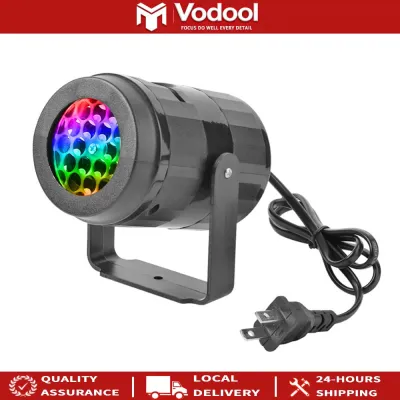
![[Vodool Home Mall] LED Christmas Pattern Projector Lamp Waterproof 360 Rotatable Stage Projection Lights Holiday Party Decor Colorful Projector Lamp Decorative Lighting](https://img.lazcdn.com/g/p/d03694eab8298bbf9a5b582a99cb2c3a.jpg_400x400q80.jpg_.webp)
![[UEB Mall]LED Christmas Pattern Projector Lamp Waterproof 360 Rotatable Stage Projection Lights Holiday Party Decor Landscape Projector Lamp Decorative Lighting](https://img.lazcdn.com/g/p/46e1e1e3a36f737e46aa7872f120c407.jpg_400x400q80.jpg_.webp)
Prices are valid at publication and may change. Please refer to the product page for the latest price.
Brightness, measured in lumens, and projection distance (often referred to as throw distance) dictate how visible your holiday display will be. In many Philippine neighborhoods, ambient light from streetlamps, security lights, and adjacent homes can easily wash out weak projection patterns. To achieve a sharp, vibrant display, look for projectors that specify their lumen output or recommended projection range. A higher lumen rating ensures the patterns remain visible even with moderate ambient light. Keep in mind that the color and texture of your home’s facade also play a significant role; light-colored, smooth stucco or concrete walls reflect light much better than dark, heavily textured stone or wood surfaces, which absorb the light and blur the projected images.
Choosing the Right Projection Style for Your Outdoor Layout
Matching the projector’s capabilities to your home’s layout is essential for an effective display. Outdoor projectors generally fall into two categories: those designed for structured pattern projection and those designed for wide-angle landscape illumination.

Facade and Wall Projection
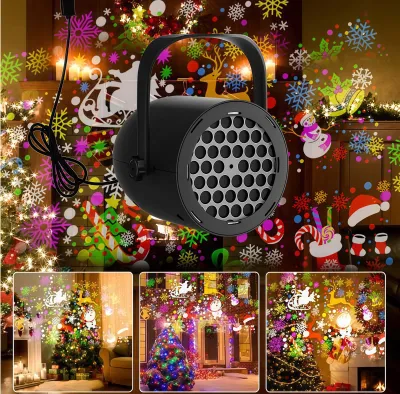
If your goal is to project distinct holiday motifs—such as moving snowflakes, nativity scenes, or festive greetings—onto the main facade of your house, you need a pattern projector. These units rely on internal slides or rotating lenses to cast sharp, recognizable images. Because your house’s walls are vertical and the projector is typically placed on the ground, the light hits the wall at an angle, which can cause the top of the image to stretch and distort. To counter this, choose a projector equipped with an adjustable mounting bracket or a 180-degree tilting head. Some premium models also feature keystone correction, which electronically or optically adjusts the image shape to ensure it remains square and undistorted on your wall. For the sharpest display, position the projector perpendicular to a flat, light-colored section of your home’s exterior wall, keeping the projection path clear of large trees or architectural obstructions that could cut off the image.
Yard and Pathway Lighting
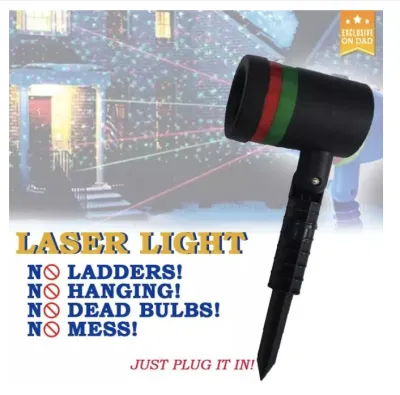
For a more diffuse, atmospheric look, landscape projectors are ideal. These devices often use lasers or wide-angle LED lenses to scatter thousands of tiny light points across your garden, trees, lawn, or driveway, creating a “starry night” effect. These projectors typically come with a sturdy ground stake that allows you to secure the unit directly into the soil. Ensure the stake is made of heavy-duty, non-corrosive plastic or aluminum to prevent it from degrading in wet soil. When positioning landscape projectors, always adjust the angle to direct the light beams downward or away from neighboring windows and oncoming street traffic. Blinding glare can be a nuisance to neighbors and a safety hazard for drivers. Additionally, pay close attention to cable management. Route all power cables along the edges of garden beds or pathways, and secure them with outdoor-safe turf staples to prevent tripping hazards on wet lawns.
Electrical Safety and Installation Best Practices
Operating electrical equipment outdoors in wet conditions requires strict adherence to safety standards. Before beginning any installation, read the manufacturer’s instruction manual to understand the projector’s voltage requirements, wattage limits, and cooling clearance. In the Philippines, the standard residential electrical supply is 220V AC at 60Hz. Ensure that the projector’s power adapter is rated for this voltage range. Using a 110V-only device without a proper step-down transformer will cause immediate damage and poses a severe fire hazard. Look for official safety certifications, such as the Philippine Standard (PS) safety mark or the Import Commodity Clearance (ICC) sticker, which verify that the product has undergone safety testing for the local market.
Always connect your outdoor projector to a Ground Fault Circuit Interrupter (GFCI) outlet. A GFCI outlet monitors the flow of electricity and will instantly shut off power if it detects a current leak, preventing electrical shocks in wet environments. If your outdoor outlets are not GFCI-protected, have a qualified electrician install them. Use only heavy-duty extension cords labeled specifically for outdoor use. Never leave electrical plug connections lying directly on the ground where water can pool. Keep all connections elevated by mounting them on stakes or placing them inside weather-resistant electrical connection boxes. Wrapping plugs in standard plastic bags or electrical tape is not a reliable waterproofing method and should be avoided.
It is vital to recognize the limits of DIY installation. While placing a low-voltage projector on a ground stake and plugging it into an existing outdoor outlet is safe for most homeowners, any task involving fixed electrical wiring, mounting projectors to high eaves or rooflines, or working near overhead service lines requires a licensed professional. Working on tall ladders during the wet season carries a high risk of slips and falls, and improper wiring can lead to short circuits, fires, or electrocution. Always turn off the main power at the circuit breaker panel before adjusting, cleaning, or connecting any permanent outdoor lighting fixtures.
Post-Holiday Cleaning and Storage to Prevent Moisture Damage
Proper maintenance at the end of the holiday season is crucial for extending the lifespan of your christmas led projector lights. The high humidity and warm temperatures in the Philippines create an environment where mold, mildew, and corrosion can quickly ruin stored electronics. Once you unplug the projector, perform a detailed visual inspection of the housing, power cord, and lens. Use a soft, dry, or slightly damp microfiber cloth to gently wipe away accumulated dust, dirt, pollen, and tree sap from the exterior surfaces. Avoid using harsh chemical solvents, glass cleaners, or abrasive scrubbing pads, as these can scratch the optical lens or degrade the rubber seals that keep water out of the housing.
After cleaning, do not immediately pack the projector away. Leave the unit and all its accessories—including stakes, brackets, and power adapters—to air-dry completely in a shaded, well-ventilated indoor space for at least 24 to 48 hours. This step is essential to ensure that any micro-condensation trapped in the crevices or around the rubber gaskets evaporates entirely. Once fully dry, store the projector in its original box or a sealed plastic storage container. To provide extra protection against the persistent tropical humidity during the off-season, place several silica gel desiccant packets inside the container. This simple step absorbs any residual moisture, protecting the internal circuit boards from rust and ensuring your lights are ready to perform perfectly next Christmas.
Frequently Asked Questions (FAQ)
Can I leave the projector outside during heavy rain?
You must check your specific projector’s user manual for its exact weather-resistance limits. While a high-quality projector with an IP65 or IP67 rating can easily withstand standard tropical rain showers, it is not designed to endure the extreme weather conditions associated with typhoons, tropical depressions, or severe localized thunderstorms. High winds can knock the projector over, and torrential downpours can overwhelm the water seals. During any severe weather warnings or periods of continuous, heavy rain, it is best practice to unplug the unit and bring it indoors to prevent water ingress and physical damage.
How far should I place the projector from the wall?
The ideal distance depends on the projector’s throw ratio, which is typically detailed on the product packaging or in the instruction manual. As you move the projector further away from your home’s facade, the projected image will grow larger, but its brightness and sharpness will decrease. Conversely, placing it too close will result in a small, overly bright image. To find the optimal position, test the projector at night by placing it on an adjustable stand or temporary stake. Move it back and forth until you achieve the desired balance of image size, clarity, and brightness before permanently securing the mount.
Community discussion
Share your experience or ask a question. Comments are reviewed before publication.