
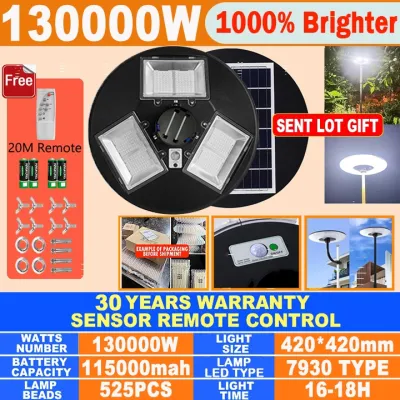
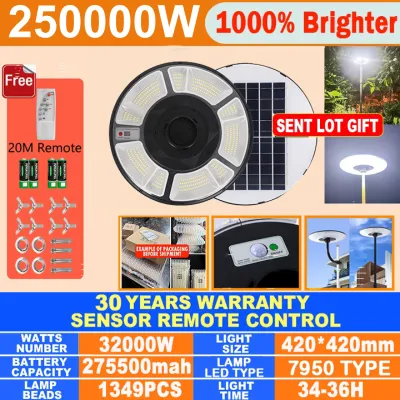
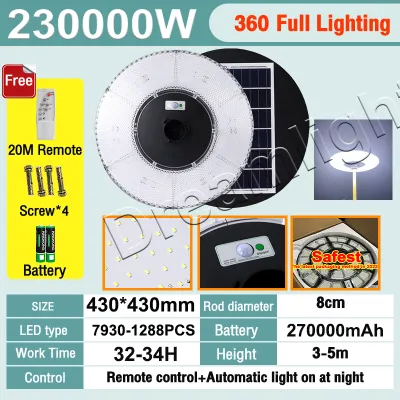
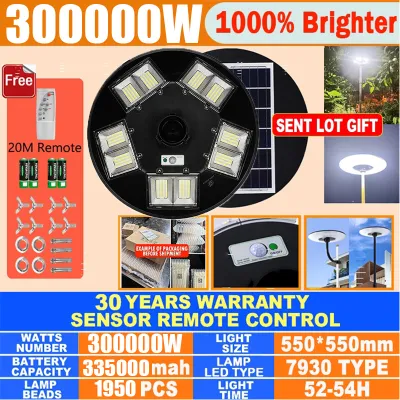
When shopping for outdoor garden illumination, you might encounter a “7000W” label on a UFO solar light. This number is a marketing term representing an “equivalent” incandescent brightness rather than the actual electrical power consumption of the unit. A self-contained solar fixture cannot physically draw or generate 7000 watts of power.
To evaluate real-world outdoor lighting performance, you must look past these inflated numbers. Instead, focus on verifiable technical metrics such as lumens, battery capacity, and solar panel efficiency to determine how well a light will illuminate your yard.
The Truth Behind the "7000W" Label
The concept of “equivalent wattage” stems from the legacy of traditional incandescent and halogen bulbs. For decades, consumers associated higher wattage directly with brighter light because older bulbs consumed massive amounts of energy to produce visible light. When highly efficient LED technology emerged, manufacturers began using extreme equivalent wattage claims to help buyers visualize how bright an LED fixture might be compared to an imaginary array of older, power-hungry bulbs.
Products mentioned in this guide
![[Free shipping]500000W UFO solar street light outdoor waterproof IP67 heavy duty Outdoor Lighting garden Led lamp with motion sensor led light solar lights with solar panel](https://img.lazcdn.com/g/p/44cfe23a59423aa8929ee904103063ef.jpg_400x400q80.jpg_.webp)
![[Free Shipping] UFO Solar Street Light Outdoor 500000W Waterproof IP67 LED Solar Light Spotlight Outdoor Lamp Motion Sensor Automatic Lighting With solar panel](https://img.lazcdn.com/g/p/89434161832b7bededed9ba8a4c3af50.png_400x400q80.png_.webp)
![[Free shipping]UFO RGB Solar Street Light Outdoor Waterproof IP67 LED 100000W 200000W 300000W 380000W 500000W Solar Light Spotlight Outdoor Lamp Motion Sensor Automatic Lighting With Pole](https://img.lazcdn.com/g/p/d61bf03680b3eb15cf71e62aaec2d30e.jpg_400x400q80.jpg_.webp)
Prices are valid at publication and may change. Please refer to the product page for the latest price.
In reality, a standalone solar light operating on a small integrated battery cannot support a true 7000W load. To put this in perspective, a genuine 7000W electrical draw would require heavy-duty commercial wiring and would quickly drain a standard household electrical circuit. A compact solar panel mounted on top of a circular UFO fixture typically generates between 15W to 50W of actual power under peak sunlight, making a true 7000W output physically impossible.
When browsing online marketplaces or local hardware stores, treat these extreme wattage ratings as loose marketing indicators rather than strict technical specifications. A light labeled as 7000W is simply the manufacturer’s way of claiming high brightness, but it does not provide a reliable measure of actual performance, durability, or energy efficiency.
Real Metrics to Check Instead of Wattage
To find a reliable outdoor light that will consistently illuminate your pathways or garden, you need to look at the actual engineering specifications. Shifting your focus to standardized metrics ensures you get a product that matches your expectations.

Lumens and Light Output
Lumens represent the true, standardized measure of visible light emitted by LED chips. Unlike wattage, which measures energy consumption, lumens tell you exactly how much light reaches your garden. When comparing UFO solar lights, look for the rated lumen output on the product packaging, user manual, or official manufacturer specifications.
Keep in mind that a higher lumen output requires more energy from the internal battery. If a fixture produces high brightness continuously, it will deplete its stored power much faster. Balancing brightness with your actual lighting needs is key to ensuring the fixture remains lit throughout the night.
Battery Capacity and Solar Panel Size
The operational duration of a solar light depends heavily on its battery capacity, which is usually measured in milliampere-hours (mAh) or Watt-hours (Wh). A larger battery capacity allows the light to store more solar energy collected during the day, ensuring it has enough power to run through the night.
Equally important is the physical size and rated wattage of the solar panel. The panel must be large enough to fully charge the battery during daylight hours. In tropical climates like the Philippines, where afternoon downpours and overcast skies are common during the wet season, a larger solar panel is essential to capture enough ambient light even when direct sunlight is limited.
A well-designed UFO solar light maintains a strict balance between solar panel input, battery storage capacity, and LED power draw. If any of these components are undersized, the light will either fail to charge fully or run out of power shortly after dusk.
How to Evaluate a UFO Solar Light for Your Garden
When selecting a UFO solar light for your landscape, use a practical checklist based on physical features and environmental conditions rather than marketing claims.
First, verify the Ingress Protection (IP) rating on the product label. Because these lights are fully exposed to the elements, they must withstand heavy rain and high humidity. Look for an IP65 or IP66 rating, which indicates the housing is sealed against dust and high-pressure water jets, preventing internal moisture damage.
Second, consider the physical dimensions and installation requirements. UFO solar lights are designed to mount on poles or walls to provide 360-degree downward illumination. Ensure the mounting location offers clear, unobstructed access to sunlight throughout the day, away from the shadow of roof eaves or mature trees.
Third, check for adjustable operational settings. Many high-quality fixtures include motion sensors, dimming options, or programmable timers. Using a motion-activated mode—where the light remains at a low standby brightness and increases to full power only when movement is detected—greatly conserves battery life during consecutive cloudy days.
Finally, plan your installation safety. Mounting a heavy UFO fixture at a height requires careful handling. Always follow the manufacturer’s installation instructions, ensure any backup electrical wiring is isolated from power sources, and consult a qualified professional if you are uncomfortable working on ladders or securing heavy suspended loads.
Frequently Asked Questions (FAQ)
Is a higher wattage always better for solar lights?
No, a higher marketed wattage does not guarantee better performance or a brighter garden. Because these numbers are often inflated for marketing purposes, you should compare fixtures using verified lumens, battery capacity, and build quality instead of relying on the wattage label.
How long will a UFO solar light stay on at night?
The runtime depends on the battery capacity, the active operational mode, and the amount of direct sunlight the panel received during the day. Under optimal charging conditions, a quality solar light should run for 8 to 12 hours, though performance may decrease during rainy or overcast seasons.
Community discussion
Share your experience or ask a question. Comments are reviewed before publication.