
Hexagon LED wall lights can work as bedside reading lights, but their effectiveness depends heavily on their design, light output, and placement. While these geometric fixtures excel at creating a modern, ambient glow, many models on the market are designed primarily for decorative accent lighting rather than focused task illumination. To use them successfully for reading, you must select a model with sufficient brightness, glare protection, and adjustable settings, or pair them with complementary light sources.
Core Lighting Requirements for Bedside Reading
Bedside reading demands a careful balance of illumination to protect your eyes and support your body’s natural sleep cycle. The primary goal of a reading light is to provide enough contrast on the page or screen so that your eyes do not have to strain to distinguish letters. When light is too dim, the ciliary muscles in your eyes must work harder to focus, leading to rapid fatigue, dryness, and tension headaches. Conversely, a light that is too bright or poorly directed can bounce off white pages or glossy screens, creating a harsh glare that is equally tiring.
Color temperature is another critical factor in a bedroom environment. Light color is measured in Kelvin (K), and different temperatures trigger different psychological and physiological responses. For evening reading, warmer light tones between 2700K and 3000K are highly recommended. These warm, amber hues mimic traditional incandescent bulbs, creating a cozy atmosphere and signaling to your brain that it is time to wind down. Cooler, neutral white lights above 4000K can enhance focus and text clarity, but their high blue-light content can suppress melatonin production, making it harder to fall asleep after you close your book.
Products mentioned in this guide
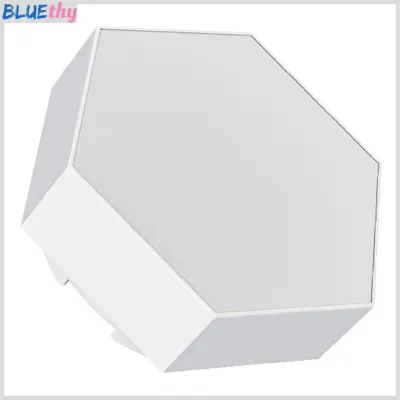
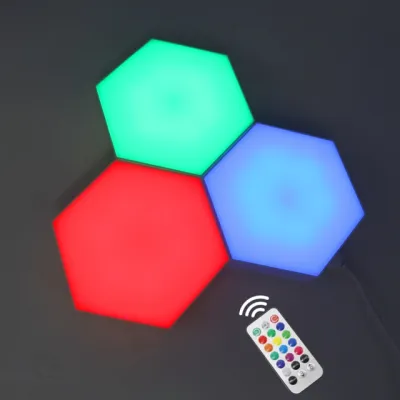
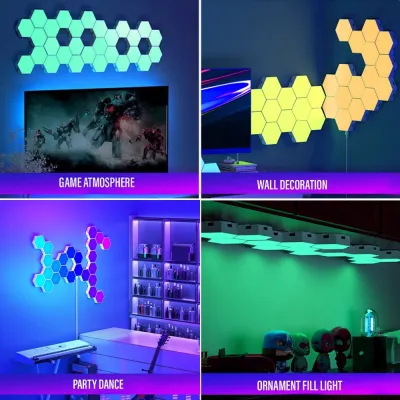
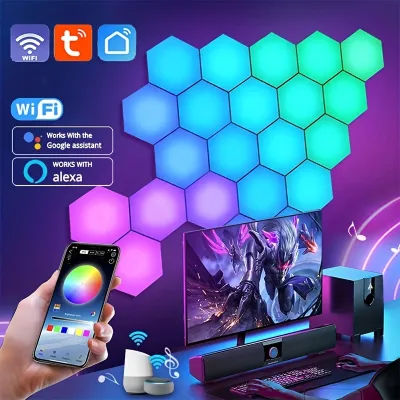
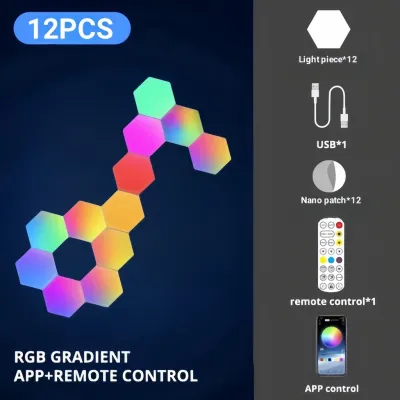
Prices are valid at publication and may change. Please refer to the product page for the latest price.
Finally, directional control is essential for a comfortable bedside setup. A dedicated reading light should project its beam directly onto your reading material, keeping the light concentrated where you need it. This directional focus prevents the light from spilling across the entire bed, which is particularly important if you share the room with a partner who wishes to sleep while you read. Without proper shielding or a focused beam angle, a wall light can shine directly into your eyes, causing immediate discomfort and disrupting your reading experience.
Evaluating Hexagon LED Wall Lights for Reading
Hexagon LED wall lights, often sold as modular panels or individual geometric sconces, typically distribute light in a wide, diffused pattern. This ambient wash is excellent for accentuating wall textures and creating a futuristic aesthetic, but it often lacks the concentrated beam required for comfortable reading. When evaluating these fixtures, you must distinguish between decorative RGB panels and high-output white LED sconces. Many modular hexagon panels are designed for gaming setups or accent walls, offering low lumen outputs that are insufficient for reading text without causing eye strain.

To determine if a specific hexagon light is suitable, check the manufacturer’s specifications for total light output, beam angle, and diffuser quality. Look for a fixture that offers a dedicated warm white mode with a lumen rating of at least 300 to 450 lumens, which is generally sufficient for close-up reading. The diffuser material is also crucial; a high-quality frosted acrylic or glass cover helps scatter the light evenly, reducing hot spots and minimizing direct glare from the individual LED chips inside the fixture.
Control accessibility is a vital practical consideration for any bedside fixture. If you have to stretch awkwardly or get out of bed to turn off the light, the setup loses its convenience. Verify whether the hexagon light features an easily reachable physical switch on the cord, a touch-sensitive surface, a remote control, or integration with a mobile application. Touch-sensitive modular panels can be particularly convenient for bedside use, allowing you to turn them on or off with a simple tap from your pillow.
Additionally, assess the physical depth and profile of the sconce. In compact bedroom layouts, a protruding fixture can become a head-bumping hazard when you sit up, adjust your pillows, or change the bedsheets. Low-profile hexagon lights that sit relatively flush against the wall are much safer and less obstructive. If you live in a highly humid tropical climate, you should also check the fixture’s build quality to ensure that moisture does not easily penetrate the housing, which could lead to premature LED failure or electrical short circuits.
Placement and Installation Considerations
Proper positioning is key to transforming a decorative hexagon light into a functional reading lamp. The optimal mounting height and horizontal offset depend on your mattress thickness, headboard height, and preferred reading posture. Ideally, the light source should sit slightly above your shoulder level when you are sitting up against the headboard, casting illumination over your shoulder onto your reading material. If the light is mounted too low, your head or shoulders will cast shadows over your book; if it is mounted too high, the light will scatter too widely and lose its effectiveness.
Before drilling any holes or applying permanent adhesives, it is wise to test the positioning. You can temporarily hold the fixture in place or use painter’s tape to mock up the layout while sitting in your typical reading position. This trial run allows you to verify that the light hits your book or tablet at a comfortable angle without shining directly into your eyes or creating distracting shadows. If you are installing a cluster of modular hexagon panels, plan the layout so that the brightest panels are positioned closest to your reading zone, while the decorative panels extend outward.
Electrical safety must be your top priority during the installation process. In the Philippines, standard household voltage is 220V, so you must verify that the fixture’s rated voltage and driver are fully compatible with your home’s electrical system. Check the condition of your wall boxes and ensure you use mounting hardware suitable for your wall type, whether it is concrete, drywall, or wood. For plug-in models, ensure the power cord is safely routed and secured so it does not pose a tripping hazard or get pinched behind the headboard.
If you are planning a hardwired installation that connects directly to your home’s electrical wiring, always isolate the power at the circuit breaker first. Working with fixed wiring, especially at heights or in tight bedside spaces, poses electrical and fire risks. If you are not fully confident in your DIY skills, or if your local building codes require it, hire a qualified professional or licensed electrician to handle the wiring. Investing a few hundred ₱ in professional installation ensures that your new lights are safely grounded, securely mounted, and fully compliant with local safety standards.
Complementary Lighting and Alternatives
If you fall in love with the aesthetic of modular hexagon lights but find their light output too soft or diffused for comfortable reading, you do not have to abandon the design. A highly effective strategy is to use a layered lighting approach. You can pair the ambient hexagon sconces with a dedicated, adjustable task light, such as a slim, flexible reading light mounted nearby. This allows you to use the hexagon panels to set a relaxing mood in the bedroom while relying on the focused, adjustable beam for actual reading.
Alternatively, if focused light is your absolute priority, you might consider adjustable wall-mounted reading arms as your primary bedside fixture. These fixtures allow you to pull the light close to your book and swing it away when not in use, offering unmatched directional control. You can still install the hexagon LED panels elsewhere on the wall as a decorative backdrop, turning them off when it is time to focus on your reading material.
For fixed-output hexagon fixtures, installing inline dimmers or smart switches can help bridge the gap between ambient and task lighting. A dimmer allows you to boost the brightness to its maximum level when you are reading, and then lower it to a soft, warm glow when you are ready to sleep. Smart switches also enable you to program schedules or control the lights via voice commands, adding a layer of modern convenience to your bedside setup.
Frequently Asked Questions (FAQ)
Do hexagon LED wall lights provide enough light for reading?
Whether hexagon LED wall lights provide enough light for reading depends entirely on the specific model’s lumen rating and beam angle. Many modular hexagon panels are designed primarily for decorative ambient lighting and may not produce enough focused light to read comfortably without straining your eyes. Before purchasing, check the manufacturer’s specifications to confirm if the fixture is rated for task lighting or if it is intended purely for decorative use.
How high should I install a bedside wall sconce?
The ideal mounting height for a bedside wall sconce depends on your seated or reclining posture, the height of your mattress, and the dimensions of your headboard. Generally, the light source should be positioned about 60 to 75 centimeters above the top of your mattress, or roughly at shoulder height when you are sitting up in bed. It is highly recommended to test the position with a temporary light source before drilling to ensure the beam hits your reading material without causing glare.
Can I use a smart bulb in a hexagon LED wall light?
Your ability to use a smart bulb depends on whether the hexagon wall light features a standard screw-in socket or an integrated LED design. Most modern hexagon wall lights utilize integrated LED chips, which are built directly into the fixture and cannot be replaced with standard smart bulbs. If your fixture has an integrated design, you can still achieve smart functionality by connecting the light to a smart plug, a smart wall switch, or by choosing a model that has built-in smart connectivity.
Community discussion
Share your experience or ask a question. Comments are reviewed before publication.