
Selecting the ideal Ecolite ceiling fan with light for your home requires balancing two critical functions: optimal air circulation and balanced room illumination. In a tropical climate like the Philippines, where high humidity and elevated temperatures are constant, an improperly sized fan will fail to circulate air effectively, leading to stuffy, uncomfortable rooms. Conversely, choosing a light fixture that does not match the scale of your space can result in harsh glare or dim, shadowy corners. By matching the square footage of your room to the correct blade span and light output, you can create a comfortable, well-lit sanctuary that functions efficiently year-round.
To make an accurate decision, you must evaluate the physical dimensions of your room, the height of your ceiling, and the specific lighting requirements of the space. Ecolite offers a range of multi-functional fixtures designed to address these varying needs. This guide breaks down the essential sizing metrics, installation clearances, and lighting specifications to help you select the perfect model for your home.
Quick Guide: Matching Ecolite Fan Sizes to Room Dimensions
Determining the correct ceiling fan size starts with calculating the total floor area of your room. In the Philippines, residential spaces are measured in square meters, while ceiling fan blade spans are globally classified in inches. Selecting a fan with a blade span that is too small for your room’s square footage results in poor air movement, forcing the motor to run at maximum speed constantly, which increases energy consumption and wear. On the other hand, a fan that is too large can create an overwhelming downdraft and visually crowd the ceiling.
Products mentioned in this guide
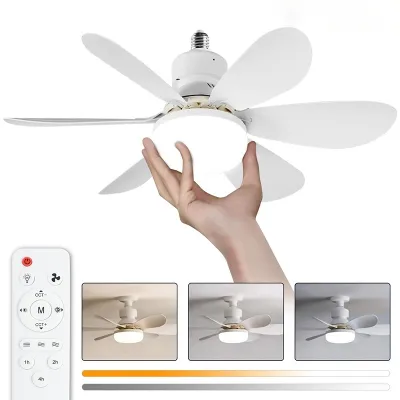
Prices are valid at publication and may change. Please refer to the product page for the latest price.
Beyond airflow, the integrated light kit must be scaled to the room. A small fan in a large room will not only fail to cool the space but will also leave the outer perimeter in darkness. Before making any purchase, always check the manufacturer’s specification label on the Ecolite packaging or the product manual for the exact recommended coverage area, voltage compatibility, and maximum wattage or lumen output.
The table below provides a general reference for matching room square footage with appropriate blade spans and typical lighting requirements:
| Room Area (Square Meters) | Recommended Blade Span (Inches) | Typical Light Output (Lumens) | Common Room Applications |
|---|---|---|---|
| Up to 12 sqm | 36" to 42" | 800 – 1,200 lm | Small bedrooms, home offices, utility rooms |
| 12 to 20 sqm | 44" to 52" | 1,500 – 2,200 lm | Standard living rooms, master bedrooms, dining areas |
| Over 20 sqm | 54" and above | 2,400+ lm (or multiple units) | Large open-plan living zones, spacious salas |
Choosing the Right Blade Span by Room Area
Small Rooms (Up to 12 Square Meters)
For compact spaces such as standard guest bedrooms, home offices, or smaller kitchens, a compact ceiling fan is the most effective choice. In these limited areas, look for Ecolite models with a blade span ranging from 36 to 42 inches. A smaller blade span ensures that the fan can rotate freely without coming dangerously close to walls, tall furniture, or open wardrobe doors.

In terms of illumination, smaller rooms do not require massive light arrays. Integrated LED panels or single-bulb fixtures are usually sufficient to provide adequate task or ambient lighting. However, because the light source is closer to the walls and occupants in a small room, it is crucial to check the product specifications to ensure the light output does not cause uncomfortable glare. Opting for a model with a frosted or diffused cover will help soften the light distribution across a compact floor plan.
Medium Rooms (12 to 20 Square Meters)
Medium-sized rooms, such as standard master bedrooms, formal dining rooms, and average-sized living rooms (salas), require mid-range blade spans typically between 44 and 52 inches. This size range provides a wider air distribution pattern, ensuring that cooling breezes reach the corners of the room rather than just the area directly beneath the fan blades.
Because these spaces cover more floor area, the lighting requirements increase accordingly. Look for Ecolite models equipped with multi-bulb fixtures or higher-lumen integrated LED modules to ensure even light distribution. A single, weak light source in a 15-square-meter room will create harsh shadows near the walls, making the space feel smaller and less inviting.
When selecting a fan for a medium-sized room, convenience becomes a major factor. Verify whether the Ecolite model includes a dedicated remote control. A remote allows you to adjust both the fan speed and the light settings from the comfort of your bed or sofa, eliminating the need to walk over to a wall switch or pull chains in the middle of the night.
Large and Open-Plan Spaces (Over 20 Square Meters)
For expansive living areas, combined dining and living zones, or high-ceiling salas, a single small or medium fan will not suffice. For these spaces, direct your attention to large Ecolite models with a blade span of 54 inches or wider. The longer blades are designed to move larger volumes of air at lower, quieter speeds, creating a gentle, consistent breeze across a wide area.
In very large or long rectangular rooms, installing a single massive fan might still leave dead zones where air does not circulate. In these scenarios, a highly effective alternative is to install two smaller or medium-sized fans spaced evenly across the ceiling. This configuration ensures balanced airflow and uniform lighting coverage throughout the entire open-plan layout.
Large spaces also demand high-lumen lighting modules with wide-beam angles to prevent dark corners. Because larger ceiling fans with integrated light kits are significantly heavier and generate more torque, they require robust structural support. Ensure your ceiling joists are rated to handle the weight and vibration of a large fixture, and plan for a professional installation to guarantee safety.
Ensuring Adequate Lighting Coverage and Brightness
When evaluating an Ecolite ceiling fan with an integrated light kit, you must look closely at the lighting specifications to ensure the fixture meets your daily needs. Do not rely solely on the physical size of the fan to estimate its light output. Instead, check the product packaging or manual for the exact lumen rating, wattage, and color temperature.
Color temperature is measured in Kelvin (K) and determines the visual warmth of the light. For relaxing areas like bedrooms or living rooms, a warm white light (around 2700K to 3000K) creates a cozy, inviting atmosphere. For task-oriented spaces like home offices or kitchens, a cool white or daylight setting (4000K to 6500K) is preferred to improve visibility and focus. Many modern Ecolite models feature tri-color LED technology, allowing you to cycle through warm, neutral, and cool white settings using your remote control.
The material of the light shade also plays a significant role in how light is diffused. Frosted glass and acrylic covers scatter the light evenly, reducing harsh glare and making them ideal for general ambient lighting. Opaque or semi-opaque covers tend to direct light downward, which can be useful for highlighting specific areas but may leave the upper parts of the room dim.
Always verify if the light kit is dimmable and what control method it uses. Some dimmable models require a compatible wall dimmer switch, while others are controlled exclusively through an included remote control or a mobile app. Lastly, remember that a ceiling fan light is designed primarily for general ambient illumination; it should not be expected to completely replace dedicated task lighting, such as desk lamps or under-cabinet strip lights in reading nooks and kitchen workspaces.
Ceiling Height, Downrods, and Safety Clearances
Safe and efficient operation of your ceiling fan depends heavily on maintaining proper physical clearances. The most critical safety standard is the vertical distance between the fan blades and the floor. For safety reasons, the lowest part of the fan blades must hang at least 2.1 meters (7 feet) above the floor. In homes with high ceilings, maintaining a distance of 2.4 meters (8 feet) is ideal for maximizing airflow efficiency.
Horizontal clearances are equally important to prevent damage and turbulence. Ensure there is a minimum clearance of 0.5 meters (18 inches) between the tips of the fan blades and any adjacent walls, hanging light fixtures, columns, or sloped ceilings. If a fan is installed too close to a wall, it will starve the blades of air, drastically reducing the fan’s cooling performance and potentially causing it to wobble.
To achieve the perfect height, you must choose the correct mounting style based on your ceiling height:
- Flush Mount (Hugger): Ideal for low ceilings (2.4 meters or below). This style mounts the fan body directly against the ceiling, maximizing headroom while keeping the blades a safe distance from occupants.
- Standard Downrod: Suitable for standard ceiling heights (2.5 to 2.7 meters). It uses a short metal pipe (usually 3 to 6 inches) to position the fan at the optimal height for air circulation.
- Extended Downrod: Necessary for high ceilings (3 meters and above). Hanging the fan too high keeps the breeze from reaching the living space; an extended downrod lowers the fan to the recommended 2.4-meter height, ensuring both the breeze and the light reach the floor effectively.
Before beginning any installation work, establish a strict safety boundary by turning off the main power supply at your home’s circuit breaker. Do not rely solely on the wall switch to isolate the electrical current. For fixed wiring installations, especially when mounting to concrete ceiling slabs common in the Philippines, always consult a qualified professional electrician. A professional will ensure that the junction box is securely anchored and rated to support both the static weight of the fan and the dynamic forces generated when the motor is running at high speed.
Common Sizing and Placement Mistakes to Avoid
One of the most frequent errors homeowners make is purchasing a fan based solely on aesthetic appeal without verifying the room’s physical dimensions. Buying a fan that is too small for a large room results in a weak, localized breeze and leaves the rest of the space dim and stuffy. Conversely, installing an oversized fan in a small room can create an uncomfortable “wind tunnel” effect, causing papers to fly off desks and generating excessive wind noise.
Another common mistake is neglecting ceiling slope limitations. Standard ceiling fans are designed for flat ceilings. If you are installing an Ecolite fan on a vaulted or sloped ceiling, you must verify if the specific model includes or supports an angled mounting bracket. Installing a standard bracket on a slope can cause the downrod to hang unevenly, leading to severe wobbling, motor damage, or physical contact between the blades and the ceiling.
Placing the fan off-center in a rectangular or L-shaped room is another placement pitfall. If the fan is mounted in the center of only one half of a long room, the other half will suffer from poor air circulation and inadequate lighting. To correct this, you must either install supplementary lighting fixtures (such as downlights or track lighting) to balance the illumination, or install a second, matching ceiling fan to cover the remaining zone.
Always cross-reference your room’s actual physical measurements with the specific installation constraints listed in the Ecolite user manual before finalizing your purchase. Taking the time to measure your space accurately and verify product specifications will prevent costly installation errors and ensure your new ceiling fan with light performs beautifully for years to come.
Frequently Asked Questions (FAQ)
Can I use an Ecolite ceiling fan with a light in a bathroom or outdoor area?
Before installing any ceiling fan in a bathroom, covered patio, balcony, or outdoor area, you must check the Ingress Protection (IP) rating or damp/wet location certification on the product label. Standard indoor ceiling fans are not designed to withstand high humidity, steam, or direct water exposure. Installing an indoor-rated fan in a damp environment can lead to rusted motor parts, warped blades, and dangerous electrical short circuits. Only install models that are explicitly certified by the manufacturer for damp or wet locations in these areas.
Does the light kit reduce the airflow of the ceiling fan?
An integrated light kit does not significantly reduce the airflow of a ceiling fan if the unit has been engineered correctly. While the light housing adds slight weight and physical bulk directly beneath the blades, modern Ecolite fans are designed with aerodynamic efficiency in mind. The motor is calibrated to handle the specific weight of the included light kit. To ensure optimal airflow, focus on selecting the correct blade span for your room size, mounting the fan at the recommended height, and using the appropriate downrod to allow proper air intake above the blades.
Community discussion
Share your experience or ask a question. Comments are reviewed before publication.