
Finding the perfect full-length mirror for a compact room requires balancing optical functionality with physical space. To see your entire body in a mirror, the glass must be at least half your height and positioned at the correct distance. However, in a small room, a mirror that is too bulky or poorly placed can make the layout feel cramped and cluttered. By understanding the relationship between mirror dimensions, room clearance, and visual placement, you can select a stand mirror that opens up your space while serving its practical purpose.
Understanding Minimum Dimensions for Whole-Body Reflection
The physics of light reflection dictate the absolute minimum size required for a full-length mirror. According to optical principles, a flat mirror must be at least half the height of the tallest person using it to display a complete head-to-toe reflection. For example, if you stand 170 centimeters tall, you need a mirror that is at least 85 centimeters high. This rule remains constant regardless of how far back you stand, though standing further away increases the field of view around your body.
Width is equally important for a comfortable viewing experience. A standard width of 35 to 50 centimeters is generally sufficient for a single user to view their entire frame without feeling restricted. If the mirror is shared by multiple household members of varying heights, opting for a slightly wider glass surface of 50 to 70 centimeters prevents the need to constantly adjust your standing position or tilt the mirror frame.
Products mentioned in this guide
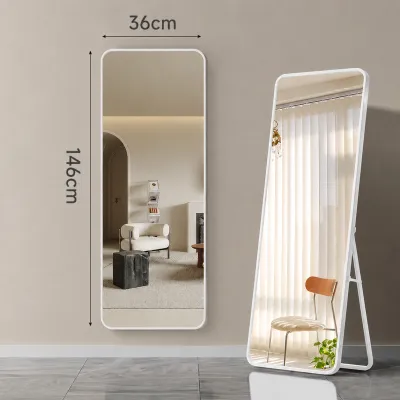
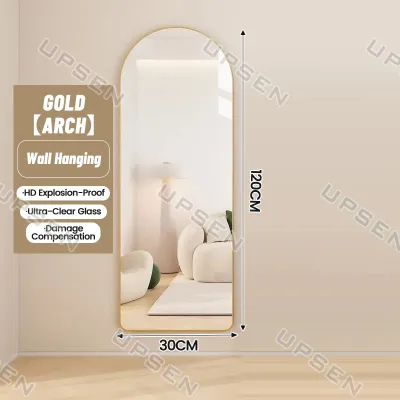
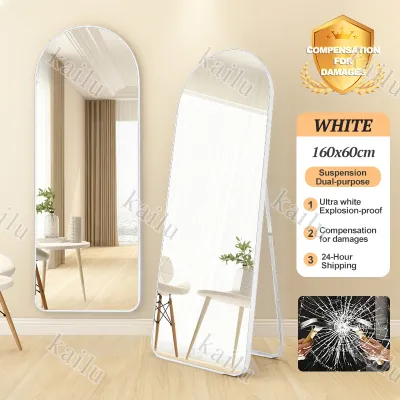


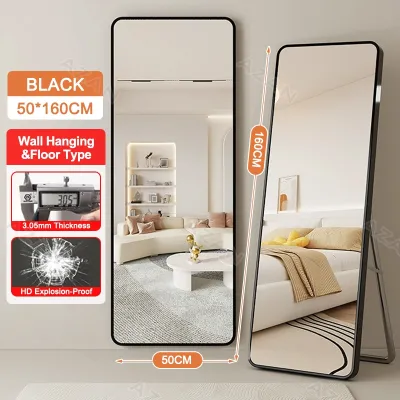


Prices are valid at publication and may change. Please refer to the product page for the latest price.
Beyond the glass itself, the physical footprint of the mirror is heavily influenced by its frame and support structure. A minimalist metal frame might only add a few millimeters to the overall dimensions, whereas a thick, carved wooden frame can add 10 to 15 centimeters of width and depth. Furthermore, the base design dictates how much floor space is lost. A traditional easel-back stand requires a deep triangular footprint, often extending 30 to 50 centimeters behind the mirror, while a flat metal base plate or a U-shaped frame keeps the physical footprint exceptionally shallow.
Measuring Your Room to Prevent a Cramped Layout
Before purchasing a stand mirror, you must carefully measure your available floor area and compare it to the physical footprint of the mirror’s base. Walking paths and high-traffic zones require a minimum clearance of 60 to 90 centimeters to allow comfortable movement. Placing a wide stand mirror in a narrow hallway or a tight bedroom walkway can restrict traffic flow, leading to accidental bumps and potential safety hazards.

You must also account for the functional clearance of nearby furniture and architectural elements. Map out the swing radius of bedroom doors, wardrobe doors, and cabinet drawers. A mirror positioned within the path of a swinging door is highly susceptible to impact damage. Ensure that even when doors are fully open, there remains a safe buffer zone of at least 15 to 20 centimeters between the door edge and the mirror frame.
Vertical and structural elements require close inspection as well. Measure your ceiling height and the height of your baseboards. In tropical climates like the Philippines, high humidity levels can cause subtle shifts in wooden flooring or subfloors over time, leading to minor unevenness. If you plan to use a leaning mirror, verify that the floor is perfectly level and that the baseboard profile allows the mirror’s base to sit securely against the wall without slipping.
Freestanding vs. Wall-Mounted: Space and Installation Trade-offs
Choosing between a freestanding stand mirror and a wall-mounted model is a critical decision for small spaces. A freestanding mirror offers excellent mobility, allowing you to easily rearrange your layout or move the mirror to different rooms. However, it inevitably consumes valuable floor space. A wall-mounted mirror, on the other hand, has a zero-footprint design that preserves floor area entirely, making it highly suitable for compact entryways, walk-in closets, or small bedrooms.
Wall-mounting a heavy glass mirror introduces structural and safety considerations. Large mirrors are heavy suspended loads that require secure anchoring. In many homes, walls are constructed from concrete, hollow blocks, or drywall. Concrete walls require masonry drill bits, heavy-duty wall plugs, and robust screws to support the weight safely. If you are installing a mirror with integrated LED lighting, you must also verify the voltage compatibility, wattage limits, and electrical certifications, ensuring all fixed wiring is handled with proper power-isolation. For any complex wall-mounting, especially at height or on delicate wall materials, hiring a qualified professional is the safest path to prevent structural failure.
If you prefer the aesthetic of a leaning mirror but want to save space, stability must be your primary focus. Leaning mirrors should always be secured with anti-tip hardware or anchor straps fastened directly to wall studs or concrete anchors. To protect polished tile, laminate, or hardwood floors from scratches and to prevent the base from sliding outward, install non-slip rubber pads or silicone bumpers on the bottom edge of the mirror frame.
Visual Placement Strategies to Expand Small Spaces
A strategically placed mirror can act as a visual amplifier, making a compact room feel significantly larger and brighter. One of the most effective design techniques is to position the mirror opposite or adjacent to a natural light source, such as a window or balcony door. In tropical homes, this placement captures the abundant daylight and bounces it deep into darker corners, creating an illusion of expanded depth and reducing the need for artificial lighting during the day.
However, mirrors reflect everything in their path, meaning poor placement can double the visual clutter of a room. If your mirror directly faces an open wardrobe, a laundry basket, or a busy workspace, it will amplify the sense of chaos, making the room feel smaller and more cramped. Instead, aim the mirror toward clean, visually quiet focal points, such as a plain accent wall, a healthy indoor plant, or a neatly styled seating area.
To maintain a cohesive interior design, align the physical edges of the mirror with existing architectural lines. Positioning the top of the mirror to match the height of a nearby door frame, window casing, or tall wardrobe creates a clean, continuous horizontal plane. This alignment prevents the visual fragmentation that often occurs when furniture pieces of mismatched heights are crowded into a small space.
Common Sizing and Placement Mistakes to Avoid
One of the most frequent errors in small-space design is choosing a mirror with an overly ornate or thick frame. While a heavy, carved frame can be a beautiful statement piece, its visual weight can easily overwhelm a compact room, making the actual reflective glass surface feel small and restricted. For tight spaces, prioritize slim metal, thin wood, or frameless designs that maximize the glass-to-frame ratio.
Another common mistake is ignoring the angle of reflection, particularly with leaning mirrors. If a leaning mirror is tilted at too steep an angle, it will distort your body proportions and reflect mostly the ceiling, failing to provide an accurate full-body view. Ensure the leaning angle is subtle—typically between 5 and 10 degrees—and secure the frame at that position to maintain both safety and visual accuracy.
Finally, avoid placing mirrors in areas where high humidity can damage the materials. In bathrooms or poorly ventilated dressing areas, persistent moisture can seep behind the glass, causing the silver backing to oxidize and develop unsightly black spots. Always verify that the mirror backing is sealed and rated for damp environments if placing it near high-moisture zones. High-quality full-length mirrors in local home decor stores typically range from ₱2,500 to ₱8,000 depending on the frame material and glass thickness, so protecting your investment from humidity is essential.
Frequently Asked Questions (FAQ)
Can a full-length mirror be too tall for a standard ceiling?
Yes, a mirror that is too tall can make a room feel vertically compressed and top-heavy. To maintain balanced visual proportions, leave a gap of at least 30 to 45 centimeters between the top of the mirror frame and the ceiling or crown molding. This empty space allows the eye to rest and prevents the mirror from looking like it was forced into a tight vertical space.
How far should a stand mirror be placed from the bed or furniture?
You should maintain a minimum clearance of 60 centimeters between your stand mirror and any major furniture pieces, such as the bed, wardrobe, or desk. This clearance ensures you have a clear walking path and allows you to stand back at a comfortable viewing distance of 1 to 1.5 meters, which is the optimal range for viewing your entire outfit without distortion.

Community discussion
Share your experience or ask a question. Comments are reviewed before publication.