
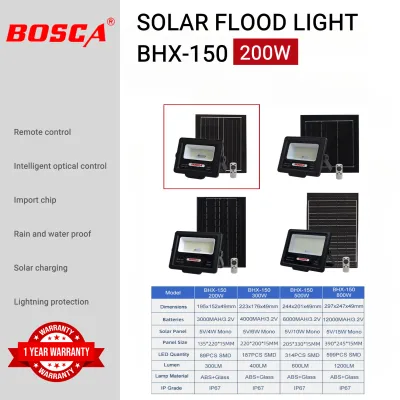
Deciding whether the Bosca 200W solar flood light is the right fit for your security setup requires looking past the “200W” label and evaluating your property’s physical layout, local weather patterns, and installation constraints. In the Philippines, where tropical downpours and intense sun alternate rapidly, outdoor security lighting must be both resilient and highly efficient. While a 200W-rated solar light can offer excellent illumination for medium-to-large outdoor spaces, its performance ultimately hinges on how much direct sunlight its solar panel receives daily and the actual battery capacity housed within the unit. By verifying key specifications, comparing wattage tiers, and understanding installation safety boundaries, you can determine if this specific model aligns with your security goals.
Understanding 200W Solar Flood Light Capabilities
In the solar lighting industry, a “200W” rating rarely represents the actual electrical power draw from a battery. Instead, manufacturers use this number as a marketing equivalent to help consumers estimate brightness relative to older halogen or incandescent floodlights. To understand what you are actually buying, you must look beyond the wattage headline and examine the rated lumen output, which measures the actual visible light emitted by the LEDs.
A true 200W-equivalent LED floodlight should ideally produce several thousand lumens, sufficient to illuminate a wide driveway, a residential backyard, or a high perimeter wall. However, the actual spread of this light depends heavily on the beam angle of the fixture, which typically ranges from 90 to 120 degrees. A wider beam angle spreads the light over a larger area but reduces the intensity at the outer edges, whereas a narrower beam focuses the light for longer-distance projection.
Products mentioned in this guide
Prices are valid at publication and may change. Please refer to the product page for the latest price.
For security purposes, a 200W solar light is best suited for open zones where you need to deter intruders or provide clear visibility for security cameras. If you mount the fixture at a height of three to four meters, a well-designed 200W unit can comfortably cover an area of approximately 80 to 120 square meters. However, if your security goal requires reading license plates or identifying faces at a distance, you must verify that the central beam intensity is high enough to support your camera’s night-vision sensors.
Key Specifications to Verify on the Bosca Label
The battery is the heart of any solar security light, determining how long the fixture can run after the sun goes down. When reviewing a Bosca 200W model, check the product label or manual for the battery capacity, usually listed in milliampere-hours (mAh) or watt-hours (Wh), as well as the operating voltage (typically 3.2V or 3.7V DC). For a 200W-equivalent light to operate reliably through the night, it typically requires a lithium iron phosphate (LiFePO4) or lithium-ion battery with a capacity of at least 15,000mAh to 20,000mAh.

Because outdoor lights in the Philippines face extreme humidity, heavy monsoon rains, and occasional typhoons, water resistance is non-negotiable. Look for an Ingress Protection (IP) rating of at least IP65 or IP66 on the Bosca packaging. An IP65 rating indicates that the housing can withstand low-pressure water jets from any direction, while IP66 offers protection against high-pressure washdowns, ensuring that driving rain will not penetrate the seals and short-circuit the internal electronics.
The solar panel’s ability to convert sunlight into electrical energy determines how quickly the battery charges. Monocrystalline panels are generally more efficient than polycrystalline alternatives, especially in overcast or slightly shaded conditions, though they may carry a higher price tag. Verify the physical dimensions of both the light fixture and the solar panel to ensure they fit your intended mounting space. Additionally, check the cable connection interface between the panel and the light—usually a threaded, waterproof multi-pin connector—to ensure a secure, weather-tight seal.
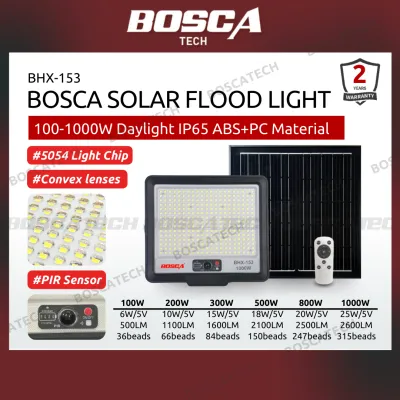
A dedicated security light should feature a passive infrared (PIR) motion sensor to conserve battery life. Check the label for the sensor’s detection range (typically 5 to 10 meters) and detection angle (usually 120 degrees). Verify the dimming method, whether it relies on an automatic sensor to drop to a low-energy state or uses a remote control to adjust brightness levels manually. Understanding these settings helps you balance security coverage with battery conservation.
Comparing Wattage Options: 100W vs. 200W vs. 300W+
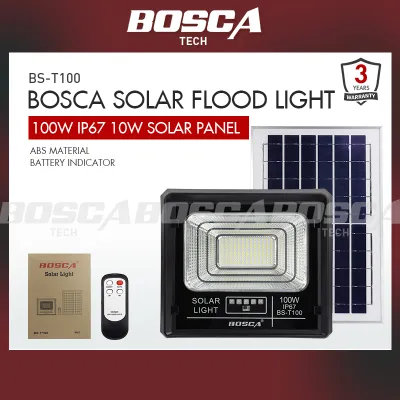
A 100W solar flood light is generally designed for localized, low-height installations, such as narrow side pathways, small entryways, or above a single-car garage door. These units are lightweight, easy to mount on standard wooden or light metal posts, and require smaller solar panels. However, they lack the punch needed to illuminate expansive yards or high-walled perimeters effectively.
The 200W tier represents a versatile middle ground for residential and light commercial security. It provides enough brightness to cover multi-car driveways, medium-sized gardens, or active loading bays without requiring excessively bulky mounting hardware. At this level, the physical weight of the light fixture and the solar panel increases, requiring more robust mounting brackets and secure anchoring into concrete, brick, or solid timber.
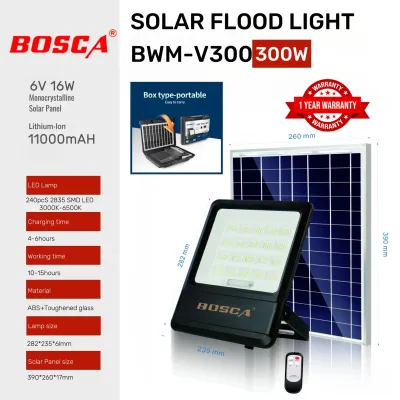
For very large properties, agricultural lots, or commercial perimeters, a 300W or higher solar flood light may seem tempting. While these high-wattage units offer maximum brightness, they also come with significant trade-offs. They require massive solar panels and heavy battery packs, which place substantial structural stress on mounting poles or building eaves. Unless you have a wide-open area that requires high-intensity illumination from a height of five meters or more, a 300W+ unit may be unnecessary and physically difficult to install safely.
Evaluating Bosca Against Other Brands in the Market
When shopping on online marketplaces or at local hardware retailers in the Philippines, comparing brands requires looking closely at after-sales support. Check if the Bosca model you are considering comes with a clear manufacturer’s warranty and whether the seller has a physical service center or responsive customer support channel in the country. A cheaper, unbranded solar light might save you money upfront, but if the battery or controller fails within six months, a lack of replacement parts or warranty coverage will force you to buy an entirely new unit.
Electrical safety and build quality vary widely among solar lighting brands. Look for recognized certification marks on the packaging, which indicate that the product has undergone testing for electrical safety and environmental compliance. Reliable brands are transparent about their specifications, listing actual lumen outputs and battery chemistry rather than relying solely on inflated wattage claims that do not match the physical size of the solar panel or battery. Whether you are looking at a budget option around ₱1,500 or a premium system costing significantly more, verifying these specifications is crucial to ensure you get what you pay for.
Before making a final decision, research long-term user feedback regarding light degradation and battery lifespan. All LEDs and batteries degrade over time, but lower-quality components will lose a significant portion of their brightness or run-time within the first year of operation. Look for reviews that specifically mention how the light performs after six to twelve months of exposure to tropical heat and heavy rain, as this provides a realistic picture of the product’s durability.
Installation and Safety Boundaries for Solar Security Lights
To get the most out of your solar flood light, the solar panel must be installed in a location that receives unobstructed, direct sunlight for at least six to eight hours a day. Avoid placing the panel under the shadow of trees, roof overhangs, or adjacent buildings, as even partial shading can drastically reduce charging efficiency. In the Philippines, angling the panel slightly to the south (typically between 10 to 15 degrees) helps maximize solar energy absorption throughout the year.
Because a 200W solar flood light and its accompanying solar panel can be heavy, secure mounting is critical to prevent falling hazards, especially during high winds or typhoons. Ensure that all mounting brackets are anchored into solid structural elements, such as concrete walls, brickwork, or heavy wooden studs, using appropriate expansion bolts or heavy-duty screws. Avoid mounting heavy solar panels directly onto thin plastic gutters or weak wooden fascia boards that could rot or warp over time.
While solar flood lights are generally self-contained, low-voltage systems, any attempt to integrate them with existing hardwired 220V security systems, smart home controllers, or backup generators must be handled with extreme caution. If your installation requires routing cables through walls, connecting to mains power for a hybrid charging setup, or working at significant heights, always isolate the power supply at the main breaker and consult a qualified electrician to ensure compliance with local electrical codes. For installations in damp areas or high-heat environments, ensure all wiring is properly insulated and protected from direct exposure to the elements.
Regular maintenance is essential to keep your solar security light operating at peak efficiency. Dust, pollen, bird droppings, and salt residue (especially in coastal areas) can accumulate on the solar panel, blocking sunlight and reducing charging capacity. Clean the panel every few months using a soft, damp cloth and clean water; avoid using harsh chemical cleaners, abrasive pads, or high-pressure washers, which can scratch the tempered glass or damage the protective seals.
Frequently Asked Questions (FAQ)
Do I need to replace the battery in a solar flood light?
Yes, the rechargeable batteries inside solar flood lights have a finite lifespan, typically lasting between two to five years depending on the battery chemistry (such as lithium-ion or LiFePO4) and usage patterns. Over time, you will notice signs of degradation, such as the light turning off much earlier in the night or failing to reach full brightness even after a sunny day. Before purchasing, check if the specific Bosca model features an accessible battery compartment that allows for straightforward replacement, or if the battery is permanently sealed, which would require professional servicing or replacing the entire fixture.
Can a 200W solar flood light work during heavy rain or typhoons?
A high-quality 200W solar flood light with a proper IP65 or IP66 rating will physically withstand heavy rain and wind without water entering the housing. However, its ability to illuminate your property during extended periods of overcast weather depends entirely on its battery capacity and smart power management. During consecutive rainy days or typhoons, the solar panel will receive minimal sunlight, meaning the battery may not fully charge. To ensure continuous security coverage during severe weather seasons, it is highly recommended to have a backup, grid-tied lighting solution or a motion-activated system in critical security zones.
Community discussion
Share your experience or ask a question. Comments are reviewed before publication.