
Quick Answer: Core Specs for Billiard Table Lighting
Selecting the right LED pendant light for a billiard table requires balancing four core technical specifications: brightness, physical coverage, mounting height, and light quality. Proper illumination is not just about making the table visible; it prevents distracting shadows, reduces eye strain during long matches, and ensures accurate color recognition when targeting stripes or solids.
To achieve this, you must match the fixture’s lumen output and physical length to your table’s specific dimensions. Additionally, verifying the mounting height and light quality metrics—such as the Color Rendering Index (CRI) and color temperature—ensures a professional-grade playing environment. Finally, always confirm that the fixture’s electrical specifications align with your room’s wiring and local power standards before beginning the installation.
Brightness and Coverage: Matching Lumens to Table Size
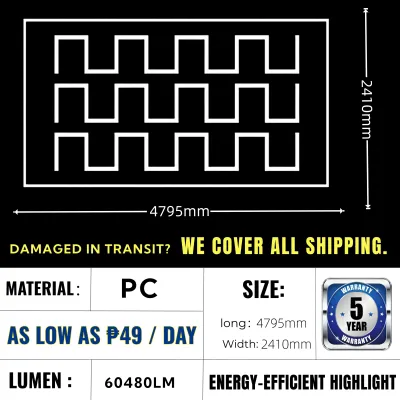
To ensure even illumination across the entire playing surface, the physical size of your LED pendant light must correspond directly to the dimensions of your billiard table. Standard residential and commercial tables typically come in 7-foot, 8-foot, and 9-foot lengths. A light fixture that is too short will leave the corners and pockets in deep shadow, while a fixture that is excessively long can spill harsh light onto the floor and into the eyes of spectators.
Products mentioned in this guide
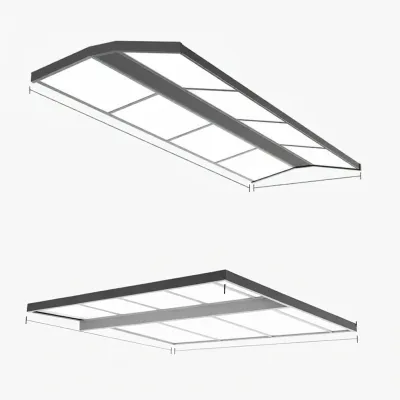
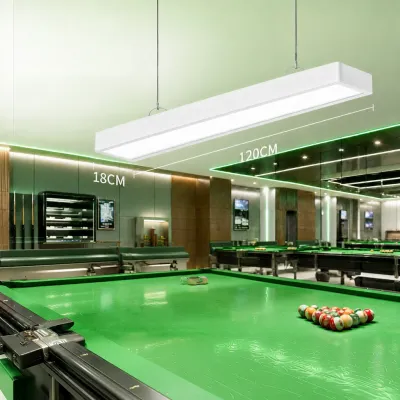
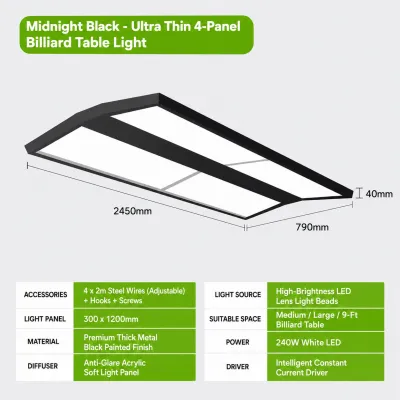
Prices are valid at publication and may change. Please refer to the product page for the latest price.

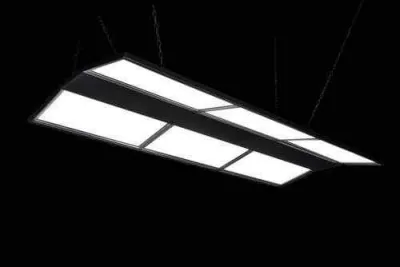
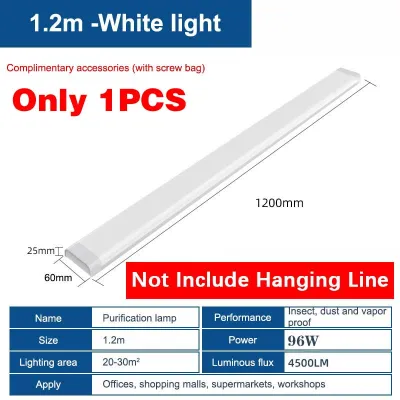
For linear LED pendants, a good rule of thumb is to select a fixture length that is approximately one-half to two-thirds the length of the table. For example, a 4-foot (120 cm) linear light provides excellent coverage for a 7-foot or 8-foot table, whereas a 5-foot (150 cm) or 6-foot (180 cm) fixture is better suited for a professional 9-foot table. If you prefer a traditional multi-shade pendant, ensure the individual shades are spaced widely enough so that their light cones overlap seamlessly across the slate.
When evaluating brightness, look closely at the manufacturer’s specification sheet for total lumen output rather than relying on outdated wattage equivalents. A high-quality billiard setup generally requires a minimum of 3,000 to 4,000 lumens of light on the table surface for smaller tables, and up to 5,000 to 6,000 lumens for larger 9-foot tables. This level of brightness ensures that every fraction of the felt is clearly illuminated, helping you judge thin cuts and bank shots with high precision.
Even light distribution is critical to prevent visual fatigue. Direct, unshielded LED chips can create blinding specular reflections on the polished surface of the billiard balls and the felt. To mitigate this, prioritize fixtures equipped with built-in acrylic diffusers, frosted lenses, or deep-set honeycomb baffles. These components soften the raw LED output, distributing the light rays evenly and eliminating the harsh glare that can ruin your focus.
In tropical environments like the Philippines, high relative humidity can cause moisture to collect inside poorly sealed light fixtures. When shopping, check the product specifications for damp-rated certifications or sealed housings. Protecting the internal LED driver and diodes from moisture buildup prevents premature corrosion and ensures the fixture remains safe and functional over years of use.
Mounting Height and Beam Angles: Eliminating Shadows
Achieving the perfect balance between broad light coverage and glare prevention depends entirely on the mounting height of the fixture. This height must always be measured from the table bed (the felt-covered slate) rather than the floor, as table heights can vary slightly. The standard recommended height is between 31 and 38 inches (78 to 96 cm) from the playing surface to the bottom of the light fixture.
Mounting the light within this specific window serves two practical purposes. First, it keeps the fixture high enough to clear the cues of players executing high-angle shots, such as jump shots or massés, and prevents the light from blocking the view of players standing on opposite sides of the table. Second, it keeps the light low enough to concentrate the illumination strictly on the playing field, preventing the light from spilling directly into the eyes of standing players.
Before purchasing a pendant light, verify the hanging specifications on the product sheet. Look for fixtures that feature adjustable steel suspension cables, aircraft wires, or chains. This adjustability is essential for fine-tuning the height during installation, especially if you are dealing with high ceilings in modern open-plan homes or lower ceilings in dedicated basement entertainment rooms.
Beam angles play an equally important role in shaping the light. While a wide beam angle of 120 degrees is excellent for general ambient lighting, a billiard table benefits from a more controlled spread. Deep-set shades or directional reflectors help focus the light downward at a narrower angle, creating a clean boundary of light that covers the table rails while keeping the surrounding seating area comfortably dim.
Installing a heavy suspended fixture over an expensive slate table requires careful physical and electrical preparation. Always turn off the main power at the circuit breaker (power-isolation) before handling any wiring. Carefully review the manufacturer’s installation instructions regarding weight limits and mounting brackets. Because these fixtures are heavy, they must be securely anchored to solid ceiling joists. For any complex hardwiring, installation of new junction boxes, or concrete ceiling drilling, always consult a qualified, licensed electrician to ensure compliance with local electrical safety standards.
Color Temperature and CRI: Distinguishing Ball Colors
Light quality is defined by two key metrics: Color Temperature and the Color Rendering Index (CRI). Together, they determine how vibrant and true-to-life colors appear on the table, which is vital when you need to quickly distinguish between similarly colored balls under pressure.
Color temperature is measured in Kelvin (K) and describes the warmth or coolness of the light. Warm white light (2700K to 3000K) creates a cozy, traditional pub atmosphere, but it can make green or blue felt look dull and distort the true colors of the balls. Conversely, neutral to cool white light (4000K to 5000K) closely replicates natural daylight. This range provides clean, high-contrast illumination that keeps players alert and makes the ball colors pop without looking clinical or sterile.
CRI measures a light source’s ability to reveal the true colors of objects faithfully on a scale from 0 to 100. For an optimal gaming experience, look for an LED fixture with a CRI rating of 90 or higher. A high CRI ensures that you can easily tell the difference between the solid red 3-ball and the brown 7-ball, or the solid yellow 1-ball and the yellow-striped 9-ball, even in your peripheral vision.
Avoid buying fixtures based on vague marketing terms like “bright white” or “daylight.” Instead, check the technical specification sheet or the product packaging for the exact Kelvin and CRI ratings. This ensures you get a fixture that delivers the precise light quality required for competitive play.
Additionally, verify that the fixture uses high-quality LEDs with consistent color binning. Low-grade LED fixtures often suffer from color shifting across different diodes, which can result in one end of your billiard table looking slightly pinkish or bluish compared to the other. Consistent color quality across the entire length of the fixture is essential for maintaining a uniform playing surface.
Dimming, Controls, and Electrical Safety
While high-intensity light is necessary during an active game, a billiard table is often the focal point of a multi-purpose room. Integrating dimmable LED drivers allows you to lower the light levels when the table is covered, transitioning the space into a relaxed lounge, home theater, or dining area. This versatility significantly increases the utility of your entertainment space.
To enjoy seamless dimming, you must pair the fixture with a compatible LED dimmer switch. Using an incompatible standard dimmer can lead to annoying flickering, audible buzzing, or even permanent damage to the LED driver. Check the manufacturer’s specifications to determine whether the fixture requires a TRIAC, Electronic Low Voltage (ELV), or 0-10V dimming controller.
Your choice of fixture style should complement your interior decor without sacrificing functional performance. Modern linear LED bars offer a sleek, minimalist aesthetic that works beautifully in contemporary homes, while traditional multi-shade metal or glass pendants fit rustic or classic game rooms. Whichever style you choose, ensure the design prioritizes downward light distribution rather than scattering light horizontally into the room.
In the Philippines, the standard electrical grid operates at 220V to 230V at 60Hz. Because many imported light fixtures are wired for 110V systems, it is critical to verify that the LED driver in your chosen fixture is rated for 220V-240V and 60Hz. Operating a mismatched driver can cause overheating, premature failure, or electrical hazards. Always check the product label for local safety certifications, such as the Philippine Standard (PS) mark or the Import Commodity Clearance (ICC) sticker, to guarantee the fixture has passed rigorous safety and quality testing.
Frequently Asked Questions (FAQ)
Can I use a regular dining chandelier over a pool table?
Using a standard dining chandelier over a pool table is generally not recommended because of how the light is distributed. Dining chandeliers are designed for ambient room lighting, meaning they cast light in all directions (omnidirectional). Over a billiard table, this scattered light creates soft, blurry shadows along the cushion rails and around the balls, making it difficult to judge precise angles and pocket paths.
Furthermore, traditional chandeliers often feature exposed bulbs or decorative crystals that create direct, blinding glare for players when they bend down to align a shot. Dedicated billiard lights, by contrast, use focused metal shades or linear diffusers to direct light strictly downward onto the playing surface. This keeps the felt bright and uniform while keeping the players’ eyes shielded from direct glare.
How do I clean and maintain an LED billiard light fixture?
Regular maintenance ensures your LED billiard light continues to perform at its best, but safety should always be your first priority. Before cleaning, turn off the power at the wall switch and allow the fixture to cool down completely. Dust, chalk residue, and airborne particles can settle on the diffusers and shades over time, gradually reducing the light output.
Use a clean, dry, or slightly damp microfiber cloth to gently wipe away dust from the shades, metal frames, and acrylic diffusers. Avoid using harsh chemical cleaners, glass sprays containing ammonia, or alcohol-based solvents, as these substances can degrade plastic lenses, strip protective coatings from metal finishes, or damage the sensitive LED components. Always refer to the manufacturer’s care instructions for your specific fixture materials, and never use abrasive pads or steel wool, which can scratch the light-diffusing surfaces and permanently distort the light beam.
Community discussion
Share your experience or ask a question. Comments are reviewed before publication.