
Choosing the right length and tube count of LED meteor shower rain lights for your condo balcony requires balancing your physical space with the specific visual effect you want to achieve. A standard 2.5-meter to 4-meter strand featuring 8 to 10 tubes is often ideal for compact or Juliet balconies, while larger terraces benefit from multiple connected strands of longer tubes to create a continuous, cascading rain effect. By matching your balcony’s layout with the proper tube spacing and length, you can avoid both underwhelming displays and costly, cluttered excess.
How to Measure Your Balcony for Accurate Light Coverage
Before browsing online marketplaces or local lighting stores, you must establish the exact boundaries of your installation area. Begin by identifying the primary zones where you want the cascading “rain” effect to appear. On a typical condo balcony, these zones usually include the top ceiling overhang, the outer railing, vertical accent walls, or privacy screens. Each zone requires a distinct measurement approach to ensure you do not end up with a strand that is too short to complete the pattern or too long to fit safely.
To measure for a straight vertical drop from a ceiling overhang or a high beam, use a reliable tape measure to find the distance from the mounting point down to your desired hanging limit. If you plan to wrap the lights around your balcony railing, do not simply measure the railing’s linear width. Wrapping or spiraling wires around thick concrete or metal balusters consumes far more material than a straight line. Measure the linear length first, then use a piece of string to mock-wrap a single section to estimate the multiplier needed for the entire run.
Products mentioned in this guide
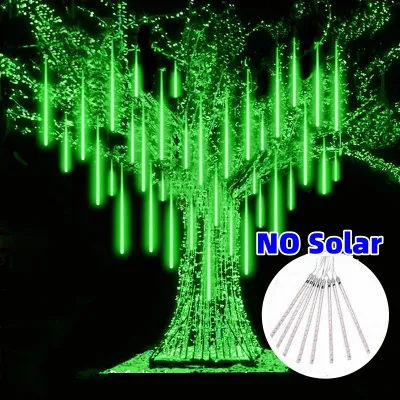
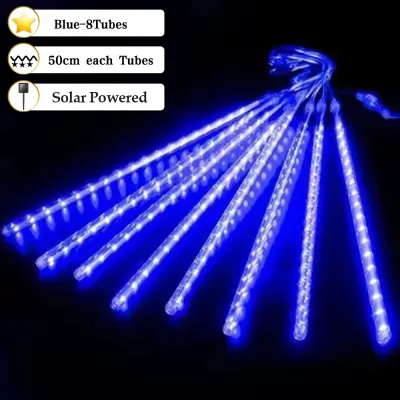
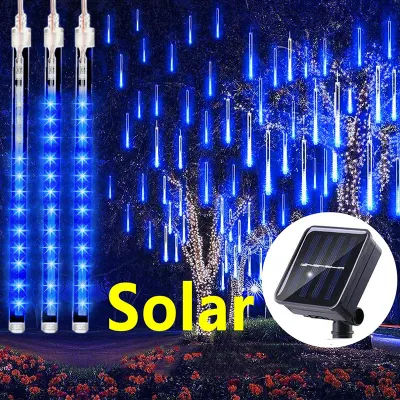
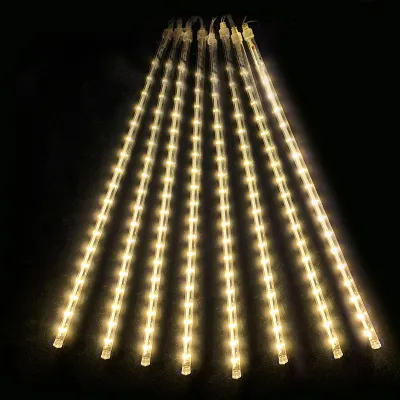
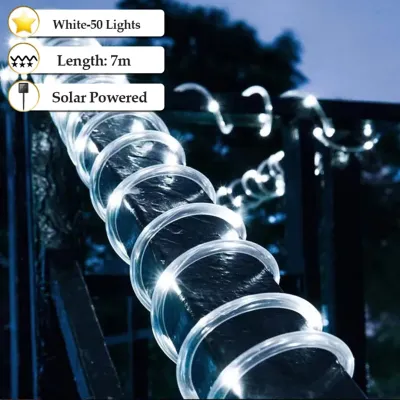
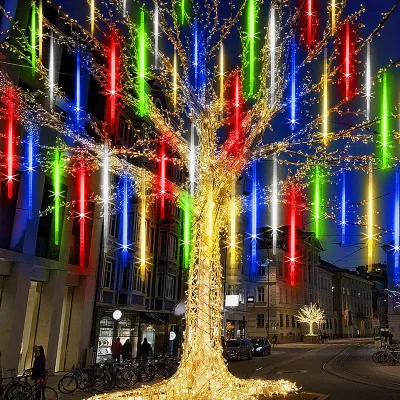
Prices are valid at publication and may change. Please refer to the product page for the latest price.
A frequent oversight is failing to account for the distance between the last light tube and the actual power source. Measure the distance from your planned starting tube to the nearest electrical outlet, keeping in mind that many balconies only have an indoor outlet accessible via a sliding door, or a single weatherproof outdoor socket. The unlit lead wire on your light strand must span this entire distance; otherwise, you will be forced to position your first glowing tube in an awkward, highly visible spot or rely on bulky extension cords.
Additionally, inspect the physical structure of your balcony before finalizing your measurements. Take note of the thickness of the railings, the presence of drainage gaps along the floor, and the texture of the ceiling or walls. These physical details determine whether you can use simple suction cups, adhesive hooks, or plastic zip ties. Knowing these dimensions beforehand helps you purchase mounting accessories that fit your balcony’s architecture perfectly without violating building rules.
Matching Tube Count and Length to Your Balcony Size
Selecting the right configuration of LED meteor shower rain lights requires understanding how tube count and tube length interact to create the illusion of falling water. The tube count—typically ranging from 8 to over 12 tubes per single circuit—dictates the density of the light points across your balcony. If the tubes are spaced too far apart, the sequential cascading animation can look disjointed and sparse; if they are packed too closely in a small space, the overlapping light can create an uncomfortable glare that washes out the delicate “meteor” effect.

Tube length, which commonly comes in 30-centimeter, 50-centimeter, and occasionally 80-centimeter variants, must scale with the height of your balcony. Shorter tubes provide a tighter, faster-moving pulse of light that suits low clearances or eye-level mountings. Longer tubes offer a more sweeping, elegant downward trail that requires sufficient vertical space to be fully appreciated.
Sizing for Small and Juliet Balconies
For compact outdoor areas or shallow Juliet balconies common in urban high-rises, restraint is key to achieving a sophisticated look. A single strand with 8 to 10 tubes, each measuring 30 centimeters in length, is usually more than enough to establish a cozy, ambient glow. Keeping the total lighted length under 3 meters prevents the wires from bunching up at the corners, which can look messy and pose a tripping hazard in tight quarters.
Instead of attempting to cover the entire perimeter of a small balcony, focus on strategic accent lighting to maximize visual impact. Hanging a short strand along a single corner or draping it gently behind a cluster of potted plants creates depth without overwhelming the space. This targeted approach draws the eye to specific focal points while leaving enough dark space to preserve the high-contrast beauty of the dripping light effect.
Avoid high-density tube clustering or hanging multiple overlapping strands in a narrow space. When too many animated light tubes are packed close together, the individual “falling star” patterns merge into a chaotic, blinking mass of light. This high visual noise can cause distracting glare inside your living room, especially when viewed through glass sliding doors at night.
Sizing for Medium to Large Balconies
Wider balconies, extended terraces, or corner units offer the physical space needed to showcase more complex and dramatic lighting configurations. For these larger areas, strands with 12 to 20 or more tubes, or individual tube lengths of 50 centimeters, are highly recommended to establish a continuous rain effect. The longer drop of a 50-centimeter tube ensures that the cascading light remains visible and impressive even when viewed from the street level below.
To calculate the total length needed for an extended terrace railing or a ceiling-mounted grid, map out the path of the wires step-by-step. If you wish to cover a 6-meter railing with a continuous wrap, you will likely need to connect two or more standard strands together. Always check the manufacturer’s technical specifications to verify the maximum number of strands that can be safely daisy-chained on a single power adapter, as exceeding this limit can lead to voltage drops, dimming, or dangerous overheating.
When covering large expanses, you must choose between buying a single, extra-long commercial-grade strand or combining multiple standard consumer-grade strands. While a single long strand simplifies power management, multiple connected strands offer greater flexibility because you can replace a single damaged section without discarding the entire setup. Whichever option you choose, ensure that all connection joints are tightly sealed against the elements.
How Installation Styles Change Your Length Requirements
The way you choose to hang your LED meteor shower rain lights directly dictates how many meters of wiring you must buy. A flat, straight-line measurement of your balcony railing or ceiling will almost never match the actual length of the light strand required once physical styling is introduced. Understanding the mechanics of different installation styles will help you calculate the correct buffer to add to your purchase order.
Vertical Hanging (Ceiling to Floor): Hanging your light tubes vertically from the ceiling overhang creates a classic “icicle” or “rainstorm” appearance. This style requires you to measure the exact drop height from the ceiling to the point where you want the tubes to end. Because the tubes hang straight down, you do not need to factor in horizontal stretching, but you must ensure the spacing between the vertical drops is even. Longer 50-centimeter or 80-centimeter tubes are highly recommended for this style to prevent the display from looking sparse or disconnected against a high ceiling.
Railing Wrapping: Wrapping your light strand around a balcony railing is one of the most popular styling choices, but it is also the most deceptive in terms of length. Because the wire must spiral around the top handrail or weave between individual balusters, the physical path of the cable is significantly longer than the straight-line distance of the railing. To avoid running out of wire halfway through the project, always add a 20% to 30% length buffer to your linear railing measurements.
Draping or Swagging: If you prefer a softer, more whimsical aesthetic, you can drape the light strand in gentle U-shapes or swags between fixed pillars, hooks, or wall mounts. Creating these elegant curves naturally consumes extra wire length depending on how deep you want the curves to sag. For this style, verify that the light strand features flexible, non-rigid wiring that can drape naturally without putting structural tension on the internal copper conductors or the individual tube connections.
Cluster or Canopy Grouping: Gathering multiple strands together in a single corner or arranging them in a dense canopy over a small seating area creates a striking, high-impact focal point. This arrangement concentrates the visual energy of the cascading lights in one spot, meaning you can use shorter individual tube lengths (such as 30 centimeters) while relying on a higher total tube count to achieve the desired density. Ensure your mounting hooks can support the concentrated weight of multiple acrylic tubes in one area.
Weather Resistance, Power, and Condo Safety Checks
Installing electrical fixtures on a condo balcony in the Philippines requires careful attention to safety, particularly due to high humidity, intense tropical sun, and heavy seasonal rains. Before purchasing any LED meteor shower rain lights, you must verify their suitability for outdoor use. Look for clear outdoor-rated or water-resistant labels on the product packaging or manufacturer’s specifications. Do not assume all LED lights are waterproof; verify the specific ingress protection (IP) claims of the manufacturer to ensure the product can withstand outdoor exposure.
Power accessibility is another critical safety factor when planning your balcony lighting. If your balcony lacks a dedicated outdoor outlet, you may need to run a power cord through a door or window, or use an outdoor-rated extension cord. Always check the manufacturer’s guidelines regarding the voltage requirements (typically 220V in the Philippines) and the maximum limit for daisy-chaining multiple strands together. Overloading a single circuit or exceeding the recommended connection limit can cause the wires to overheat, posing a serious fire hazard.
Because balconies are classified as damp, semi-outdoor environments, safety must always come first during installation. Before mounting your lights, handling any wiring, or adjusting connections, ensure that the power source is completely isolated and turned off. If your installation requires working at heights, such as reaching a high ceiling overhang, use a stable, secure ladder and have a second person assist you. For any complex setups that involve tapping directly into your condo’s fixed electrical wiring, always hire a qualified professional electrician to perform the work.
Before buying or hanging any lights, consult your condominium administration’s house rules and building guidelines. Many condo corporations in the Philippines enforce strict rules regarding exterior modifications, visible holiday decor, or hanging items over railings that could fall and injure pedestrians below. Additionally, drilling into exterior walls or concrete ceilings is often strictly prohibited to protect the building’s structural integrity and waterproofing layers.
Finally, pay close attention to the weight of the light tubes and the mounting methods you use. Heavy acrylic or glass tubes can put significant strain on temporary mounts, especially during high winds or typhoons. Use heavy-duty, UV-resistant zip ties or specialized outdoor adhesive clips that are rated for your balcony’s specific surface material, such as powder-coated metal, concrete, or glass. Ensure that all mounted components are securely fastened so they do not detach and cause damage or injury.
Common Sizing and Installation Mistakes to Avoid
One of the most common errors buyers make is confusing the “lighted length” of a strand with its “total length.” The total length specified on the packaging often includes several meters of unlit lead wire extending from the power plug to the first tube, as well as a short tail end. If you fail to read the fine print, you may end up with a strand where the actual glowing section is far too short to cover your planned balcony layout. Always check the specific dimensions of the lighted portion before purchasing.
Another frequent disappointment is buying tubes that are too short for high balcony ceilings. If your condo has a high overhead clearance and you install 30-centimeter tubes, the cascading light effect can look weak, distant, and fail to reach the eye level of someone standing on the balcony. For ceilings higher than 2.7 meters, opt for 50-centimeter or longer tubes to ensure the visual movement is prominent and engaging.
Ignoring the physical spacing between the tubes along the wire can also ruin the visual effect of your display. If you purchase a long strand with widely spaced tubes to save money, wrapping it around a thick railing or draping it across a wide span will result in a sparse, disconnected look that lacks the continuous “shower” illusion. Ensure the tube spacing matches your styling choice, aiming for closer spacing (around 30cm to 40cm) for dense railing wraps.
Lastly, failing to protect the power adapter, controller box, and connection joints from moisture is a recipe for premature product failure. Even if the individual LED tubes are waterproof, the power plug and control box are often only water-resistant or designed for indoor use. Always secure these sensitive electrical components in a dry, elevated spot, or protect them inside a dedicated weatherproof junction box to prevent water ingress during heavy tropical downpours or routine balcony floor washing.
Community discussion
Share your experience or ask a question. Comments are reviewed before publication.