
To illuminate a billiard table evenly and eliminate distracting shadows, you need a pendant light setup that matches the table’s proportions, hangs at the correct height, and directs light downward through opaque or diffused shades. Proper billiard table lighting is not just about aesthetics; it directly impacts gameplay by ensuring the balls cast minimal shadows and their colors remain highly visible from any angle. Achieving this balance requires looking beyond standard residential fixtures to find configurations designed specifically for wide, flat playing surfaces.
In tropical environments like the Philippines, where high humidity and ambient temperatures can affect indoor recreation spaces, selecting the right fixture also involves considering material durability and heat dissipation. Whether you are setting up a dedicated game room in a coastal home or upgrading a commercial pool hall, understanding the relationship between fixture design, bulb specifications, and physical placement is key to creating a comfortable, glare-free playing environment.
Sizing and Placement Rules for Shadow-Free Billiard Lighting
Billiard tables come in standard sizes, typically ranging from 7 feet to 9 feet or more. To prevent dark zones at the corners and edges, the length of your pendant light fixture must scale with the playing surface. A general guideline is that a multi-light pendant bar or linear fixture should cover approximately two-thirds of the table’s length. For instance, a standard 8-foot table benefits from a fixture that is roughly 50 to 60 inches long. If the fixture is too short, the ends of the table will suffer from dimness and elongated shadows; if it is too long, light will spill excessively onto the floor, causing unnecessary glare for spectators and wasting energy.
Products mentioned in this guide
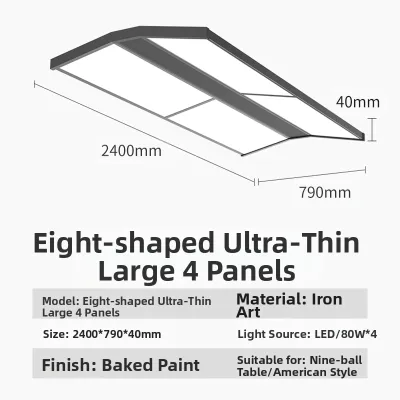
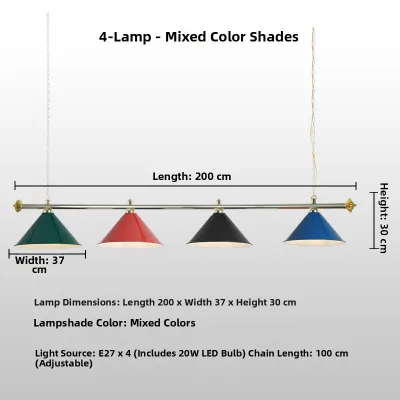
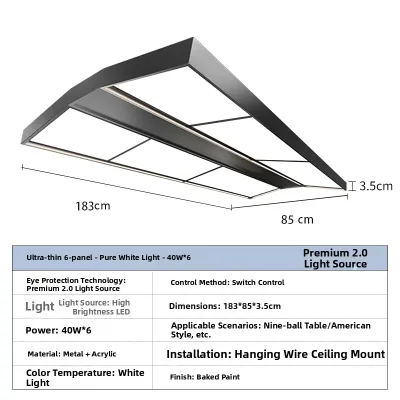
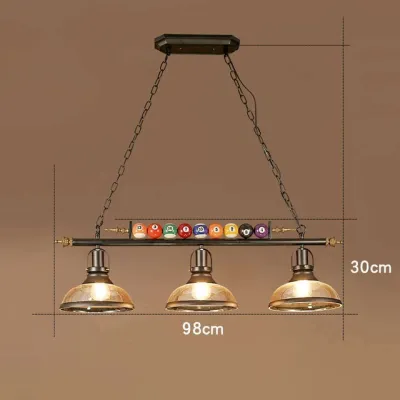

Prices are valid at publication and may change. Please refer to the product page for the latest price.
The distance between the table bed (the slate surface covered in felt) and the bottom of the pendant fixture is critical. Hanging the light too low restricts player movement, increases the risk of accidental cue stick strikes, and creates a narrow, intense hotspot of light in the center. Conversely, hanging it too high allows light to escape into the players’ eyes, causing direct glare, while reducing the intensity of illumination on the table. A standard height range of 32 to 38 inches from the playing surface to the lowest point of the fixture is widely recommended. This range balances uniform light distribution with clear player sightlines.
Because ceiling heights vary significantly—from standard residential ceilings to high-vaulted rafters in open-plan homes—selecting a pendant light with adjustable suspension components is highly advantageous. Look for fixtures that utilize adjustable chains, aircraft cables, or threaded downrods with removable segments. This flexibility allows you to fine-tune the mounting height during installation to account for the specific height of your table’s legs and frame. In humid tropical climates, ensure these adjustable components are made of corrosion-resistant materials, such as powder-coated steel, brass, or treated aluminum, to prevent rust and structural degradation over time.
Pendant Light Configurations That Deliver Uniform Coverage
For most standard and oversized billiard tables, linear multi-light bars remain the traditional and highly effective choice. These fixtures typically feature three or four individual light sources spaced evenly along a single metal or wooden bar. This layout ensures that light overlaps across the entire length of the table, minimizing the dark spots that often occur between single bulbs. A three-light bar is generally sufficient for a 7-foot or 8-foot table, while a four-light configuration is better suited for a 9-foot table or larger. The spacing between the individual shades on the bar must be calculated to provide a continuous, seamless pool of light across the felt.

If you are working with a compact room or a smaller table, a single wide dome or a modern rectangular LED panel can serve as an excellent space-saving alternative. These fixtures use a single, large housing to distribute light. A wide dome fixture must have a sufficiently broad aperture and a highly reflective interior to spread light outward. Rectangular LED pendants, often featuring integrated light-emitting diodes behind a frosted diffuser, offer a sleek, minimalist aesthetic. They provide exceptionally even, shadow-free illumination because the light source is continuous rather than point-based, making them ideal for modern interior designs.
For spaces where the billiard table might not be permanently fixed, or where the room serves multiple purposes, track-mounted pendant systems offer unparalleled flexibility. By installing a track on the ceiling, you can slide individual pendant heads along the rail to align perfectly with the table, even if the table is shifted slightly during a room rearrangement. Track systems also allow you to add, remove, or swap out individual fixtures as your lighting needs change. However, when using track pendants, you must ensure that each individual fixture is securely locked into place and that the overall track can handle the weight of the suspended shades without sagging.
Bulb Specifications and Glare Control for Clear Gameplay
Achieving uniform brightness across the table requires selecting bulbs with the appropriate lumen output and beam spread. For a standard billiard table, a total light output of approximately 3,000 to 4,000 lumens across the entire fixture is generally recommended to ensure the surface is bright enough for precise aiming. The beam spread of the bulbs should be wide enough to overlap without creating harsh, localized hotspots directly beneath each light source. Using LED bulbs with a beam angle of 110 degrees or wider helps distribute the light evenly, preventing the high-contrast shadows that can distort a player’s perception of ball distance and angle.
Accurate color rendering is essential in billiards, where players must quickly distinguish between solid and striped balls, as well as subtle color differences like red and brown or blue and purple. Look for bulbs with a Color Rendering Index (CRI) of 90 or higher to ensure colors are represented accurately under artificial light. For color temperature, a neutral to cool white range of 3000K to 4000K is ideal. This range provides a clean, alert atmosphere that enhances contrast on the green or blue felt without feeling overly clinical or harsh. Avoid warm yellow light (below 2700K), which can dull the colors of the balls and make the felt appear muddy, as well as extremely cool blue light (above 5000K), which can cause eye strain during long playing sessions.
Direct glare is one of the most common disruptors of a good billiard game. When a player leans over the table to line up a shot, their eyes are naturally positioned closer to the light source. To prevent temporary blinding or eye fatigue, the pendant fixture must feature robust glare control. Opaque shades made of metal, thick glass, or dense acrylic are excellent because they force all light downward onto the table rather than letting it escape horizontally into the room. Additionally, fixtures equipped with deep-set bulbs, inner baffles, or bottom diffusers (such as frosted glass panels) help soften the light and block direct line-of-sight to the glowing filaments or LED chips.
Installation Checks and Structural Safety Boundaries
Billiard pendant lights, especially solid wood or heavy metal multi-light bars, can weigh significantly more than standard residential fixtures. Before mounting any fixture, you must verify the weight capacity of your ceiling junction box. Standard plastic or lightweight metal boxes may not be rated to support heavy suspended loads. If your chosen fixture exceeds the standard weight limit (typically 50 pounds or approximately 22.7 kilograms), you must install a heavy-duty, fan-rated junction box or brace the fixture directly to the ceiling joists. In tropical regions where ceiling structures may be exposed to high humidity, check that all mounting hardware is rust-resistant and securely anchored to prevent structural failure over time.
Working with fixed electrical wiring always carries inherent risks, including electrical shock and fire hazards. Always isolate the power at the main circuit breaker before attempting any installation or maintenance. In the Philippines, electrical installations should comply with the Philippine Electrical Code (PEC). If your installation requires running new wiring, upgrading an existing circuit to handle higher wattages, or mounting a complex multi-light system, it is highly recommended to hire a licensed electrician. A professional will ensure that the wiring is properly grounded, the voltage matches the standard 220V system, and the connections are safely insulated against moisture and heat.
Beyond electrical safety, you must consider the physical environment surrounding the billiard table. Ensure there is adequate clearance around the entire perimeter of the table for players to swing their cue sticks without hitting walls, furniture, or the suspended light fixture itself. A standard cue stick is approximately 57 to 58 inches long, so the light fixture must hang high enough and be positioned centrally enough that a player raising their cue during a break or a trick shot will not make contact with the shades. Additionally, plan for safe maintenance access; the fixture should be positioned so that you can safely reach it with a sturdy stepladder to clean dust from the shades and replace bulbs when necessary.
Frequently Asked Questions (FAQ)
Can I use a standard dining room chandelier over a pool table?
While a standard dining room chandelier may look elegant, it is generally unsuitable for illuminating a billiard table. Dining chandeliers are designed to cast ambient, decorative light in all directions, including upward and outward, to create a warm atmosphere for dining. This multi-directional light distribution often results in significant glare for players standing around the table. Furthermore, chandeliers typically lack the focused, downward-directed beam spread needed to eliminate shadows on the playing surface. Using one can lead to uneven lighting, dark corners, and distracting shadows under the billiard balls, which directly hinders accurate gameplay.
Do I need a dimmer switch for my billiard table pendant?
A dimmer switch is not strictly necessary for active gameplay, as you will want consistent, bright, and uniform illumination while playing. However, installing a compatible dimmer switch offers excellent versatility for multi-purpose rooms. When the billiard table is not in use, dimming the pendant light allows it to serve as soft ambient lighting, contributing to the overall mood of the room during social gatherings. If you choose to install a dimmer, ensure that both the pendant fixture and the bulbs (especially LEDs) are explicitly labeled as dimmable, and verify that the dimmer switch is compatible with the specific bulb technology to prevent flickering or buzzing.
Community discussion
Share your experience or ask a question. Comments are reviewed before publication.