
Quick Answer: Which LED Strip Light Is Right for Your Nighttime Routine?
Choosing the perfect lights for room at night requires balancing visual comfort, sleep hygiene, and personal style. The ideal choice between Red-Green-Blue (RGB) color-changing strips and warm white LED strips depends entirely on how you intend to use your space during the evening hours. By identifying your primary nighttime activities, you can select a lighting system that enhances your room’s atmosphere without disrupting your body’s natural rest cycle.
Choose Warm White if: Your primary goal is winding down for sleep, reading physical books in bed, or maintaining a calm, consistent ambient glow. Warm white light closely mimics traditional incandescent lighting, creating a cozy environment that signals to your brain that it is time to rest.
Choose RGB if: You want dynamic mood lighting for gaming, watching movies, or hosting social gatherings. RGB strips allow you to change colors to match different nighttime activities, offering vibrant hues and customizable effects that can transform the visual character of a room instantly.
Products mentioned in this guide
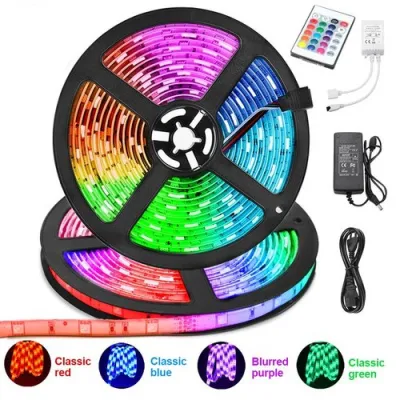
Prices are valid at publication and may change. Please refer to the product page for the latest price.
Verify first if: Your condo or rental agreement has strict rules regarding adhesive damage to walls, as some mounting tapes can strip paint or plaster upon removal. Additionally, check if you need specific smart-home ecosystem compatibility, such as integration with voice assistants or home automation hubs, before making an upfront purchase.
How Light Color Impacts Sleep and Nighttime Relaxation
The biological relationship between light exposure and sleep quality is governed by human evolutionary biology. Human eyes contain specialized photoreceptors called intrinsically photosensitive retinal ganglion cells (ipRGCs). These cells are highly sensitive to blue light wavelengths, which are abundant in daylight and in many artificial light sources. When blue light strikes these receptors, it suppresses the secretion of melatonin, the hormone responsible for regulating sleep-wake cycles, making it harder for the body to transition into deep rest.

Warm white LED strip lights, typically rated between 2700K and 3000K on the Kelvin scale, are engineered to emit light with a heavy concentration of red and amber wavelengths. This spectral composition mimics the natural progression of a sunset. By reducing exposure to high-energy blue wavelengths in the evening, warm white lighting helps minimize disruption to your circadian rhythm, allowing your body to wind down naturally as bedtime approaches.
In contrast, RGB LED strip lights present a more complex scenario for nighttime relaxation. Standard RGB strips create white light by activating their red, green, and blue diodes simultaneously at maximum intensity. This mixed white light contains a significant amount of blue light, which can inadvertently stimulate your brain and suppress melatonin if used late at night. If you choose to run RGB strips in the evening, keeping them set to pure red, deep orange, or dim amber wavelengths is highly recommended, as these longer wavelengths have the least impact on your circadian rhythm.
To ensure your lighting aligns with your sleep goals, always check the specific color temperature listed in Kelvin (K) on the product packaging. The label “warm white” is not universally standardized across manufacturers; some low-cost brands may label a cooler 3500K or 4000K light as warm white, which contains more blue light than is optimal for a bedtime routine. For the best sleep-friendly environment, prioritize strips explicitly rated at 2700K or lower, or opt for high-quality RGB strips that allow you to isolate the red channel completely during the hour before sleep.
Matching Lights for Room at Night to Your Activities
Reading and Relaxing
For activities that require focused visual attention, such as reading physical books or writing in a journal, warm white LED strips are vastly superior to standard RGB options. Warm white strips provide high-quality, glare-free illumination that enhances contrast on paper without causing rapid eye fatigue. This comfort is largely due to a higher Color Rendering Index (CRI), which measures how accurately a light source reveals the true colors of objects compared to natural sunlight. Warm white strips often feature a CRI of 80 or 90+, whereas the mixed light from RGB diodes generally suffers from a low CRI, making text harder to read and causing subtle eye strain over extended periods.
Entertainment and Gaming
If your room serves as a media hub or gaming station at night, RGB LED strips offer distinct functional advantages through bias lighting. Placing RGB strips behind a television screen or computer monitor raises the ambient light level in your immediate field of view without projecting light directly onto the screen. This setup reduces the harsh contrast between a bright display and a dark room, which mitigates asthenopia (eye strain) during long viewing sessions. Furthermore, many modern RGB systems can sync with your screen’s output, projecting matching colors onto the wall behind the monitor to create a highly immersive entertainment experience.
Dimming Capabilities
Both lighting types offer dimming features, but their performance at low brightness levels can vary significantly. High-quality warm white strips utilize dedicated dimming controllers that reduce the electrical current smoothly, maintaining a stable, warm glow even at 10% brightness. On the other hand, cheaper RGB strips often rely on low-frequency Pulse Width Modulation (PWM) to dim their light. This rapid cycling of power can cause noticeable flickering at low brightness levels, which may trigger headaches or eye strain in sensitive individuals. Additionally, some RGB strips lose color accuracy when dimmed, shifting toward unwanted pinkish or greenish hues as the controller struggles to balance the voltage across three separate color channels.
Smart Controls, Power, and Hardware Differences
Operating and maintaining your nighttime lighting setup requires an understanding of the control interfaces and physical hardware that power these systems. Warm white and RGB strips utilize different technological frameworks, which directly influences their ease of use, physical installation requirements, and long-term reliability.
Controllers
Basic warm white LED strips are highly straightforward, often requiring nothing more than a simple inline physical dial, a rotary dimmer, or a basic Radio Frequency (RF) remote control. This simplicity makes them exceptionally reliable and easy to operate without a smartphone. RGB strips, however, require dedicated controllers to manage the color-mixing process. These systems typically utilize Infrared (IR) remotes, smartphone applications via Bluetooth or Wi-Fi, or integration with smart-home hubs using protocols like Zigbee or Thread. While smart RGB controllers offer convenient features like automated scheduling and voice control, they also introduce potential failure points, such as network connectivity drops or software compatibility issues.
Power Supplies
Before purchasing any LED strip, you must verify the voltage compatibility and wattage requirements of your system. LED strips typically operate on low-voltage Direct Current (DC), commonly 12V or 24V, which requires an external power adapter to convert the 220V Alternating Current (AC) from your home’s wall outlets. Always ensure that the voltage rating of your power adapter matches the voltage rating of the LED strip exactly; connecting a 12V strip to a 24V adapter will destroy the diodes, while connecting a 24V strip to a 12V adapter will result in extremely dim light. Additionally, follow the “80% rule” for power supplies: the total wattage consumption of your LED strip run should not exceed 80% of the maximum wattage rating of your power adapter to prevent overheating and premature hardware failure.
Heat Dissipation
Though LEDs are highly efficient, they still generate heat, particularly when run for extended periods. RGB strips running multiple diodes simultaneously to create white or bright mixed colors produce more heat per meter than single-channel warm white strips. In tropical climates characterized by high ambient temperatures and humidity, this heat buildup can accelerate the degradation of the LED chips, leading to premature dimming and color shifting. To mitigate this risk, install high-output strips inside aluminum channels. These channels act as heat sinks, drawing thermal energy away from the diodes and protecting the adhesive backing from melting or peeling off the wall.
Upfront Costs and Long-Term Energy Use
When planning your room’s lighting design, it is helpful to evaluate both the initial purchasing costs and the ongoing operational expenses. Budgeting for these systems involves understanding how smart features and diode configurations affect overall value.
Price Tiers
The market for LED strip lights spans a wide range of price points, which can be categorized into three broad tiers:
- Basic Warm White Strips (₱150 – ₱500): Non-smart, low-voltage strips that include a simple power adapter and a physical switch or basic dimmer. These are highly economical and ideal for simple accent lighting.
- Standard RGB Strips (₱400 – ₱1,200): Color-changing strips controlled via an IR remote or a basic Bluetooth app. These offer good color variety but may lack advanced smart-home integrations.
- Premium Smart RGB/IC Strips (₱1,200 – ₱3,500+): High-end strips featuring individually addressable LEDs (RGB-IC), Wi-Fi connectivity, app control, and seamless integration with smart-home ecosystems. These allow for complex multi-color animations and scheduling.
Energy Consumption
The electrical power drawn by an LED strip is directly tied to which diodes are illuminated and at what brightness level. A standard warm white strip has a consistent, predictable power draw that scales linearly with dimming. An RGB strip’s power consumption, however, fluctuates dramatically based on the color selected. If you set an RGB strip to a single primary color, such as pure red, only one of the three internal diodes in each node is active, resulting in very low energy consumption. If you set the same strip to bright white, all three diodes (Red, Green, and Blue) must run at 100% capacity, which triples the power draw and increases your electricity costs.
Value Check
To get the most value for your money, avoid choosing products based solely on the lowest upfront price. Look for indicators of robust build quality, such as a dual-layer copper PCB (Printed Circuit Board) with a thickness rating of at least 2 ounces, which ensures better electrical conductivity and less voltage drop over long runs. Additionally, verify that the power adapter carries local safety certifications, such as the Philippine Standard (PS) mark or the Import Commodity Clearance (ICC) sticker. These certifications guarantee that the power supply has undergone rigorous testing to ensure it will not overheat, short-circuit, or pose a fire hazard during overnight operation.
Safe Installation Guide for Condo and Bedroom Walls
Installing LED strip lights is a highly accessible project, but executing it safely requires careful preparation, especially when dealing with the painted concrete walls and humid conditions common in tropical condo environments.
Preparation
Before peeling any adhesive backing, you must prepare the mounting surface to ensure a long-lasting bond. Dust, oil, and ambient moisture will rapidly degrade pressure-sensitive adhesives, causing the strip to sag or fall within a few weeks. Clean the target area thoroughly using a microfiber cloth dampened with 70% isopropyl alcohol, and allow it to dry completely. Next, measure the installation path carefully. If you need to shorten the strip, locate the designated cut lines, which are marked by copper pads and a scissor icon. Cutting anywhere else will permanently damage that section of the strip, preventing it from lighting up.
Application
Once the surface is clean and dry, peel away the protective backing from the adhesive tape a few inches at a time, pressing the strip firmly onto the wall with steady pressure for at least 30 seconds per section. In highly humid environments, standard adhesive backings can lose cohesion over time. For a secure, long-term installation on ceilings, textured walls, or painted concrete, use physical mounting clips, silicone brackets, or rigid aluminum channels. Aluminum channels not only provide a professional, finished look by diffusing the individual light points into a smooth glow, but they also prevent the strip from peeling away and damaging your condo’s paint when it is time to remove them.
Safety Boundaries
To ensure a safe installation and protect your home’s electrical system, always adhere to the following safety boundaries:
- Power Isolation: Always completely unplug the power adapter from the wall outlet before cutting, splicing, or mounting the LED strips.
- Environmental Limits: Do not install standard, non-waterproof (IP20 rated) LED strips in areas exposed to high humidity, such as bathrooms, near open windows where rain can blow in, or directly adjacent to air conditioning vents where condensation can form. For these areas, opt for silicone-coated, waterproof strips rated at IP65 or higher.
- Professional Consultation: If you plan to hardwire your LED strips directly into your condo's electrical panel, use high-voltage (220V AC) driverless strips, or if your condo's electrical circuits are already running near their capacity limits, stop immediately and consult a qualified, licensed electrician to handle the installation.
Frequently Asked Questions (FAQ)
Can I use RGB LED strips as my main reading light at night?
RGB LED strips are not recommended as a primary reading light. Because standard RGB strips create white light by mixing red, green, and blue wavelengths rather than using dedicated white phosphors, the resulting light has a low Color Rendering Index (CRI). This lack of spectral completeness reduces text contrast and causes significant eye strain during prolonged reading sessions. For comfortable reading, it is best to use a dedicated warm white light source with a CRI rating of 80 or higher.
Do warm white LED strips consume less electricity than RGB ones?
Generally, yes, warm white LED strips are more energy-efficient than RGB strips when comparing equivalent light outputs. A warm white strip uses highly efficient blue LEDs coated with yellow phosphor to produce white light directly. An RGB strip must activate three separate diodes (Red, Green, and Blue) at maximum power to produce a mixed white light, which consumes significantly more electricity. However, if the RGB strip is set to a single, dim color like pure red, its power consumption will be comparable to or lower than a warm white strip.
Is it safe to leave LED strip lights on all night?
It is safe to leave high-quality LED strip lights on overnight, provided you take a few basic precautions. Ensure that the low-voltage power adapter is placed in a well-ventilated area where heat can dissipate freely, and verify that the strips themselves are not covered by curtains, bedding, or flammable materials. To prevent unnecessary energy waste and extend the lifespan of your lights, consider using smart timers, mobile apps, or motion sensors to automatically turn the lights off once you fall asleep.
Community discussion
Share your experience or ask a question. Comments are reviewed before publication.