
Solar security lights can reliably protect your home during the Philippine rainy season, but their performance depends heavily on the specifications you choose and how you install them. While these fixtures do not require connection to the electrical grid, they rely entirely on solar energy stored during the day. When consecutive cloudy days and heavy monsoon rains limit direct sunlight, a standard solar light may struggle to maintain its usual brightness or runtime.
Understanding how these systems operate under overcast skies is the first step to ensuring your property remains illuminated. Solar panels do not require direct, blazing sunlight to generate electricity; they can still produce power from diffuse light filtering through clouds. However, this charging rate is significantly lower than on a clear summer day, meaning the balance between energy collection and nightly power consumption becomes critical.
To prevent your security lights from going dark when you need them most, you must manage expectations and select fixtures designed for low-light efficiency. During extended wet spells, high-quality units will automatically adjust their output or rely on energy-saving motion modes to conserve their stored reserves. By focusing on key technical specifications, you can find a system that withstands the challenging tropical climate.
Products mentioned in this guide
![Top Seller [171.8K Sold] KKSKY Buy 1 Take 1 1000W 60W 100W 200W 300W 500W Solar Led Lights Outdoor Flood Light 40W Street Lamp Waterproof With Remote 5 Years Warranty](https://img.lazcdn.com/g/p/71908228683594faabd610cdd55824de.jpg_400x400q80.jpg_.webp)
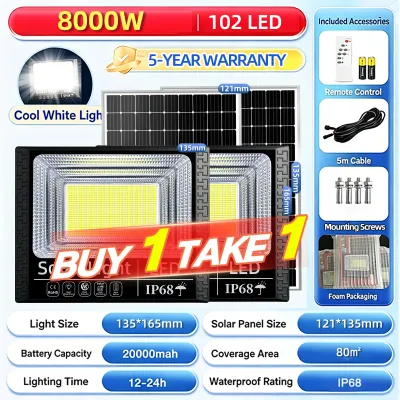
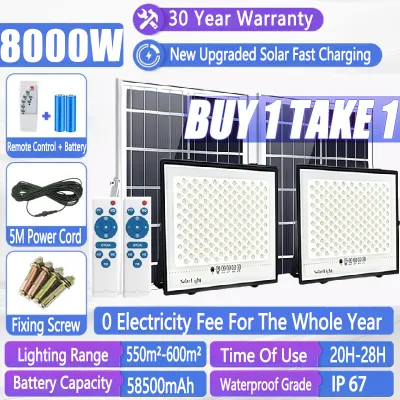
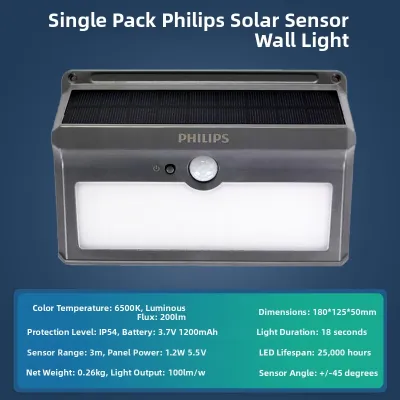
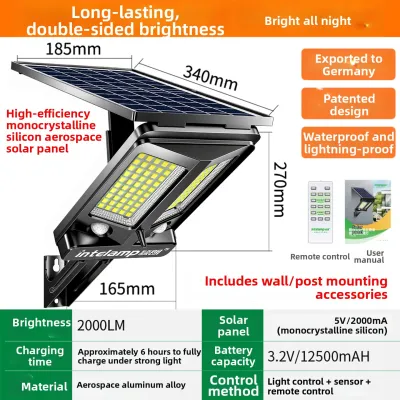
Prices are valid at publication and may change. Please refer to the product page for the latest price.
Essential Specifications for Rainy Season Reliability
Selecting a solar security light that survives the Philippine wet season requires looking beyond basic aesthetic designs. You must carefully evaluate the technical specifications listed on the product packaging or manufacturer data sheets to ensure long-term durability.
Ingress Protection (IP) Ratings The IP rating indicates how well the light fixture prevents water and dust from entering its delicate internal electronics. For outdoor security lights exposed to torrential rains and tropical storms, an IP65 rating is the recommended minimum. The first digit, 6, means the unit is completely dust-tight, while the second digit, 5, indicates protection against water jets from any angle. If you live in an area prone to severe typhoons or flooding, upgrading to an IP67-rated fixture provides temporary immersion protection, offering greater peace of mind.
Battery Type and Capacity The internal battery acts as the reservoir for the energy collected during the day. Look for fixtures utilizing Lithium Iron Phosphate (LiFePO4) batteries rather than older Nickel-Cadmium (NiCad) or standard Lithium-ion (Li-ion) chemistries. LiFePO4 batteries offer superior thermal stability in hot, humid climates and can endure significantly more charge-discharge cycles before degrading. Additionally, check the battery capacity, measured in milliampere-hours (mAh) or watt-hours (Wh); a larger capacity allows the light to run for multiple nights even when daytime charging is minimal.
Solar Panel Type The efficiency of the solar panel determines how quickly the battery charges under overcast skies. Monocrystalline solar panels are highly recommended for rainy season reliability because they have a higher conversion efficiency compared to polycrystalline panels. Monocrystalline cells are made from a single crystal structure, allowing electrons more room to flow, which translates to better performance under diffuse or low-light conditions. Verify the panel type on the product specifications before purchasing.
Lighting Modes and Power Management A security light that remains on at full brightness from dusk to dawn will quickly deplete its battery during consecutive rainy days. Look for fixtures that offer multiple operating modes, particularly a motion-activated setting. In this mode, the light remains completely off or at a very low standby brightness (dim mode) until the passive infrared (PIR) sensor detects movement, at which point it switches to full brightness. This smart power management drastically reduces energy consumption, ensuring the light remains functional throughout the night.
Strategic Placement for Limited Sunlight
Even the most efficient solar security light will fail if its panel is installed in a permanent shadow. Strategic placement is crucial during the wet season when daylight hours are shorter and cloud cover is dense.

Evaluating Shadows and Obstructions Before mounting your light, observe the proposed installation site at different times of the day. In the Philippines, residential properties often feature close-neighboring firewalls, roof overhangs, and dense tropical foliage like mango or palm trees. Keep in mind that the sun’s path shifts seasonally; a spot that receives abundant sunlight in April may be cast in deep shadow by August. Ensure the solar panel is positioned away from rooflines and branches that block diffuse sky light.
Optimizing Panel Angle Because the Philippines is located close to the equator in the northern hemisphere, solar panels should generally face south to maximize daily sun exposure. If your fixture features an adjustable solar panel, tilt it at an angle of approximately 10 to 15 degrees. This tilt not only helps capture low-angle sunlight during overcast days but also allows heavy rainwater to run off the surface naturally, washing away dust and preventing water pooling.
Positioning the Motion Sensor Heavy downpours, wind-blown rain, and swaying tree branches can trigger sensitive motion sensors, causing the light to turn on repeatedly and drain the battery. To prevent these false alarms, position the sensor away from moving foliage. If the fixture allows, adjust the sensor’s physical angle downward so it focuses primarily on ground-level movement near entryways or pathways rather than distant activity.
Wet Season Maintenance and Troubleshooting
Regular maintenance is essential to keep your solar security lights operating at peak efficiency during the wet season. High humidity, wind, and rain can create conditions that degrade performance over time.
Cleaning the Solar Panel Rainwater does not clean solar panels; instead, it often deposits fine dust, pollen, and hard water spots on the glass surface. This accumulation creates a barrier that blocks sunlight from reaching the solar cells, reducing charging efficiency. Every few weeks during the rainy season, gently wipe the panel surface with a soft, damp microfiber cloth and mild soapy water. Avoid using abrasive sponges or harsh chemical cleaners, which can scratch the protective coating.
Inspecting Seals and Gaskets The combination of high humidity and heavy rain can test the physical integrity of any outdoor fixture. Periodically inspect the rubber gaskets and seals around the battery compartment and light lens. Look for signs of moisture ingress, such as condensation behind the lens or rust on the battery contacts. If you detect moisture, turn off the power, dry the internal components thoroughly, and check if the seal needs to be reseated or replaced according to the manufacturer’s instructions.
Adjusting Sensor Sensitivity If you notice your light turning on constantly during heavy rainstorms, you may need to adjust the sensor settings. Many outdoor security lights feature physical dials on the sensor housing labeled “SENS” (sensitivity) and “TIME” (duration). Reducing the sensitivity slightly will prevent rain droplets from triggering the light, while shortening the duration setting to 15 or 30 seconds ensures the light turns off quickly, preserving valuable battery power.
Identifying Battery End-of-Life Rechargeable batteries do not last indefinitely; most outdoor solar batteries have a lifespan of one to three years. If your security light fails to turn on or only stays illuminated for a few minutes even after a clear, sunny day, the battery may have reached the end of its lifecycle. Consult your product manual to identify the correct replacement battery type and voltage, ensuring you follow proper safety precautions when opening the compartment.
When to Consider Hardwired or Hybrid Alternatives
While solar security lights offer excellent flexibility and ease of installation, they may not be suitable for every security application on your property.
Critical Security Zones For high-risk areas where continuous, uninterrupted lighting is non-negotiable—such as main gates, dark alleyways, or commercial perimeters—relying solely on solar power can be risky during extended typhoons. In these critical zones, a hardwired security light connected to your home’s electrical system provides guaranteed uptime regardless of weather conditions.
Permanent Structural Shade If you need to illuminate a covered carport, a narrow side passage between high concrete walls, or a deeply shaded porch, a standard integrated solar light will not receive enough light to charge. In these scenarios, you can either use a split-type solar light (where the panel is mounted on the roof and connected via a long cable to the light fixture) or opt for a hardwired alternative.
Installation and Safety Boundaries Installing fixed hardwired fixtures involves working with mains voltage, which is typically 220V in the Philippines. For your safety, always isolate the power at the main circuit breaker before attempting any electrical work. Carefully follow the manufacturer’s installation instructions. If you are not experienced with electrical wiring, hire a registered, qualified electrician to handle the installation to ensure compliance with local electrical codes and prevent fire hazards.
Frequently Asked Questions (FAQ)
Will heavy rain damage the solar panel itself?
High-quality solar panels are designed to withstand outdoor elements, including heavy tropical downpours. The tempered glass or durable polymer coating protects the solar cells from direct rain impact, provided the manufacturer’s IP rating remains intact. However, you should inspect the panel for physical cracks or seal degradation after severe tropical storms, especially if falling debris or branches have struck the fixture.
Can I use a power bank to charge the solar light during a typhoon?
Most standard outdoor solar security lights are designed as fully sealed units to maintain their water resistance and do not feature external USB or DC input ports. You should never attempt to open the sealed casing to apply external power from a power bank or charger, as this will compromise the waterproof seals, void the manufacturer’s warranty, and create a risk of electrical shorting or battery damage.
Do solar security lights attract more insects during the rainy season?
Insect attraction is determined by the light’s spectrum and color temperature, not its power source. Cool white LEDs, which typically range from 5000K to 6500K, emit a higher amount of blue light that is highly attractive to nocturnal insects. If insect accumulation is a concern around your entryways during the humid wet season, check the product label and choose a fixture with a warmer color temperature, such as 3000K or lower, which attracts fewer pests.
Community discussion
Share your experience or ask a question. Comments are reviewed before publication.