
The Truth Behind the '20000W' Label
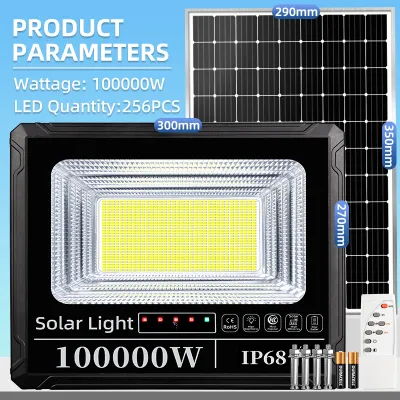
When browsing online marketplaces in the Philippines, you have likely encountered listings boasting “20000W” solar lights, often bundled with “Buy 1 Take 1” promotions for just a few hundred pesos. This number sounds incredibly powerful, promising to illuminate your entire yard with the intensity of a stadium floodlight. However, from a physical and electrical standpoint, a compact, battery-operated solar light cannot consume or output 20,000 watts of power.
To put this figure into perspective, a typical household air conditioner draws between 1,000 and 2,000 watts. A true 20,000W power draw would require massive industrial cabling, a heavy-duty connection to the electrical grid, and enough energy to trip a standard residential circuit breaker instantly. If a small outdoor solar fixture actually drew this much power, its built-in battery would drain in a fraction of a second, and the resulting heat would melt the plastic casing.
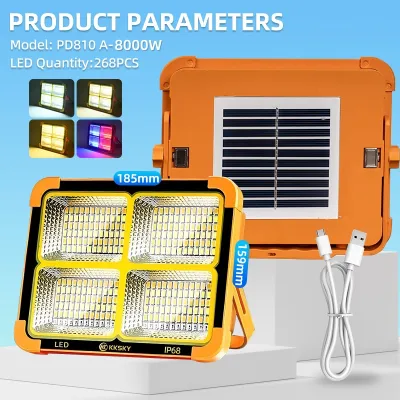
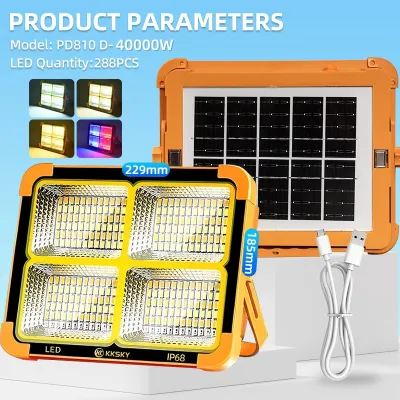
So, what does that “20000W” label actually mean? In most e-commerce listings, this number is purely a marketing tactic. It may represent an arbitrary model number, a theoretical “incandescent equivalent” calculated using highly exaggerated metrics, or simply a random figure meant to grab your attention in a crowded search result. Many sellers use these inflated numbers to stand out, knowing that average buyers associate higher wattage with superior brightness.
Products mentioned in this guide
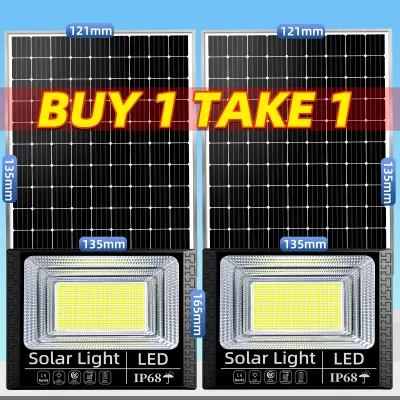
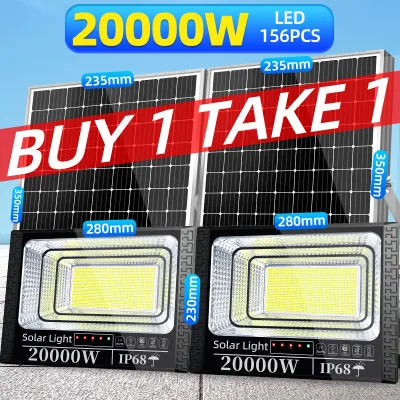
![KONE [BUY 1 TAKE 1] 20000W Super Bright Outdoor Lighting IP68 Waterproof Not Heavy Duty Solar light With Solar Panel Garden Lamp Room Night Light Bulb For Courtyard Automatic With Remote Control 5 Year Warranty Supported](https://img.lazcdn.com/g/p/ad9307b555fb2519fa446d4199a36e59.jpg_400x400q80.jpg_.webp)
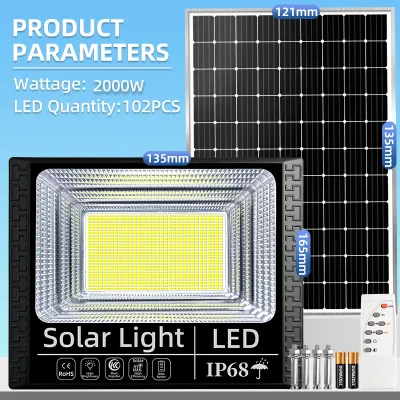
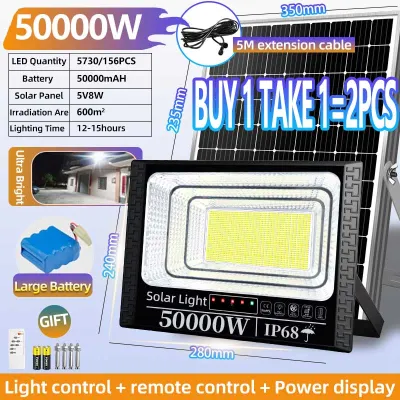
Prices are valid at publication and may change. Please refer to the product page for the latest price.
These claims are frequently paired with “Buy 1 Take 1” deals to create a false sense of extreme value. While these bundles can be highly tempting, they often feature low-cost, generic components that fail to deliver on their promises. In reality, standard outdoor solar lights designed for residential use operate on a much smaller scale, typically consuming between 1W and 20W of actual electrical power. Even high-end, commercial-grade solar streetlights rarely exceed 50W to 100W of actual power draw.
Real Metrics: How to Actually Measure Solar Light Brightness
To find a solar light that genuinely illuminates your outdoor space, you must look past exaggerated wattage claims and focus on verifiable technical specifications. Understanding these metrics will help you make an informed decision and avoid wasting money on underperforming products.

Lumens vs. Watts: The True Measure of Light
Historically, we associated wattage with brightness because traditional incandescent bulbs consumed a lot of energy to produce light. However, modern outdoor solar lights use light-emitting diodes (LEDs), which are incredibly energy-efficient. Because of this, wattage is no longer a reliable way to measure brightness; instead, you should look at lumens (lm).
Lumens measure the total amount of visible light emitted by a source. To set realistic expectations for your garden or driveway, keep these practical lumen ranges in mind:
- Pathway and accent lights: 50 to 200 lumens are ideal for marking borders and creating a warm, ambient glow.
- Patio and deck lights: 200 to 400 lumens provide comfortable visibility for outdoor seating areas.
- Security floodlights: 1,000 to 3,000+ lumens are necessary to brightly illuminate large areas like driveways or dark corners.
When shopping online, look for listings that explicitly state the lumen output in the product specifications. If a seller boasts about a “20000W” rating but completely hides the lumen count, it is a strong indication that the light may not be as bright as advertised.
LED Chip Count and Light Distribution
Another common marketing tactic is highlighting a massive number of LED beads inside the fixture, such as “300 LEDs” or “1000 LEDs.” While a higher chip count can distribute light across a wider area, it does not automatically guarantee a brighter output.
If the solar panel and battery cannot supply sufficient electrical current, the available power is simply divided among all those individual diodes. This often results in a dim, disappointing glow across many tiny bulbs rather than a powerful beam of light.
The type of LED technology also matters. Most solar lights use Surface Mounted Diode (SMD) chips, which are excellent for spreading light over a wide, general area. Alternatively, Chip on Board (COB) technology packs multiple LED chips closely together on a single module. COB LEDs offer high light density, a more uniform light beam, and reduced glare, making them highly effective for focused security lighting.
Battery and Solar Panel Capacity
A solar light’s performance is only as good as its power storage and generation system. Even if a fixture has highly efficient LEDs, it will quickly go dark if the battery capacity is insufficient.
When evaluating a product, check the battery capacity, which is typically measured in milliampere-hours (mAh) or watt-hours (Wh). For long-lasting performance, look for Lithium Iron Phosphate (LiFePO4) batteries. These are highly stable, handle high temperatures well, and have a longer lifespan than standard Lithium-ion (Li-ion) or older Nickel-Metal Hydride (NiMH) batteries.
Equally important is the solar panel that recharges this battery. Monocrystalline solar panels are more efficient and perform better in low-light conditions than cheaper polycrystalline panels. Make sure the panel’s physical size and rated wattage are sufficient to charge the battery fully during the day, especially when sunlight is limited.
Setting Realistic Expectations for Outdoor Spaces
Choosing the right solar light involves matching its actual specifications to your specific landscape lighting needs while considering your local environment.
In the Philippines, the tropical climate plays a massive role in how well your solar lights perform. While we enjoy abundant sunshine during the dry season, the country also experiences prolonged rainy seasons, heavy cloud cover, and frequent typhoons. During these overcast periods, your solar panels will receive significantly less sunlight, which directly reduces their charging efficiency. To ensure your lights stay on through consecutive rainy days, prioritizing a larger battery capacity and a highly efficient monocrystalline panel is far more important than chasing peak brightness claims.
Proper installation is also key to maximizing performance. Ensure the solar panel is installed in an unshaded area that receives direct sunlight for at least six to eight hours a day. In the Philippines, angling the panel slightly to the south helps maximize sun exposure throughout the year. Additionally, regular maintenance is necessary; wipe the solar panel clean periodically to remove dust, dirt, and salt residue, which can block sunlight and reduce charging efficiency.
It is also important to understand the limits of solar technology. While solar lights offer incredible off-grid convenience and zero electricity costs, they are generally not designed to replace heavy-duty, hardwired utility floodlights. If your project requires high-voltage electrical work, mounting fixtures at significant heights, or installing lights in highly damp areas, safety must come first. Always isolate the power source before installation, carefully read the manufacturer’s instructions, and consult a qualified professional if you are unsure about the wiring or structural load.
Finally, keep in mind that aesthetic lighting effects are highly subjective. For instance, cool white light (around 6000K) is often perceived as brighter and works well for security, while warm white light (around 3000K) creates a cozy, inviting atmosphere for garden pathways. These color temperatures are conditional preferences and do not represent the actual light output or quality of the fixture.
Quick Checklist for Evaluating Online Solar Light Listings
To help you navigate online marketplaces and filter out misleading listings, use this quick reference checklist before clicking “Add to Cart.”
Green Flags to Look For
- Explicit Lumen Ratings: Look for clear statements of light output (e.g., "1,200 lumens") rather than vague descriptions.
- Detailed Battery Specs: High-quality listings specify the battery chemistry and capacity (e.g., 3.2V 5000mAh LiFePO4).
- IP Waterproof Rating: Ensure the light has an IP65 or IP67 rating, indicating it can withstand heavy tropical downpours and high humidity.
- Solar Panel Details: Listings that specify the panel type (monocrystalline) and wattage (e.g., 10W) show transparency.
- Electrical Certifications: Look for standard safety and quality certifications in the product description.
Red Flags to Avoid
- Extreme Wattage Claims: Ignore listings boasting 5,000W, 10,000W, or 20,000W.
- Unrealistically Low Prices: Be skeptical of "Buy 1 Take 1" deals priced under ₱300 that claim commercial-grade brightness.
- Missing Technical Specs: Avoid products that hide battery capacity, panel type, or lumen output behind buzzwords like "super bright."
- Highly Edited Images: Watch out for promotional photos where the light beam has been digitally painted on to make the fixture look like a stadium spotlight.
Before making a purchase, always scroll down to the user reviews. Look for real-world photos and videos uploaded by local buyers showing the light’s actual performance at night. This feedback provides a much more accurate representation of what you will receive.
Frequently Asked Questions (FAQ)
Can a portable solar light actually consume 20000 watts?
No. A portable, battery-operated solar light cannot consume 20,000 watts of power. To put this in perspective, 20,000W is equivalent to running multiple heavy-duty household appliances, like air conditioners and water heaters, at the same time. A small solar light’s battery and panel simply do not have the physical capacity to generate, store, or handle that level of electrical power.
Is a higher LED count always brighter?
Not necessarily. A higher number of LED chips only increases brightness if the solar panel and battery can supply enough electrical current to power them all efficiently. A well-designed solar light with 50 high-quality LEDs and a robust power system will often shine brighter and last much longer than a cheap fixture with 300 low-grade LEDs sharing a weak, undersized battery.
Community discussion
Share your experience or ask a question. Comments are reviewed before publication.