
To achieve a professional-grade playing experience in your home game room, selecting the correct billiard lamp size is just as critical as choosing the right cue or felt. A properly sized fixture ensures that every corner of the table is evenly illuminated, eliminating distracting shadows that can distort your perception of angles and distances. As a general rule, the total length of your billiard lamp should cover 60% to 75% of the length of the playing surface, and it must be suspended between 30 and 40 inches above the bed of the table.
Finding this balance requires looking beyond aesthetics to evaluate the physical dimensions of your table, the height of your ceiling, and the technical specifications of your light sources. In the humid tropical climate of the Philippines, where indoor recreation spaces often contend with unique ventilation and structural conditions, selecting the right fixture also involves assessing material durability and electrical safety. By matching the scale of your lighting fixture to your specific pool table, you can create a focused, glare-free playing field that elevates your accuracy and enjoyment.
Match the Lamp Length to Your Pool Table Size
Achieving uniform light distribution across your pool table starts with understanding the proportional relationship between the fixture and the playing surface. If a lamp is too short, the corners and short cushions of the table will fade into shadow, making crucial bank shots and corner-pocket runs exceptionally difficult to judge. Conversely, an excessively long fixture will spill unnecessary light into the eyes of spectators and dilute the focused, intimate atmosphere of the game room.
Products mentioned in this guide
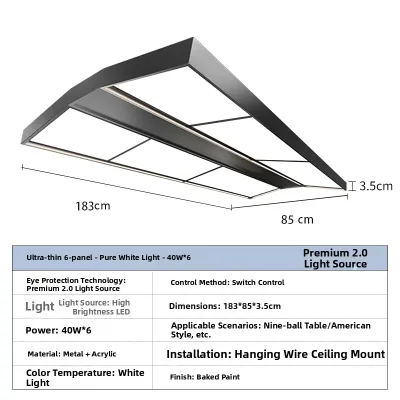
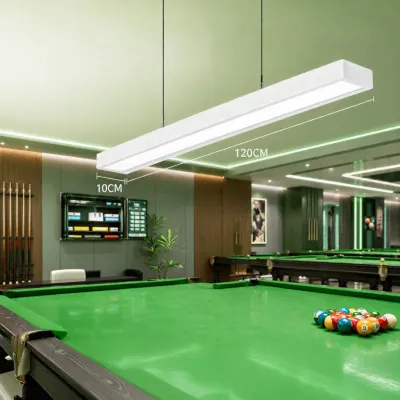
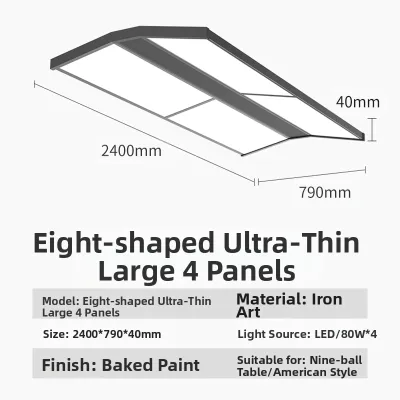
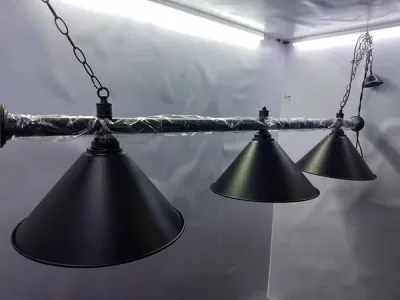
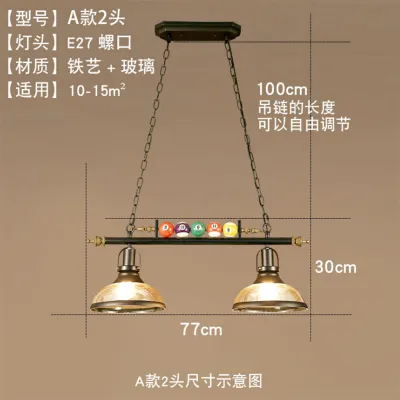
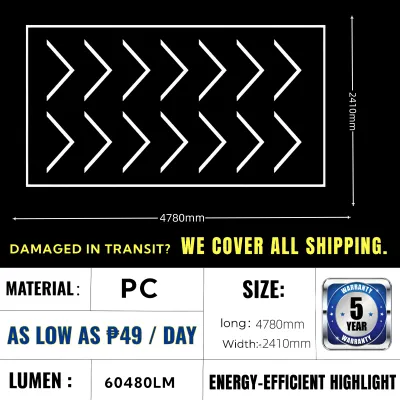
Prices are valid at publication and may change. Please refer to the product page for the latest price.
To prevent these issues, lighting designers rely on the proportional rule, which dictates that the length of the billiard lamp should span approximately 60% to 75% of the table’s playing surface. It is important to emphasize that this measurement refers specifically to the bed of the table—the area inside the cushions—rather than the outer wooden rails or the entire footprint of the cabinet. By focusing on the active playing area, you ensure that the light is concentrated precisely where the balls interact.
In the local market, quality billiard lamps typically range from entry-level single-shade pendants starting around ₱3,500 to premium multi-shade linear fixtures that can exceed ₱20,000. Standard pool tables generally fall into four common sizes, each requiring a different light configuration to achieve optimal coverage:
Seven-Foot Tables Often found in smaller home game rooms or local bars, a seven-foot table has a playing surface of approximately 39 by 78 inches. For this size, a 3-light fixture with individual shades spaced evenly apart, or an integrated linear LED panel measuring around 40 to 48 inches in length, provides complete coverage without overwhelming the space.
Eight-Foot Tables Considered the standard home size, an eight-foot table features a playing surface of roughly 44 by 88 inches. A robust 3-light fixture with larger individual shades or a 4-light linear fixture is ideal here, ensuring that the light spread reaches the cushions on both ends without leaving a dim spot in the center of the table.
Nine-Foot Tables As the standard size for professional tournaments, a nine-foot table has a playing surface of 50 by 100 inches. To illuminate this expansive area, a 4-light fixture or a longer, high-output integrated LED panel is highly recommended to guarantee that the head and foot spots receive the same level of brightness as the center.
Ten-Foot and Snooker Tables Larger tables, such as ten-foot models or full-sized 12-foot snooker tables, require specialized multi-light setups. These massive playing fields typically demand a 5-light or 6-light linear fixture, or multiple independent pendant lights hung in a precise row, to ensure that the entire length of the table remains perfectly bright.
When evaluating potential fixtures, always check the manufacturer’s specifications regarding light spread and shade dimensions. Because shade shapes and beam angles vary significantly between a deep dome design and a shallow cone, the physical length of the fixture bar is only one part of the equation. Ensure the actual light cone emitted by the chosen model matches your table’s width and length before finalizing your purchase.
Determine the Ideal Hanging Height and Clearance
Once you have selected a billiard lamp of the correct length, determining its hanging height is the next critical step. This calculation must always begin from the playing surface’s slate bed covered in felt, rather than the floor or the bottom of the table frame. Measuring from the floor is a common error that fails to account for varying table heights and cabinet designs, which can lead to inconsistent lighting.

The standard height range for a billiard lamp is 30 to 40 inches above the table bed. This range is designed to strike a balance between providing a wide, even spread of light and keeping the fixture high enough to stay out of the players’ physical way. You should adjust this height within the recommended range based on the average height of the players in your household to ensure comfortable sightlines.
To find the perfect height, you can perform a simple “line of sight” test with the help of a second person:
- Stand in a normal shooting stance at the side of the table.
- Observe the bottom edge of the lamp shades.
- The bottom rim of the shades should be low enough to completely block your direct view of the bare lightbulbs or LED elements.
- If you can see the bare bulbs while standing or leaning to shoot, the lamp is hung too high, which will cause distracting glare during play.
While standard pendant fixtures work beautifully in rooms with average to high ceilings, low-ceiling spaces present a distinct challenge. If your ceiling height does not allow for a standard pendant drop while maintaining the 30-to-40-inch clearance, look for semi-flush mount billiard lights. These fixtures attach closer to the ceiling but feature wide-angle shades or specialized diffusers designed to cast a broad, downward light path that still covers the table bed effectively.
Bulb Configuration: Brightness, Color, and Glare Control
The quality of light emitted by your billiard lamp is just as important as its physical size and placement. To eliminate harsh shadows under the balls and around the cushions, you must carefully configure your light sources. Relying on a single, high-wattage bulb in the center of a fixture is a recipe for uneven lighting; instead, opt for multiple lower-wattage bulbs or evenly spaced integrated LED strips to distribute light smoothly across the entire surface.
Color temperature plays a vital role in both visual comfort and game accuracy. It is best to choose bulbs in the neutral to warm-white range, specifically between 3000K and 4000K. This range accurately renders the vibrant colors of the billiard balls—such as the deep reds, blues, and yellows—without causing the eye strain associated with cooler, clinical blue light (above 5000K) or the muddy, overly yellow tones of traditional incandescent bulbs (below 2700K).
Another critical metric to consider is the Color Rendering Index (CRI), which measures how accurately a light source reveals the true colors of objects. For a pool table, select bulbs or integrated LEDs with a CRI of 80 or higher, with 90+ being the gold standard. A high CRI ensures that subtle differences in ball markings and the condition of the felt are clearly visible, allowing you to read the table with absolute precision.
Controlling glare is essential for maintaining focus during long matches. To soften the light and prevent direct eye irritation, implement these glare-mitigation strategies:
- Use frosted LED bulbs instead of clear filament designs.
- Select fixtures with integrated diffusers that scatter light evenly.
- Choose lamp shades with matte white or gold interior finishes, which reflect and soften the light as it is directed downward.
- Avoid polished chrome or high-gloss silver interiors, as they can create harsh, concentrated hot spots on the table felt.
Installation Considerations and Safety Checks
Installing a billiard lamp requires careful planning, particularly regarding structural support and electrical safety. Multi-shade billiard lamps are often significantly heavier than standard residential pendants due to their long metal bars and heavy glass or metal shades. Before hanging the fixture, verify that your ceiling junction box is rated to support the weight of the lamp, and plan to anchor the mounting brackets directly into ceiling joists if necessary.
In the Philippines, electrical installations must comply with local standards to ensure safety in tropical, high-humidity environments. Verify that your chosen billiard lamp is compatible with the standard 220V-240V, 60Hz power supply. Look for products that carry safety certifications such as the Import Commodity Clearance (ICC) sticker or the Philippine Standard (PS) safety mark, and ensure that metal fixtures are properly grounded to prevent electrical shock.
Precision is key when aligning your fixture over the pool table. Do not make the common mistake of centering the lamp according to the room’s walls, as pool tables are rarely placed perfectly in the center of a room due to cue clearance requirements. Instead, use a plumb bob or a laser level to align the center point of the billiard lamp exactly over the center pocket line of the playing surface.
Because installing a heavy ceiling fixture involves working at heights, handling complex wiring, and potentially reinforcing ceiling structures, safety should always be your top priority. Always isolate the power at the main circuit breaker before attempting any electrical work. To guarantee a secure, code-compliant installation that protects both your family and your investment, it is highly recommended to hire a licensed electrician to handle the hardwiring and structural mounting.
Common Sizing and Placement Mistakes to Avoid
To ensure your game room setup is flawless, review your plans against these common sizing and placement errors before making any permanent adjustments to your ceiling:
- Under-sizing the fixture: Choosing a billiard lamp that is too short for your table size will leave the corners in deep shadow, making it incredibly difficult to align shots along the short rails.
- Hanging the lamp too high: Elevating the fixture beyond the 40-inch limit allows light to spill into the eyes of players and spectators, creating uncomfortable glare and reducing the intensity of light on the table bed.
- Hanging the lamp too low: Dropping the fixture below 30 inches increases the risk of players accidentally bumping their heads or striking the shades with their cue sticks during high-angle or jump shots.
- Ignoring table placement sequence: Installing the ceiling fixture before the pool table is permanently positioned and leveled often results in a misaligned light source that cannot be easily corrected without drilling new holes in your ceiling.
Frequently Asked Questions (FAQ)
Can I use a regular dining chandelier or island pendant over a pool table?
While dining chandeliers and kitchen island pendants may look stylish, they are rarely suitable for a pool table. These fixtures are typically designed for ambient room lighting or soft dining illumination, meaning they lack the specific downward shade geometry and glare control required for billiards. Using them often results in distracting peripheral shadows, uneven light distribution across the felt, and severe eye strain during extended play.
Do I need a dimmer switch for my billiard lamp?
A dimmer switch is not required for active gameplay, as you will always want your billiard lamp at full brightness to ensure clear visibility and eliminate shadows. However, a dimmer can be highly beneficial for adjusting the room’s ambiance when the table is not in use. If you choose to install a dimmer, ensure that both your LED bulbs and the dimmer switch are explicitly rated as mutually compatible to prevent annoying flickering or high-pitched buzzing.
Community discussion
Share your experience or ask a question. Comments are reviewed before publication.