
Selecting the ideal waterproof curtain lights for outdoor spaces in the Philippines requires balancing aesthetic appeal with strict technical standards to withstand a demanding tropical climate. The right choice combines an Ingress Protection (IP) rating of IP65 or higher, UV-stabilized heavy-duty cabling, and a safe power configuration—either a low-voltage plug-in system with a step-down transformer or a high-efficiency solar setup. By focusing on these core specifications, you can ensure your decorative lighting remains safe, functional, and beautiful throughout the year.
Quick Guide to Outdoor Curtain Lights in the Philippines
Operating outdoor lighting in the Philippines presents unique environmental challenges. The transition between the dry season (Amihan) and the wet monsoon season (Habagat) brings extreme shifts in weather. Outdoor installations must endure intense heat, high humidity levels often exceeding 90 percent, torrential downpours, and severe seasonal typhoons. Standard indoor-rated lights or low-quality decorative strings will quickly fail under these conditions, presenting serious electrical hazards.
To ensure durability and safety, look for curtain lights specifically engineered for permanent or extended outdoor use. The best options feature high IP ratings (IP65 or higher) to keep out driving rain, UV-resistant materials to prevent wire degradation under the tropical sun, and safe power configurations. Your choice will largely depend on your specific installation site:
Products mentioned in this guide
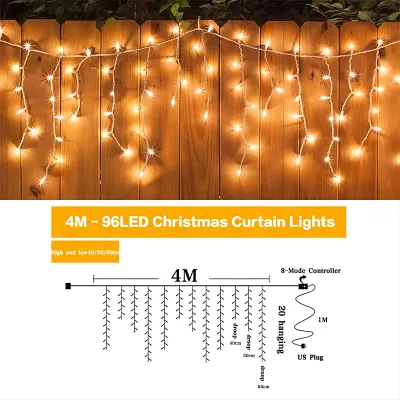
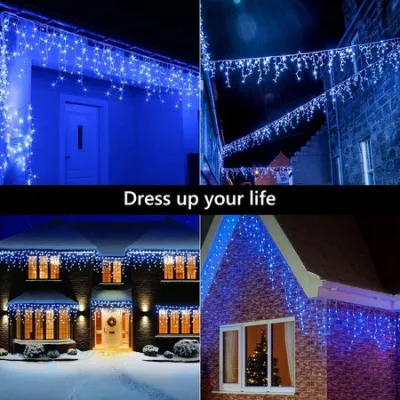
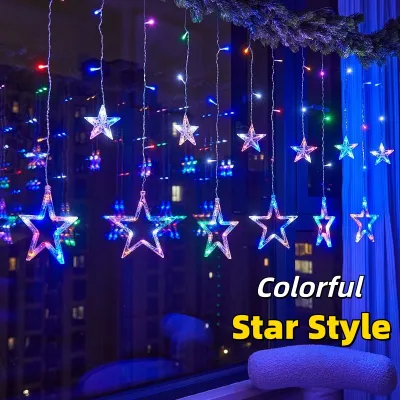
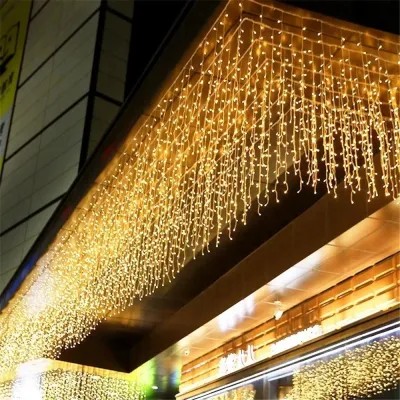
Prices are valid at publication and may change. Please refer to the product page for the latest price.
- Solar-Powered Lights: These are ideal for remote garden areas, perimeter fences, and structures far from outdoor electrical outlets, offering zero operating costs and easy installation.
- Low-Voltage Plug-In Lights: These are best for covered patios, gazebos, and terraces where consistent, high-intensity brightness is desired, operating safely via a step-down transformer.
Key Features for Withstanding Tropical Weather
To survive the Philippine climate, outdoor curtain lights must possess specific technical features that protect their internal circuitry from water, heat, and physical wear.

Understanding IP Ratings for Rain and Humidity
The Ingress Protection (IP) rating system is an international standard that classifies the degree of protection provided against mechanical intrusions and liquids. The rating consists of two digits: the first represents protection against solid objects (scale 0–6), and the second represents protection against liquids (scale 0–9).
- IP44 (Splash-Proof): Lights with an IP44 rating are protected against solid objects larger than 1 millimeter and splashes of water from any direction. These are only suitable for deeply covered eaves, protected balconies, or temporary outdoor setups during dry spells. They should not be exposed to direct, heavy rain.
- IP65 (Water-Jet Proof): These lights are completely dust-tight and can withstand water projected by a nozzle from any direction. IP65 is the baseline standard for fully exposed outdoor installations in the Philippines, capable of surviving heavy monsoon downpours.
- IP67 (Immersion-Proof): IP67 lights are dust-tight and can withstand temporary immersion in water up to 1 meter deep for 30 minutes. This rating is highly recommended for low-lying garden areas, pathways, or patio edges where temporary water pooling occurs during intense storms.
Always verify the specific IP rating of both the light string and the controller or power supply, as manufacturers often use lower-rated components for plugs and controllers.
Voltage Compatibility and Power Sources
The standard electrical grid in the Philippines operates at 220V with a frequency of 60Hz. When selecting plug-in curtain lights, you must verify that the product is fully compatible with these specifications. Direct 220V line-voltage string lights pose a significant safety hazard if the insulation is compromised in a wet outdoor environment.
To mitigate this risk, high-quality plug-in curtain lights utilize a step-down transformer (or driver) that reduces the voltage to a safe 12V or 24V. In the event of wire damage, low-voltage systems drastically minimize the risk of severe electrical shock. Ensure the transformer carries recognized electrical safety certifications (such as the Philippine Standard quality mark, the Import Commodity Clearance sticker, or international equivalents like CE, RoHS, and UL) and is housed in an outdoor-rated enclosure.
Solar-powered curtain lights operate entirely on low-voltage direct current (DC) generated by an attached solar panel and stored in a rechargeable battery. This completely isolates the system from the grid, eliminating high-voltage hazards and making them exceptionally safe for damp garden environments.
UV Resistance and Material Durability
The intense tropical sun in the Philippines delivers a high UV index that rapidly degrades standard plastics. Standard PVC (polyvinyl chloride) wire insulation without UV stabilizers will dry out, become brittle, crack, and eventually expose the underlying copper wires to moisture and air, leading to short circuits and corrosion.
When evaluating materials, look for the following specifications:
- Cabling: Look for heavy-duty rubberized cables (such as neoprene or chloroprene rubber) or UV-stabilized PVC. These materials remain flexible and intact despite prolonged exposure to direct sunlight and high ambient temperatures.
- LED Encapsulation: The LED bulbs should be fully encapsulated in solid epoxy or silicone sleeves. This prevents moisture from seeping into the diode housing through capillary action.
- Connectors: Look for heavy-duty, threaded locking connectors with integrated rubber O-rings. These maintain a watertight seal between daisy-chained light strings and prevent galvanic corrosion, which occurs when moisture bridges different metals in the connector pins.
Best Types of Curtain Lights for Gardens and Patios
Understanding the distinct types of curtain lights available helps you match the product specifications to your specific outdoor layout and functional requirements.
Solar-Powered LED Curtain Lights
Solar-powered LED curtain lights are a highly practical solution for areas without easy access to outdoor electrical outlets. These systems consist of a curtain light string connected to a separate solar panel equipped with a rechargeable battery (typically Lithium-ion or Lithium Iron Phosphate) and an integrated light sensor.
- Benefits: Solar lights offer zero operating costs, automatic dusk-to-dawn operation, and simple installation without the need for trenching or running extension cords across your lawn.
- Limitations: Their performance is entirely dependent on sunlight. During the peak of the rainy season, heavy cloud cover reduces solar harvesting. A panel that requires 6 to 8 hours of direct sunlight to achieve a full charge may only receive partial ambient light, resulting in shorter runtimes (e.g., 2 to 3 hours instead of 8 to 10 hours) or dimmer LEDs.
- Selection Tip: Choose models that feature monocrystalline solar panels, as they are more efficient at harvesting energy under diffused or overcast light than polycrystalline panels. Additionally, verify that the solar panel mounting bracket is made of rust-proof materials like heavy-duty ABS plastic or stainless steel.
Low-Voltage Plug-In LED Curtains
For covered patios, gazebos, and terraces where consistent, high-intensity illumination is required, low-voltage plug-in LED curtain lights are the superior choice. These lights connect to your home’s electrical system via an outdoor-rated step-down transformer.
- Benefits: Plug-in models deliver stable, uncompromised brightness regardless of the weather or time of day. They are highly customizable, often supporting dimming functions and longer runs (daisy-chaining) without a drop in light output.
- Limitations: They require proximity to an outdoor electrical outlet and involve managing physical cables, which must be routed safely to prevent tripping hazards and water exposure.
- Selection Tip: Verify the maximum wattage limit of the transformer before connecting multiple sets. For example, if a transformer is rated for 12 watts and each curtain light string consumes 4 watts, you can safely connect up to two strings (keeping the total load under the recommended 80 percent safety threshold to prevent overheating).
Smart and Timer-Equipped Curtain Lights
Smart curtain lights incorporate advanced control modules that allow you to manage your outdoor lighting through mobile applications, voice assistants, or dedicated remote controls. These systems offer convenient features such as automated scheduling, custom dimming levels, and dynamic lighting scenes.
- Dimming Methods: Smart systems typically utilize Pulse Width Modulation (PWM) to dim the LEDs smoothly. If you plan to use an external wall dimmer, verify that the light’s transformer is specifically rated as dimmable (such as TRIAC dimmable).
- Controller Weatherproofing: The smart controller (the receiver module containing the Wi-Fi or Bluetooth chip) is highly sensitive to moisture. Even if the light string is rated IP65, the controller itself is often only IP44 or completely unrated. Always house smart controllers in a dedicated, weatherproof junction box (IP66 or higher) if installed outdoors.
- Energy Management: Utilizing built-in timers or smart schedules ensures your lights only operate during active evening hours (e.g., 6:00 PM to 11:00 PM). This prevents unnecessary power consumption and significantly extends the operational lifespan of the LEDs.
Safe Installation and Weatherproofing Practices
Proper installation is critical to protecting your property, ensuring electrical safety, and maximizing the lifespan of your outdoor curtain lights.
Mounting Without Damaging Surfaces
When hanging curtain lights on outdoor structures like wooden pergolas, concrete walls, or metal gutters, avoid any mounting methods that could compromise the physical integrity of the light wires or your home’s surfaces.
- Isolate Power: Before performing any installation work, especially when working at heights or near damp structures, isolate the power supply by turning off the corresponding circuit breaker at your main panel.
- Approved Fasteners: Use non-destructive, UV-resistant mounting hardware. Excellent options include:
- UV-Stabilized Nylon Zip Ties: Ideal for securing light strings to railings, beams, or trellis structures. Black zip ties generally offer higher UV resistance than clear ones.
- Outdoor-Rated Adhesive Hooks: Suitable for smooth, painted, or sealed surfaces. Ensure the adhesive is rated for outdoor, high-humidity environments.
- Plastic Gutter Clips: Perfect for hanging lights along rooflines without drilling.
- Prohibited Fasteners: Never use metal nails, staples, or screws directly over or tight against the wires. High winds can cause the wires to rub against metal fasteners, wearing down the insulation and exposing live copper, which can cause short circuits or fires.
- Wind Load Management: Leave a small amount of slack in the vertical strands of the curtain lights. Wind loads during sudden afternoon thunderstorms can put immense tension on tightly stretched wires, leading to internal copper fatigue or tearing.
Protecting Connections and Power Sources
The weakest points in any outdoor lighting setup are the connection joints where the light string connects to the power adapter, or where multiple strings are daisy-chained together.
- Self-Fusing Silicone Tape: Even if your light strings feature threaded locking collars with rubber O-rings, wrap all outdoor connections with self-fusing silicone tape. This tape bonds to itself to create a seamless, watertight, and weatherproof seal over the joint.
- Drip Loops: Always form a drip loop on all cables leading into plugs, transformers, or controllers. A drip loop is a simple downward curve in the wire that forces water to drip off the lowest point of the loop before it can reach the electrical connection.
- Elevate Components: Keep all transformers, plugs, and controllers elevated off the ground (at least 30 to 50 centimeters high) to prevent immersion during localized flash floods or heavy pooling.
- GFCI Protection: Ensure that any plug-in model is connected to an outdoor outlet protected by a Ground Fault Circuit Interrupter (GFCI). A GFCI outlet monitors the balance of electrical current and will instantly cut power if a ground fault or moisture-induced short circuit is detected.
- Professional Boundaries: For permanent outdoor installations or fixed wiring, consult a qualified, licensed electrician to ensure compliance with the Philippine Electrical Code (PEC).
Maintenance and Storage for Long-Term Use
Routine upkeep is essential to maximize the lifespan of your outdoor curtain lights in a humid, tropical environment.
- Monthly Visual Inspection: Regularly check your lighting setup for signs of wear. Look for wire degradation, pest damage (such as chewing by rodents or insects), and rust on connector pins. If you notice exposed copper or cracked insulation, disconnect the power immediately and replace the damaged section.
- Clean Solar Panels: Dust, pollen, and bird droppings accumulate quickly on solar panels, blocking sunlight and reducing charging efficiency. Wipe the panel surface gently with a soft, damp microfiber cloth. Avoid abrasive cleaners or rough pads that can scratch the protective glass.
- Check for Condensation: Inspect the LED bulb caps for moisture condensation. While high-quality sealed LEDs resist this, minor condensation can occur over time due to extreme temperature fluctuations. If significant water accumulation is visible inside a bulb cap, disconnect the power and replace the affected strand.
- Typhoon Preparation: During severe weather events, such as typhoons with high-velocity winds, temporarily take down your curtain lights. High winds can whip the strands violently, causing them to tangle, tear, or damage the structures they are attached to.
- Proper Storage: When storing lights, loosely coil each strand around a cardboard tube or a dedicated light spool. Avoid tight kinking or folding, which stresses the internal copper conductors and leads to premature wire failure. Store the lights in a cool, dry, well-ventilated indoor space.
Frequently Asked Questions (FAQ)
Can I leave curtain lights outside during heavy monsoon rains?
Yes, you can leave curtain lights outside during heavy monsoon rains, provided the light strings themselves have a verified IP65 or higher waterproof rating. However, the power plug, transformer, and any non-waterproof controllers must be housed in an outdoor-rated, weatherproof enclosure or kept indoors. During severe typhoons with high winds, it is highly recommended to take the lights down to prevent physical damage from wind and flying debris.
Do solar curtain lights work well on cloudy days?
Solar panels can still charge on cloudy or overcast days, but their efficiency drops significantly. On a heavily overcast day, the battery may only charge to a fraction of its capacity, resulting in shorter runtimes or dimmer light output at night. For reliable, year-round performance during the long rainy season in the Philippines, consider choosing dual-power models that allow for USB charging or plug-in operation as a backup.

Community discussion
Share your experience or ask a question. Comments are reviewed before publication.