
Illuminating the exterior of your home requires a balance of practical security, reliable performance, and aesthetic appeal. For homeowners in the Philippines, solar wall outdoor lights offer an energy-efficient way to light up garden pathways and courtyard entrances without the need for complex trenching or rising electricity bills. However, the tropical climate presents unique challenges, including intense UV exposure, high humidity, and torrential monsoon rains. Selecting the right fixtures requires looking beyond attractive designs and understanding the technical specifications that ensure long-term durability.
By focusing on verified hardware standards, battery chemistry, and light distribution patterns, you can secure a lighting system that performs consistently night after night. This guide outlines the essential criteria for evaluating solar wall outdoor lights, helping you build a conditional shortlist tailored to your property’s specific layout and environmental conditions.
Core Selection Criteria for Solar Wall Outdoor Lights
When selecting solar wall outdoor lights, the primary goal is to balance visibility, safety, and ambiance. Pathway lighting must provide clear, low-level guidance to prevent trips and falls along garden walkways. Entrance lighting, on the other hand, requires broader and brighter illumination to secure gates, doorways, and driveways, allowing you to identify visitors and navigate entry points safely after dark.
Products mentioned in this guide
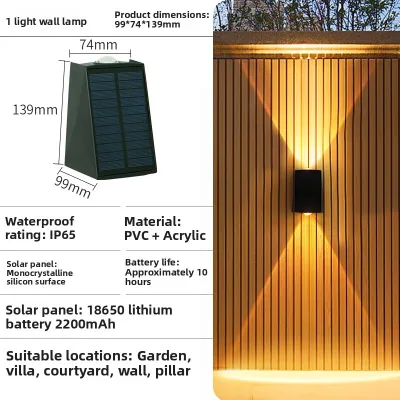
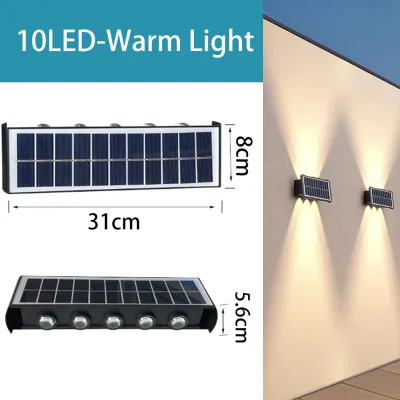
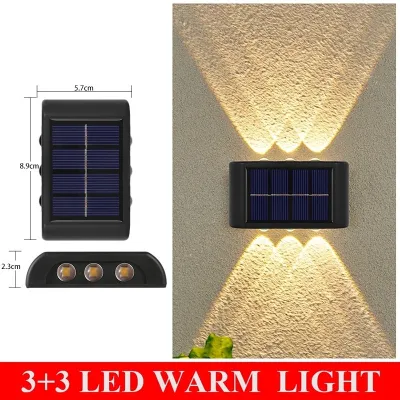
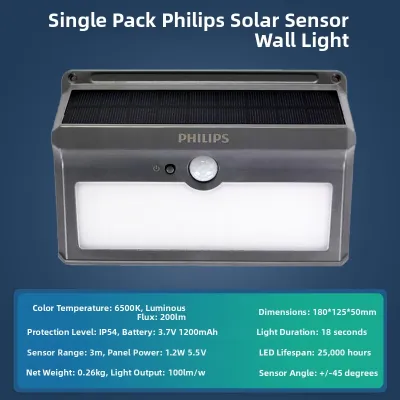
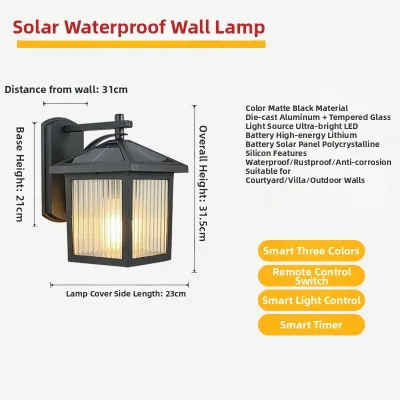
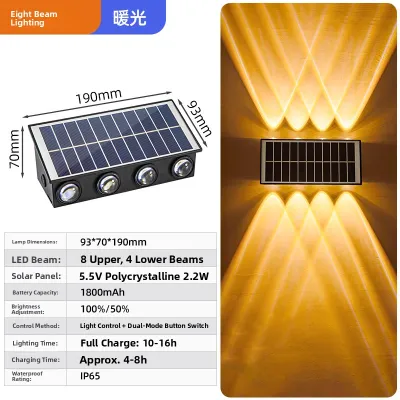
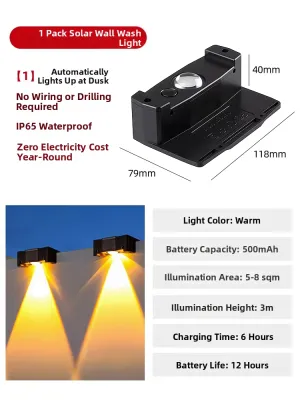
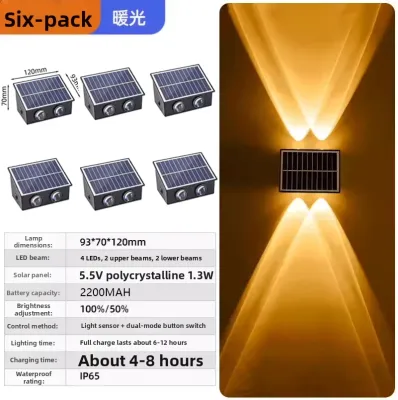
Prices are valid at publication and may change. Please refer to the product page for the latest price.
To ensure your selected fixtures can withstand the demanding local climate, you must perform strict verification steps before purchasing. Rather than relying on vague marketing claims on the front of the packaging, check the manufacturer’s technical specification label for the actual battery capacity in milliampere-hours (mAh), the solar panel wattage (W), and the verified Ingress Protection (IP) rating. These metrics dictate how long the light will run and how well it will resist water penetration during heavy downpours.
It is equally important to match the light’s sensor type and lumen output to the specific traffic patterns of your outdoor space. High-traffic areas like main courtyard gates benefit from responsive motion sensors that deliver high-intensity light when needed. Conversely, quiet garden paths are better served by low-intensity, continuous marking lights that preserve battery life while maintaining a soft, welcoming ambiance throughout the night.
Matching Light Distribution to Your Landscape Needs
Achieving the right lighting effect depends heavily on matching the beam angle and light distribution to your specific landscape layout. For narrow garden pathways, focused downlighting is highly effective. Downward-directed beams concentrate light directly onto the walking surface, minimizing glare and preventing light pollution from spilling into your neighbors’ windows or up into the night sky.

For wide courtyard entrances, gates, or driveways, wider floodlighting is the preferred choice. Fixtures with wide-angle lenses or multi-directional LED panels spread light across a broader area, eliminating dark corners where security risks might arise. When evaluating these fixtures, verify the physical dimensions and mounting angles to ensure the light spread covers your entire entry point without obstruction.
Color temperature is another critical factor, though it should be treated as a conditional preference rather than a universal performance standard. Warm white light (typically 2700K to 3000K) creates a cozy, relaxing, resort-like ambiance that enhances the natural beauty of garden foliage and masonry. Cool white light (5000K to 6500K) provides high-contrast, crisp visibility that is often preferred for security-focused areas like perimeter walls and main gates.
To manage energy consumption, you must select the appropriate sensor technology for each zone. Passive Infrared (PIR) motion sensors are ideal for security and energy preservation, keeping the light off or dimmed until movement is detected. Photocell sensors, which enable automatic dusk-to-dawn operation, provide continuous low-level illumination but demand a much larger battery capacity to sustain output throughout the night.
Understanding the trade-offs between continuous low-level lighting and motion-activated high-brightness modes is essential for preventing premature battery drain. In areas with frequent nightly traffic, a continuous dusk-to-dawn light may deplete its battery long before sunrise. A hybrid mode—where the fixture remains at a dim standby level (e.g., 10% brightness) and switches to 100% brightness only when the PIR sensor is triggered—offers an excellent compromise for tropical environments with variable daily sunlight.
Durability and Weather Resistance in Tropical Climates
Operating outdoor electronics in a tropical climate requires exceptional weatherproofing. The first line of defense is the fixture’s Ingress Protection (IP) rating, which must be clearly printed on the product packaging or manual. For solar wall lights exposed to driving rain and high humidity, an IP65 rating is the recommended minimum, indicating the unit is dust-tight and protected against water jets. For highly exposed walls or coastal areas, look for IP67-rated fixtures that can withstand temporary submersion.
The housing material of the fixture directly impacts its structural integrity and resistance to UV degradation over time. High-grade ABS plastic treated with UV inhibitors is a cost-effective option that resists yellowing and cracking under intense tropical sunlight. For premium installations, anodized aluminum or powder-coated stainless steel offers superior durability, though you must verify that the metal contacts and fasteners are treated to prevent rust and galvanic corrosion in high-humidity environments.
Battery chemistry is another critical specification that requires careful verification. Lithium Iron Phosphate (LiFePO4) batteries are highly recommended for tropical climates due to their superior thermal stability, safety profile, and ability to withstand high ambient temperatures without rapid degradation. Standard Lithium-ion (Li-ion) batteries are also common, but you must check the manufacturer’s specifications to ensure the operating temperature limit exceeds the peak temperatures experienced on sun-baked exterior walls.
Solar panel efficiency determines how quickly the battery can recharge, especially during the overcast monsoon season. Monocrystalline solar panels offer the highest conversion efficiency, making them the best choice for maximizing power generation in limited space or under partially shaded conditions. Polycrystalline panels are more affordable but require a larger surface area to produce the same wattage, which may result in bulkier fixtures that are harder to mount securely.
Building Your Conditional Shortlist
To simplify your purchasing decision, you can use a structured framework to filter available solar wall lights based on your specific site conditions and usage goals. This prevents you from buying fixtures that are incompatible with your home’s architecture or local sun exposure.
Site-to-Fixture Decision Matrix
- Direct Sun Exposure: Choose integrated solar wall lights (all-in-one fixtures) where the solar panel is built directly onto the top of the light housing.
- Shaded Walls or Covered Entrances: Choose split-panel solar lights, which feature a separate solar panel connected to the light fixture via a weather-resistant cable, allowing you to mount the panel on a sunny roof or fence while keeping the light in the shade.
- High-Traffic Security Zones: Choose high-lumen fixtures equipped with PIR motion sensors and hybrid operating modes to conserve battery power.
- Continuous Pathway Marking: Choose low-lumen, dusk-to-dawn fixtures with high-capacity LiFePO4 batteries to ensure continuous overnight operation.
Verification Checklist and Stop Conditions
Before finalizing any purchase, run through this checklist to verify product claims and identify potential red flags:
- Replaceable Batteries: Verify if the battery compartment can be opened to replace the cells when they eventually degrade. Reject any product with a permanently sealed battery housing, as the entire fixture must be discarded once the battery dies.
- Manual Physical Switch: Ensure the fixture has an accessible, rubber-sealed manual switch. This is crucial for turning the unit off during typhoons, extended power outages, or maintenance.
- Electrical Certification: Check for recognized safety and quality certifications (such as CE, RoHS, or local quality marks) on the product label to ensure the internal circuitry meets basic safety standards.
- Mounting Hardware Compatibility: Evaluate the included mounting hardware. Concrete or hollow-block walls—common in local residential construction—require masonry drill bits, robust wall plugs (tox), and stainless steel screws. Wooden fences or metal posts require specialized self-tapping screws.
Stop Conditions: Immediately reject any fixture that lacks a certified IP rating, fails to specify the battery chemistry and capacity, or uses vague marketing terms like “ultra-bright” without listing the actual lumen output and wattage limits.
Installation Planning and Safety Boundaries
Proper installation is key to maximizing the performance and lifespan of your solar wall lights. The solar panel must be positioned to receive direct, unobstructed sunlight for at least six to eight hours daily. Avoid mounting fixtures directly under deep roof eaves, gutters, or overhanging tropical foliage, such as palm fronds or banana leaves, which cast dense shadows that severely limit charging efficiency.
Before drilling into any exterior wall, perform a thorough structural check. Ensure the mounting surface is solid and capable of supporting the weight of the fixture over time, especially during high winds. Use a stud finder or wall scanner to check for hidden water pipes or electrical conduits behind the mounting point.
It is vital to establish clear safety boundaries during installation. If your project involves mounting fixtures at unsafe heights requiring tall extension ladders, or if you are installing split-panel systems near existing high-voltage electrical wiring, stop and consult a qualified professional. For any installation that interfaces with fixed household wiring or damp outdoor junction boxes, always isolate the main power supply at the circuit breaker before beginning work.
Finally, always follow the manufacturer’s specific instructions for initial charging and activation. Most manufacturers recommend placing the fixture in direct sunlight for 24 to 48 hours with the power switch in the “off” position before turning it on for the first time. This initial deep charge balances the battery cells and ensures optimal performance from the very first night.
Frequently Asked Questions (FAQ)
How long do solar wall outdoor light batteries typically last before needing replacement?
Under typical operating conditions, high-quality solar light batteries last between two and four years before their capacity degrades significantly. The exact lifespan depends heavily on the battery chemistry and the depth of discharge cycles. Lithium Iron Phosphate (LiFePO4) batteries generally offer a longer cycle life compared to standard Lithium-ion (Li-ion) batteries. Extreme tropical heat and frequent deep discharges—where the battery is completely drained every night—will accelerate degradation. To maximize your investment, check the product label to ensure the battery is easily replaceable and note the exact voltage and mAh specifications for future replacement.
Can solar wall lights function effectively on walls that receive limited direct sunlight?
Solar wall lights require direct sunlight to charge efficiently, and mounting them on shaded walls will drastically reduce their nightly runtime. If a wall receives only ambient or reflected light, the battery will not charge fully, leading to dim output or early shutoffs. To overcome this limitation, use a split-panel solar light design. This system allows you to mount the solar panel on a sunny roofline, gutter, or nearby fence where it receives maximum sunlight, while running a thin, low-voltage cable down to the light fixture mounted on the shaded wall or covered entrance.
What maintenance is required to keep solar wall lights functioning optimally?
Regular maintenance is essential to keep your solar wall lights operating at peak efficiency. Clean the solar panel surface every few months using a soft, damp microfiber cloth to remove accumulated dust, pollen, salt residue, and bird droppings that block sunlight absorption; avoid harsh chemical cleaners or abrasive pads that can scratch the protective coating. Periodically inspect the fixture’s casing for hairline cracks, moisture ingress, or corrosion on the metal mounting brackets. Finally, check the surrounding garden vegetation regularly to ensure growing tree branches or climbing vines do not cast new shadows over the solar panel.

Community discussion
Share your experience or ask a question. Comments are reviewed before publication.