
Choosing the right size of Christmas balls depends directly on the height and scale of your Christmas tree. For a standard 1.5-meter to 1.8-meter (5 to 6 feet) tree, which is highly popular in many Filipino living rooms, ornaments with a diameter of 6 to 8 centimeters serve as the ideal baseline. Smaller tabletop trees under 1.2 meters (4 feet) require miniature ornaments of 3 to 5 centimeters to avoid overwhelming the branches, while grand trees of 2.1 meters (7 feet) or taller demand larger statement ornaments of 10 centimeters or more to maintain visual balance. Combining these sizes strategically ensures your holiday display looks professionally styled rather than cluttered or sparse.
Understanding Tree Height and Ornament Proportions
In home decorating, scale is everything. A towering tree decorated solely with tiny ornaments will look unfinished, as the small pieces get lost in the vast green foliage. Conversely, hanging massive baubles on a compact tree crowds the branches and disrupts the natural silhouette. Achieving the perfect balance requires matching the physical presence of your tree with ornaments that carry the appropriate visual weight.
Relying on just one ornament size often results in a flat, uninspiring look. When every Christmas ball is identical in diameter, the eye has no focal point to rest upon, making the tree look more like a retail display grid than a warm, layered holiday centerpiece. Introducing a variety of sizes creates natural depth, drawing the eye inward toward the trunk and outward to the tips of the branches.
Products mentioned in this guide
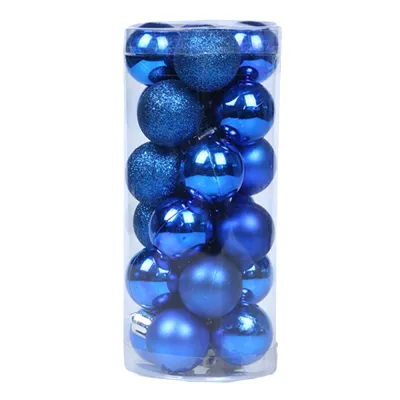
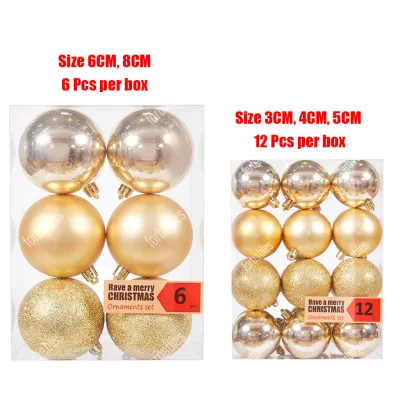
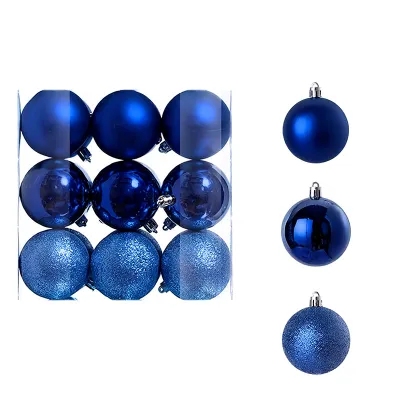
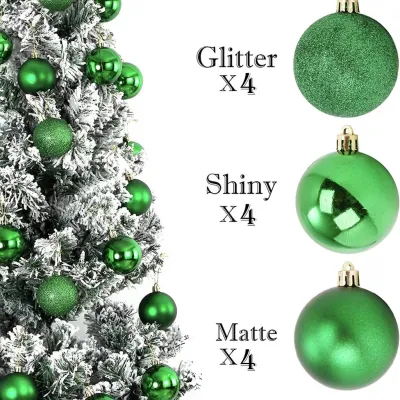
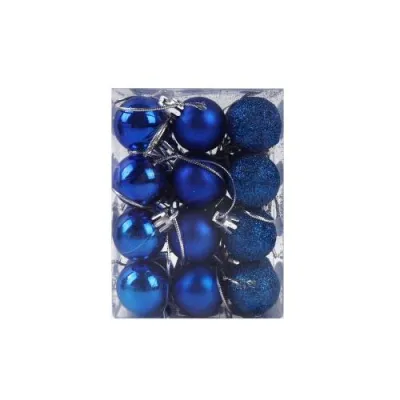
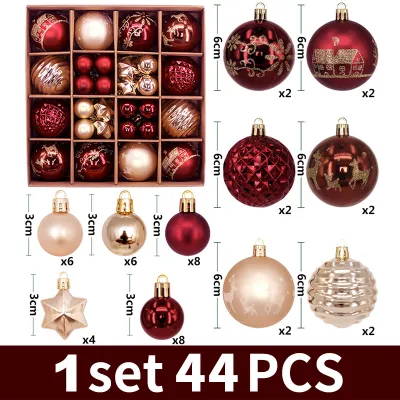
![[READY STOCK] 50Pcs Christmas Tree Decorations Balls Bauble Xmas Party Hanging Ball Ornaments Christmas for Home New Year Gift](https://img.lazcdn.com/g/p/be1fd30512ee7a3d7b11707718fe99b0.jpg_400x400q80.jpg_.webp)
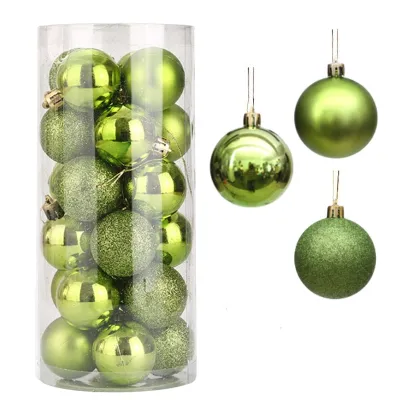
Prices are valid at publication and may change. Please refer to the product page for the latest price.
Before heading to the local department store or browsing an online marketplace—whether you plan to spend ₱1,000 or ₱10,000 on your holiday setup—take precise measurements of your decorating space. Measure the actual height from the floor to the very tip of the tree, keeping in mind the clearance needed for your ceiling fan and your tree topper. Additionally, measure the widest point of the tree’s base, as a wide-profile tree will require significantly more large-diameter ornaments than a slim or pencil-shaped tree of the same height.
Evaluating Your Tree's Density and Branch Structure
The fullness of your tree’s foliage plays a major role in how ornaments sit. A dense, classic pine or fir style provides a thick backdrop that can easily swallow smaller ornaments, meaning you will need larger sizes or brighter finishes to make them visible. On the other hand, sparse, modern, or twig-style trees have open gaps that allow you to hang ornaments deeper inside, but they require careful placement so the branches do not look overloaded.
Before hanging your heavier Christmas balls, physically test the strength of the branches. Gently press down on a branch tip to gauge its springiness and resistance. In tropical climates like the Philippines, where open windows and high-velocity ceiling fans are common to keep rooms cool, a strong breeze can easily set ornaments in motion. Checking branch strength and securing ornaments with tight wire hooks prevents them from swinging into each other and falling.
For artificial trees, always refer to the manufacturer’s instructions or product labels regarding weight limits and branch construction. High-quality artificial trees often feature hinged branches made of heavy-gauge wire that can support substantial weight, while budget-friendly models might use wrapped wire branches that bend easily under pressure. Additionally, high humidity can soften some paper-based or cheap plastic ornament caps over time, so verifying the attachment points before hanging is essential.
Mixing Sizes for a Balanced and Layered Look
Large Christmas balls, typically 10 centimeters or larger, act as the visual anchors of your tree. Instead of hanging these heavy pieces on the very tips of the branches where they can cause sagging, tuck them slightly deeper into the foliage, closer to the trunk. This placement creates an illusion of depth, hides any empty gaps in the inner branches, and provides a solid foundation that makes the entire tree look fuller and more robust.
Medium-sized balls, ranging from 6 to 8 centimeters, are the workhorses of your holiday decor. These ornaments should make up the majority of your collection, as they are light enough to hang on mid-branch sections without causing droop, yet large enough to be easily seen from across the room. Use these to establish your primary color scheme and distribute them evenly across the middle layers of the tree to tie the entire design together.
Small Christmas balls, usually 3 to 5 centimeters in diameter, are perfect for adding detail and finishing touches. Hang these delicate pieces on the outer tips of the branches and near the top of the tree where the branches are naturally thinner and shorter. They are also incredibly useful for filling in small, awkward gaps between larger ornaments, ensuring that no spot on your tree looks bare or neglected.
The ratio of these sizes must shift depending on the scale of your tree. For a compact tabletop tree, you might use 80 percent small ornaments and 20 percent medium ornaments, skipping large ones entirely to prevent overcrowding. For a standard 1.8-meter tree, a balanced ratio of 20 percent large, 50 percent medium, and 30 percent small works beautifully. For grand, extra-tall trees, you can increase the proportion of large and extra-large statement pieces to 40 percent, using medium and small ornaments primarily to fill the remaining spaces.
Common Sizing Mistakes to Avoid
One of the most common decorating mistakes is hanging oversized Christmas balls on a small or tabletop tree. While a large, beautiful ornament might catch your eye at the store, placing it on a compact tree can bend or snap delicate branches, creating a lopsided appearance. Visually, these massive pieces overwhelm the tree’s natural shape, making the entire setup look cluttered and disorganized rather than festive and neat.
Conversely, decorating a tall, grand tree exclusively with small ornaments leads to a fragmented, busy look that lacks cohesion. From a distance, hundreds of tiny baubles simply blend into a chaotic blur, failing to create the warm, festive impact you want. If you already own a large collection of small ornaments, group them together in clusters of three using ornament hooks or floral wire to give them the visual weight of a single, larger ornament.
A Christmas tree naturally tapers from a wide, heavy base to a narrow, delicate point at the top. Your ornament placement should mirror this natural geometry. Placing large, heavy balls near the top of the tree makes it look top-heavy and unstable, while also putting immense strain on the weakest branches. Always transition from your largest ornaments at the bottom of the tree to your smallest, lightest pieces as you work your way up to the topper.
Frequently Asked Questions (FAQ)
How many Christmas balls do I need for my tree?
The total number of Christmas balls you need depends on your tree’s height, width, and your personal decorating style. For a standard 1.8-meter (6 feet) tree with a traditional full profile, a minimalist look might require around 60 to 80 ornaments, while a lush, fully decorated look can easily accommodate 100 to 150 pieces. If you prefer a highly dense, maximalist style where the green foliage is barely visible, you may need upwards of 200 ornaments. To estimate your needs, visualize the tree in vertical sections and plan for roughly 15 to 20 ornaments per foot of height, adjusting upward for wider trees and downward for slim, pencil-style models.
Should I use shatterproof or glass Christmas balls for a tall tree?
For a tall tree, a combination of both materials often provides the best balance of safety, durability, and visual appeal. Glass ornaments offer a classic, high-gloss finish and beautiful light reflection, but they pose a significant safety hazard if they fall from high branches, especially in homes with active pets, young children, or high-velocity ceiling fans. It is highly practical to use lightweight, shatterproof plastic ornaments on the higher branches and outer tips where falls are more likely to occur. Reserve your delicate glass ornaments for the sturdy, inner branches of the middle and lower sections of the tree, where they can be securely anchored and enjoyed safely.

Community discussion
Share your experience or ask a question. Comments are reviewed before publication.