
Finding the most suitable high-power solar lighting for expansive spaces in the Philippines requires looking past the massive wattage numbers printed on product packaging. While a “7000W” label on a UFO solar light suggests immense illuminating power, this figure is a marketing equivalent rather than a measure of actual electrical power draw. To illuminate large driveways, barangay courts, parking lots, or spacious gardens effectively, you must evaluate the fixture’s true lumen output, battery capacity, solar panel efficiency, and structural durability.
Selecting the right fixture involves understanding how these components interact under local tropical conditions. High humidity, intense solar exposure, and frequent monsoon rains demand specific material standards and realistic performance expectations. By focusing on verifiable technical specifications rather than raw wattage claims, you can secure a reliable lighting setup that keeps your outdoor areas bright and secure throughout the night.
Understanding "7000W" Marketing vs. Actual Solar Performance
In the solar lighting industry, high wattage ratings like “7000W” are almost always used as marketing shorthand to describe the perceived brightness relative to traditional incandescent or halogen floodlights. A true 7000-watt electrical draw would require an enormous solar array and a battery bank the size of a refrigerator, which is physically impossible for a self-contained UFO-style fixture. Instead, these ratings indicate that the LED array is designed to produce a high volume of light, though the actual power consumed by the LEDs is a tiny fraction of that number.
Products mentioned in this guide
![[Free shipping]500000W UFO solar street light outdoor waterproof IP67 heavy duty Outdoor Lighting garden Led lamp with motion sensor led light solar lights with solar panel](https://img.lazcdn.com/g/p/44cfe23a59423aa8929ee904103063ef.jpg_400x400q80.jpg_.webp)
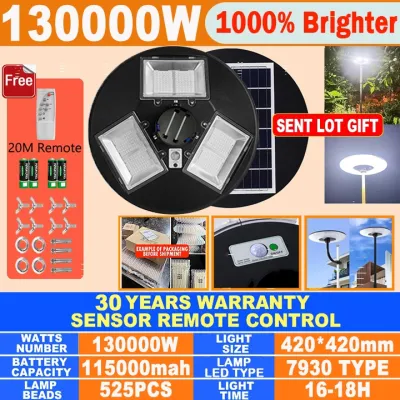
![[Free Shipping] UFO Solar Street Light Outdoor 500000W Waterproof IP67 LED Solar Light Spotlight Outdoor Lamp Motion Sensor Automatic Lighting With solar panel](https://img.lazcdn.com/g/p/89434161832b7bededed9ba8a4c3af50.png_400x400q80.png_.webp)
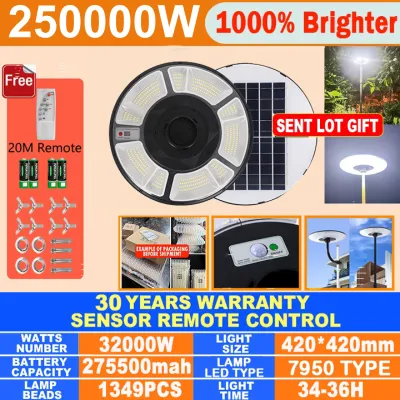
![[Free shipping]UFO RGB Solar Street Light Outdoor Waterproof IP67 LED 100000W 200000W 300000W 380000W 500000W Solar Light Spotlight Outdoor Lamp Motion Sensor Automatic Lighting With Pole](https://img.lazcdn.com/g/p/d61bf03680b3eb15cf71e62aaec2d30e.jpg_400x400q80.jpg_.webp)
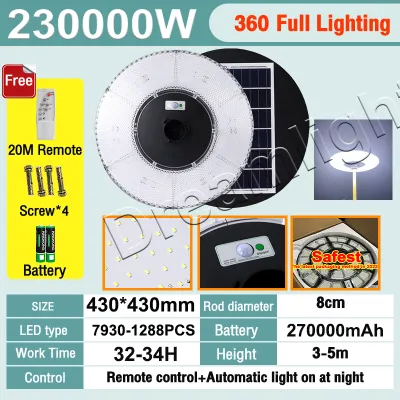
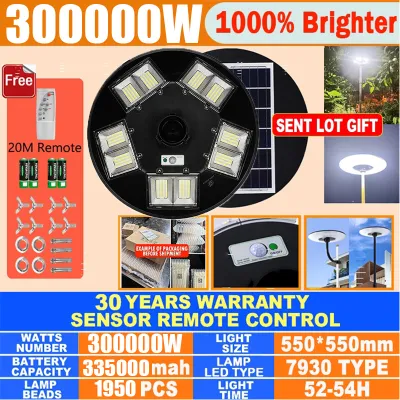
Prices are valid at publication and may change. Please refer to the product page for the latest price.
To assess the true brightness of a UFO solar light, you must look for the lumen rating rather than the wattage. Lumens measure the total amount of visible light emitted by a source. A high-quality outdoor fixture designed for large areas should ideally deliver several thousand verified lumens. Additionally, the density and quality of the LED chips—such as SMD 5730 or SMD 2835 chips—play a critical role in how efficiently the fixture converts electrical energy into visible light.
The performance of any solar light is strictly limited by its energy storage and generation capacity. You must verify the battery capacity, which is typically measured in milliampere-hours (mAh) or watt-hours (Wh), alongside the solar panel’s peak wattage (Wp). For instance, a fixture paired with a low-capacity battery will rapidly dim or shut down after a few hours, regardless of how many LEDs are packed into the housing. Look for lithium iron phosphate (LiFePO4) batteries, which offer superior thermal stability and a longer lifespan compared to standard lithium-ion alternatives.
The solar panel itself must be large enough to fully charge the battery during the day. In the Philippines, where cloud cover can be unpredictable, a high-efficiency monocrystalline solar panel is preferred over a polycrystalline one. Monocrystalline panels perform better in low-light and overcast conditions, ensuring that the battery receives a charge even when the sun is partially obscured. Always cross-reference the physical size of the solar panel with the battery capacity; a small panel cannot fully replenish a massive battery in a standard eight-hour day of sunlight.
Evaluating Brightness and Coverage for Expansive Areas
UFO solar lights are named for their circular, disc-like shape, which is specifically engineered to provide 360-degree horizontal light distribution. This wide beam angle makes them excellent for central mounting in open spaces, as they cast a broad, even pool of light downward and outward. However, this wide distribution means the light intensity decreases rapidly as you move away from the pole, following the inverse-square law of physics.

To achieve uniform illumination without creating dark spots, you must carefully plan the mounting height and spacing of the fixtures. Mounting a UFO light too low concentrates the light in a small, intensely bright circle directly underneath, leaving the surrounding areas in darkness. Conversely, mounting the fixture too high spreads the light over a larger area but significantly reduces the ground-level brightness (lux). For most high-power residential and commercial UFO lights, a mounting height of 4 to 6 meters offers a balanced compromise between coverage area and light intensity.
Pole compatibility and structural placement are critical when designing your layout. UFO lights typically mount onto a vertical pole or a tenon adapter, requiring a sturdy foundation to resist swaying in the wind. When planning the layout of a large yard or parking area, you must decide whether to install a single high-power unit or a distributed network of multiple lower-wattage fixtures.
While a single large fixture might seem more convenient and cost-effective, a distributed layout of multiple smaller fixtures often yields better results for expansive spaces. Spacing multiple lights across the area helps eliminate harsh shadows cast by trees, vehicles, or buildings. It also ensures more consistent light levels across the entire zone, preventing the extreme contrast between a blindingly bright center and pitch-black edges that can compromise security and visibility.
When planning your layout, keep in mind that perceived color temperature and spatial effects are highly subjective. A cool white light (6000K to 6500K) is often preferred for security and high-visibility areas because it appears brighter and crisper to the human eye. However, a warmer color temperature (3000K to 4000K) may be more suitable if you prefer a softer, more inviting ambiance for residential gardens or outdoor dining spaces. These aesthetic choices are conditional preferences rather than objective measures of lighting performance.
Matching Build Quality to Local Weather and Climate
The tropical climate of the Philippines presents severe challenges for outdoor electronic devices, making build quality a primary selection criterion. High humidity, intense UV radiation, and torrential rains can quickly degrade poorly constructed fixtures. To ensure long-term survival, the light fixture and its integrated solar panel must carry a verified Ingress Protection (IP) rating of at least IP65, which guarantees protection against dust ingress and low-pressure water jets from any direction.
Material selection directly impacts how well the fixture resists environmental wear. Many budget-friendly UFO lights utilize ABS plastic housings, which can degrade, crack, and discolor under prolonged exposure to intense tropical sunlight. For maximum durability, look for fixtures constructed with die-cast aluminum housings and tempered glass covers. Aluminum not only resists UV damage but also provides structural rigidity to withstand strong winds during typhoon season.
If you live in a coastal region, salt spray corrosion is an additional threat that can ruin metal components and electrical connections. Saltwater accelerates the rusting of steel screws, brackets, and non-treated aluminum. In these environments, ensure that all mounting hardware is made of stainless steel or has been treated with a specialized anti-corrosion coating.
Thermal management is another critical factor that is often overlooked. LEDs generate significant heat during operation, and high ambient temperatures can cause them to overheat, leading to rapid lumen depreciation and premature failure. Quality UFO solar lights feature integrated aluminum heat sinks with deep fins that facilitate passive air cooling. This design draws heat away from the LED chips and the internal battery, preserving their efficiency and extending their operational lifespan in hot weather.
Planning Safe Mounting and Structural Support
Installing a large UFO solar light requires careful structural planning to prevent physical accidents and property damage. Because these fixtures combine a large light head, a heavy battery, and a wide solar panel into a single assembly, they present a significant wind load. During typhoons, a strong gust of wind can exert immense force on the mounting pole and bracket, potentially causing structural failure if the support system is inadequate.
Before mounting, you must perform a thorough structural check of the intended support, whether it is a ground-mounted pole, an exterior wall, or a roof eave. Ground-mounted poles must be anchored in a deep, concrete foundation to prevent tilting or collapsing under the weight and wind shear. If you are mounting the fixture to a wall, ensure the fasteners penetrate solid structural members, such as concrete blocks or wooden studs, rather than thin siding or fascia boards.
Even though solar lights operate on low-voltage direct current (DC), which minimizes the risk of severe electrical shock, safe wiring practices remain essential. Before beginning any installation or maintenance, ensure complete power isolation by turning off the fixture’s physical switch or disconnecting the solar panel cable. Any external cables connecting the solar panel to the light head must be UV-resistant and rated for outdoor use. Ensure all cable connections are tightly sealed with waterproof connectors or wrapped in high-grade electrical tape to prevent water from seeping into the wiring harness, which can cause short circuits and ruin the internal controller.
You must establish clear safety boundaries and know when to halt a DIY installation. Working at heights carries inherent risks of falls and serious injury. If your installation requires mounting a fixture higher than 4 meters, working near overhead power lines, handling heavy suspended loads, or performing complex structural modifications, stop and consult a qualified professional. Professional installers have the necessary scaffolding, safety harnesses, and structural expertise to complete the job safely and securely in accordance with local building codes.
Verifying Product Claims Before You Buy
Navigating online marketplaces and local hardware stores requires a healthy dose of skepticism, especially when evaluating high-wattage claims. To avoid purchasing a substandard product, you must actively verify seller claims by looking for concrete technical documentation. Request the product manual or specification sheet from the seller, and look for independent user reviews that include real-world photos or videos of the light in operation.
When evaluating a specific model, verify the electrical certifications (such as CE, RoHS, or local quality marks) to ensure the internal components meet basic safety and manufacturing standards. Check the exact dimensions of both the light head and the solar panel, as some listings use deceptive photography to make the product appear larger than it is. Additionally, confirm the dimming method used by the fixture—whether it relies on a remote control, a pre-programmed timer, or an automatic motion sensor—to ensure it matches your operational needs.
Pay close attention to the warranty terms and the availability of after-sales support. A manufacturer that stands behind its product will typically offer a warranty of at least one to two years. Because batteries and solar panels are wear items that will eventually degrade over several years of continuous use, check whether the seller offers replacement parts. A modular design that allows you to replace the battery pack without discarding the entire light fixture will save you significant money in the long run.
When browsing product listings, watch out for common red flags that indicate low-quality or misleading items. Be wary of listings that fail to specify the exact battery capacity in mAh or Wh, or those that claim a runtime of multiple days on a single charge without a massive battery to back it up. Other warning signs include missing IP ratings, vague dimensions, and product photos that have been poorly edited to make the light appear much larger than its actual physical measurements.
Frequently Asked Questions (FAQ)
How long will a high-capacity solar light last during consecutive cloudy days?
The runtime of a solar light during consecutive cloudy days depends entirely on its battery capacity and the efficiency of its charging system. When sunlight is limited, a fully charged high-capacity battery can typically power the light for one to two nights, depending on the selected brightness mode. To conserve energy during extended periods of overcast weather, most modern UFO solar lights feature intelligent power management systems. These systems automatically dim the light to a low standby level (such as 20% brightness) and only boost to 100% when the built-in motion sensor detects movement, significantly extending the battery’s endurance.
What is the best way to maintain the solar panel's efficiency over time?
To maintain optimal charging efficiency, you should establish a routine cleaning schedule for the solar panel. Over time, dust, pollen, bird droppings, and windblown debris accumulate on the glass surface, blocking sunlight and reducing the panel’s power output. Cleaning the panel every three to six months with a soft cloth, mild soap, and water is usually sufficient to restore its performance. Additionally, perform regular physical inspections to check for cracked glass, loose mounting brackets, or corroded electrical connections. You should also trim any nearby tree branches or vegetation that have grown over the installation area, as even partial shading can drastically reduce the solar panel’s daily energy generation.

Community discussion
Share your experience or ask a question. Comments are reviewed before publication.