
Selecting the right solar street lights for your garden or yard involves more than simply picking a model with the highest wattage. To create a beautifully illuminated landscape that remains functional throughout the night, you must evaluate how different fixtures interact with your outdoor layout, local weather patterns, and specific lighting goals. Because solar-powered systems operate independently of the electrical grid, their performance relies heavily on matching the technical capabilities of the light with the environmental conditions of your property.
Assessing Your Garden and Yard Lighting Requirements
To design an effective outdoor lighting scheme, begin by dividing your garden and yard into distinct functional zones. Pathways and walkways require consistent, low-glare illumination to guide foot traffic safely without blinding those walking by. In contrast, open lawns, play areas, and driveways demand broad, high-intensity light distribution to maximize visibility and coverage. Security zones, such as blind spots along perimeter walls, dark corners near gates, or entryways, benefit from targeted, high-output lighting that can deter unauthorized access or highlight movement.
Evaluating the required brightness levels and beam spread for each zone prevents common lighting mistakes, such as over-illuminating quiet garden corners or leaving critical pathways in deep shadow. The beam spread, or the angle at which light is emitted from the fixture, determines how wide an area the light will cover at a specific mounting height. A narrow beam angle is ideal for highlighting architectural features, large trees, or specific garden ornaments, whereas a wide beam angle is essential for casting an even wash of light across a spacious driveway or open lawn.
Products mentioned in this guide
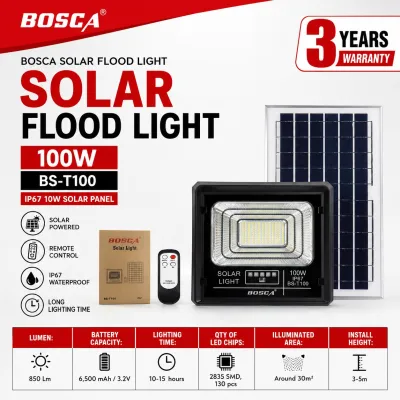
Prices are valid at publication and may change. Please refer to the product page for the latest price.
Sun exposure is the most critical factor determining the success of any solar lighting installation, particularly in tropical environments where lush vegetation is common. You must carefully observe your yard throughout the day to identify areas that receive direct, unobstructed sunlight for at least six to eight hours. Heavily shaded spots—such as areas directly beneath dense tree canopies, adjacent to high perimeter walls, or under wide house eaves—will severely limit the solar panel’s ability to charge the internal battery. Mapping these microclimates in your yard allows you to place solar collectors in high-sunlight zones, even if the light fixture itself is positioned slightly further away using a split-panel design.
Key Specifications to Evaluate in Bosca Solar Models
When comparing different Bosca solar street lights, looking past marketing buzzwords and focusing on the technical specifications listed on the product packaging or in the user manual is essential. The brightness of an LED light is measured in lumens, not watts. While wattage indicates the amount of power the LEDs consume, lumens represent the actual light output. To ensure you select a fixture with adequate brightness, check the rated lumen output on the technical datasheet to match the specific requirements of your target zone. Additionally, verify the voltage compatibility, mounting interface, wattage limits, physical dimensions, and dimming methods of the fixture to ensure it fits your installation environment. Always check for recognized electrical certifications on the product label to guarantee safety.

The reliability of a solar street light during consecutive cloudy days depends on its solar panel efficiency and battery capacity. Look for models featuring monocrystalline solar panels, which offer superior energy conversion rates compared to polycrystalline alternatives, especially in diffuse light conditions. Additionally, verify the battery capacity, typically specified in milliampere-hours (mAh) or Ampere-hours (Ah), along with the battery chemistry. Lithium Iron Phosphate (LiFePO4) batteries are highly recommended for tropical climates like the Philippines because they offer excellent thermal stability, handle high ambient temperatures safely, and provide a significantly longer lifespan than standard lithium-ion or lead-acid batteries.
Outdoor fixtures must be built to withstand harsh environmental exposure, making the Ingress Protection (IP) rating a vital specification to verify. An IP rating consists of two digits: the first indicates protection against solid objects like dust, and the second indicates protection against liquids. For garden and yard installations, look for a minimum rating of IP65, which ensures the fixture is completely dust-tight and protected against water jets from any direction. In areas exposed to heavy monsoon rains or high-pressure garden sprinklers, upgrading to an IP66-rated model provides an extra layer of moisture protection.
Understanding the sensor types integrated into the light fixture allows you to optimize energy usage and customize performance. Many solar street lights feature passive infrared (PIR) motion sensors that detect heat signatures from moving people or animals. These sensors can be configured to keep the light at a dim, energy-saving level (such as 10% or 20% brightness) until motion is detected, at which point the fixture instantly ramps up to 100% brightness. Alternatively, dusk-to-dawn sensors automatically turn the light on at sunset and off at sunrise, maintaining a constant level of illumination throughout the night, which is ideal for continuous security or pathway visibility.
Matching Bosca Light Features to Landscape Zones
Achieving a balanced landscape design requires pairing specific light characteristics and mounting styles with the unique demands of each garden zone. Keep in mind that decorative style, perceived color temperature, and spatial effects are highly subjective and should be treated as conditional preferences based on your landscape design, rather than universal performance facts. For pathway and border lighting, the primary goal is to provide safe navigation while maintaining a soft, inviting ambiance. To achieve this, select fixtures with lower mounting heights—typically between 2 and 3 meters—and focused, downward-directed beam angles. This configuration prevents the light from shining directly into the eyes of pedestrians, reducing glare and preserving the natural beauty of the surrounding foliage.
Open yards, spacious lawns, and residential driveways require a completely different approach, prioritizing broad coverage and high visibility. For these expansive areas, choose models designed for higher mounting poles, ranging from 4 to 6 meters. These fixtures should feature wide-angle lenses or multi-directional LED panels that distribute light over a large surface area. Mounting the lights higher not only increases the ground coverage but also helps minimize harsh shadows, creating a safer and more uniform lighting environment across your driveway or open lawn.
Accent and security zones require high-performance fixtures that can deliver intense illumination when needed. For perimeter walls, dark alleyways, or back gates, prioritize high-lumen models equipped with responsive motion sensors. By keeping these lights in a low-power standby mode during quiet hours, you conserve valuable battery energy while ensuring that any movement triggers a bright, sudden burst of light. This sudden transition is highly effective at deterring potential intruders and providing clear visibility for security cameras or homeowners inspecting unusual noises.
Installation, Safety, and Maintenance Best Practices
Proper installation is key to maximizing the lifespan and performance of your solar street lights. When mounting the fixtures, ensure the solar panels are positioned to receive unshaded sunlight throughout the day. In the Philippines, which lies close to the equator, solar panels should ideally be tilted at a slight angle of approximately 10 to 15 degrees facing south (or north, depending on your exact location) to optimize solar energy collection year-round. This tilt also helps rainwater wash away accumulated dust and debris naturally.
When working with fixed wiring, damp garden areas, work at height, or suspended loads, always prioritize safety by ensuring complete power isolation before beginning. Strictly follow the manufacturer’s installation instructions, and do not hesitate to establish clear boundaries where a qualified professional or licensed electrician must take over. Structural safety is a critical consideration, especially in regions prone to strong tropical typhoons. Before securing your fixtures, perform a thorough check of the mounting height and verify the stability of the pole or wall bracket. Heavy solar street lights, which combine the weight of the LED fixture, solar panel, and internal battery, exert significant wind load during storms. Ensure that mounting poles are anchored deep into a solid concrete foundation or bolted securely to structural concrete walls using heavy-duty expansion bolts.
Maintaining your solar lights involves establishing a simple yet regular cleaning routine to preserve charging efficiency. Over time, dust, pollen, bird droppings, and mold can accumulate on the surface of the solar panel, blocking sunlight and reducing energy production. Every few months, gently wipe down the solar panel and the light lens using a soft microfiber cloth, mild soap, and clean water. Avoid using abrasive cleaning pads, harsh chemical solvents, or high-pressure washers, as these can scratch the protective glass or damage the weather seals.
While many residential solar installations can be completed as DIY projects, certain scenarios require professional expertise. If your landscaping plan involves high-mast installations exceeding 4 meters, working at significant heights, or pouring deep concrete footings for heavy poles, hiring a qualified contractor ensures structural safety. Furthermore, if you intend to integrate your solar street lights with an existing hardwired outdoor electrical system, backup generator, or smart home controller, consult a licensed electrician to handle the wiring and ensure compliance with local electrical safety codes.
Purchasing Checklist and Warranty Verification
Before finalizing your purchase, completing a thorough verification process helps ensure you receive a genuine, high-quality product with reliable long-term support. When browsing online marketplaces or local retail stores, always verify that the seller is an authorized Bosca distributor. Counterfeit or substandard solar lights are common, often utilizing low-grade solar cells and recycled batteries that degrade rapidly under tropical heat. Checking for official brand store badges or requesting authorization certificates from the seller can protect your investment.
When budgeting for your outdoor lighting project, compare the final checkout prices in ₱, making sure to account for all associated costs. Because solar street lights are often bulky and heavy, shipping and handling fees can add a significant amount to the total price, especially if you are ordering mounting poles or heavy-duty brackets. Additionally, factor in the cost of any necessary installation hardware, concrete mix, or mounting accessories that may not be included in the standard product package.
Reviewing the warranty terms in detail is essential for understanding your long-term protection. A comprehensive warranty should explicitly cover the solar panel, the LED chips, and the rechargeable battery, as these components have different lifespans. Pay close attention to the battery warranty, as the battery is the component most likely to require replacement over years of continuous cycling. Ensure the manufacturer or seller provides a clear process for claiming warranty service, including the location of local service centers in the Philippines.
Confirming the seller’s return policies and the availability of local after-sales support is another critical step before making your decision. A reputable seller should offer a straightforward return window for units that arrive damaged or fail shortly after installation. Having access to a local customer support team or a physical service center makes it much easier to source replacement parts, ask technical questions, or resolve any operational issues that may arise during the lifetime of your garden lighting system.
Frequently Asked Questions (FAQ)
Do Bosca solar street lights work during the rainy season in the Philippines?
Yes, they are designed to operate during overcast periods, but their performance depends on the battery capacity and solar panel efficiency. During the rainy season, extended cloudy days will limit the amount of sunlight the panel receives, resulting in a partial charge. Most high-quality models feature a backup runtime of several nights on a full charge when operating in energy-saving motion-sensor modes. However, you should expect reduced brightness or shorter operating hours during prolonged periods of heavy rain and low sunlight.
Can I replace the built-in battery in a Bosca solar landscape light?
Whether you can replace the battery depends on the specific design of the model. Many integrated solar street lights feature sealed battery compartments to maintain their IP weatherproofing rating, making user replacement difficult without compromising the seal. Always check the product manual to see if the battery is designed to be user-replaceable. If replacement is supported, you must match the exact battery chemistry (such as LiFePO4), voltage, and connector type, and follow local environmental guidelines for the safe disposal of the old battery.
How far apart should I space solar street lights along a garden pathway?
The ideal spacing depends on the fixture’s lumen output, mounting height, and beam angle. To avoid dark spots and ensure safe navigation, space the lights so that their beam spreads overlap slightly at ground level. For typical garden pathways using lower mounting heights, spacing fixtures 3 to 5 meters apart generally provides a continuous, even path of light. If your goal is purely decorative or ambient lighting, you can increase the spacing to create a more dramatic, alternating pattern of light and shadow. Testing the placement temporarily at night before permanently securing the poles is highly recommended.

Community discussion
Share your experience or ask a question. Comments are reviewed before publication.