
Choosing the right LED light fixture for your billiard table is the difference between a professional-grade playing experience and a frustrating game filled with shadows. To get the sizing right, you must match the physical length of the light fixture to the active playing surface of your table, ensuring the beam angle covers all four corners and cushions evenly. A properly sized fixture eliminates dark spots in the pockets while preventing blinding glare from spilling into the players’ eyes. By understanding how fixture dimensions, hanging height, and light spread interact, you can transform your game room into a perfectly illuminated arena.
Core Sizing Principles for Billiard Table Lighting
To achieve even illumination across a billiard table, you must understand how light behaves as it travels from the ceiling to the felt. The primary goal of billiard lighting is to cast a uniform sheet of light that covers the entire playing bed, including the cushions and pockets, without creating distracting shadows behind the balls. This requires a balanced relationship between the fixture’s physical length, its mounting height, and the beam angle of the LEDs.
When a light fixture is too small for the table, the light spread fails to reach the far ends of the playing surface. This results in dim, shadowed pockets and rails, making it incredibly difficult to judge bank shots or align precise cuts near the corners. Conversely, an oversized fixture might seem like a safe way to guarantee coverage, but it often causes light to spill past the table boundaries. This excess peripheral light shines directly into the eyes of players standing at the table, causing glare and visual fatigue during long matches.
Products mentioned in this guide
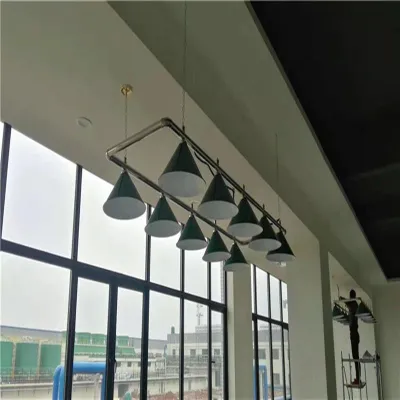
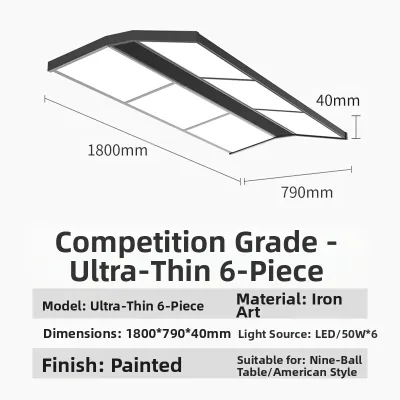
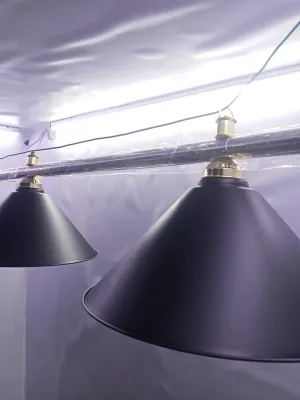
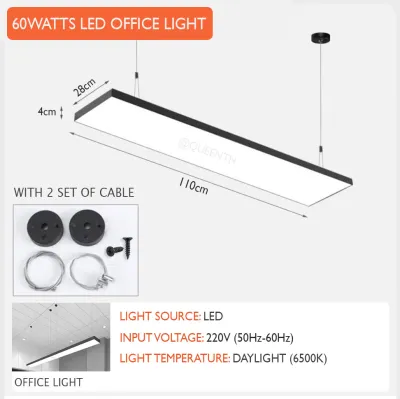
Prices are valid at publication and may change. Please refer to the product page for the latest price.
To control this spread, high-quality billiard fixtures utilize specialized optical components. Reflector shades, frosted diffusers, or engineered lenses are integrated into the design to direct the light downward in a controlled cone or rectangular pattern. These components prevent the light from scattering horizontally into the room, focusing the illumination precisely where it is needed: on the felt. When shopping for an LED fixture, verifying the presence of a high-quality diffuser or downward-facing reflector is essential for maintaining visual comfort.
Matching Fixture Length to Your Table Dimensions
Selecting the correct fixture length starts with measuring your billiard table accurately. Many homeowners make the mistake of relying solely on the advertised table size, such as a “7-foot” or “8-foot” table, which actually refers to the outer frame dimensions. For lighting purposes, you must measure the actual playing surface—the area inside the cushions from the nose of one rubber rail to the opposite side. This playing bed is always smaller than the outer cabinet, and it is the exact zone that requires uniform illumination.

As a general rule of thumb, the length of your linear LED fixture should be approximately one-half to two-thirds of the length of the table’s playing surface. For a standard 7-foot table (which typically has a playing surface of 39 by 78 inches), a linear fixture measuring between 36 and 48 inches is ideal. For an 8-foot table (with a playing surface of 44 by 88 inches), look for a fixture between 48 and 54 inches in length. If you own a professional 9-foot table (measuring 50 by 100 inches of playing space), a robust fixture of 54 to 68 inches is recommended to ensure the light reaches the corner pockets without fading.
The style of the fixture also influences how you calculate these proportions. Traditional multi-light linear fixtures, which feature three or four individual shaded bulbs suspended along a single bar, rely on the spacing of the individual shades to distribute light. For these setups, ensure the distance between the outermost shades spans at least half the table length. Modern single-panel LED lights, often referred to as stadium lights or LED light boxes, use dense arrays of light-emitting diodes behind a single massive diffuser. Because these panels distribute light incredibly evenly from edge to edge, you can often choose a slightly more compact panel size while still achieving flawless, shadow-free coverage.
Calculating the Ideal Hanging Height
Once you have selected a fixture of the correct length, mounting it at the proper height is the next critical step. If the light is hung too low, players risk bumping their cues against the fixture during high-angle shots, and the light spread will be too narrow, leaving the outer edges of the table in the dark. If the fixture is hung too high, the light spreads too wide, reducing the intensity of the illumination on the felt and casting harsh glare directly into the eyes of anyone standing near the table.
The industry standard clearance for billiard lighting is between 32 and 38 inches (approximately 81 to 96 centimeters) measured from the bed of the table (the slate surface, not the floor) to the very bottom of the light fixture. This height range strikes the perfect balance, keeping the light source safely above the average player’s line of sight while ensuring the downward beam fully saturates the playing field.
You may need to fine-tune this height based on the specific beam angle of your LED fixture and the height of the players in your home. Fixtures with a narrow beam angle require a slightly higher mounting position to allow the light cone to spread to the cushions, while wide-angle LEDs can be positioned closer to the lower limit of the clearance range. To make this adjustment process easier, look for fixtures that include adjustable suspension systems, such as aircraft cables, chains, or telescoping stems. These systems allow you to temporarily hang the fixture, test the light spread with actual billiard balls on the table, and easily adjust the height before finalizing the installation.
Installation, Clearance, and Electrical Safety
Installing a heavy overhead light fixture requires careful attention to structural support and electrical safety. Billiard lights, especially multi-light metal pendants or large LED panels, can be heavy and put significant stress on your ceiling. Never mount a billiard light directly into drywall or plaster using simple plastic anchors. Instead, the mounting bracket must be secured directly to a ceiling joist or a structural support block capable of handling the fixture’s weight.
In tropical environments like the Philippines, high humidity levels can accelerate the wear on electrical connections and metal components. When selecting a fixture, verify that the metal housing features a rust-resistant finish and that all wiring connections are properly sealed. Ensure the fixture is compatible with the local 220V mains supply, and verify that the unit is properly grounded, particularly if it features a metal chassis. This grounding is a crucial safety measure to prevent electrical shocks in humid conditions.
Before beginning any installation work, always isolate the power at the main circuit breaker. Working at heights on a ladder over a heavy billiard table introduces physical risks, so ensure your ladder is stable and have an assistant help you lift and hold the fixture. If your installation requires running new electrical lines, mounting a new ceiling junction box, or if you are unsure about the grounding and wiring configuration, always hire a licensed professional electrician. Investing a few thousand ₱ in professional installation ensures your fixture is structurally secure and electrically safe, protecting both your home and your family.
Frequently Asked Questions (FAQ)
Can I use a standard dining room pendant light over a billiard table?
Standard dining room pendant lights are generally unsuitable for billiard tables because they are designed for ambient room lighting rather than focused task lighting. Dining pendants often cast light in an omnidirectional pattern, sending light sideways to illuminate faces and the surrounding room. When placed over a pool table, this design creates intense glare at eye level and fails to deliver the concentrated, downward-directed light needed to eliminate shadows on the felt. Billiard-specific fixtures feature deep shades or specialized diffusers that direct 100% of the light downward, ensuring high contrast on the balls and complete visual comfort for the players.
How do I evaluate brightness requirements for my billiard room?
Evaluating brightness requires looking beyond simple wattage, especially with highly efficient LED fixtures. Instead, focus on the total lumen output of the fixture and how it translates to lux (lumens per square meter) on the playing surface. For recreational play, a target of around 300 to 500 lux on the felt is ideal, while professional play often requires 800 lux or more. If your billiard room has dark wood paneling, low ceilings, or minimal natural light, the room will absorb more light, meaning you will need a fixture with a higher lumen output or adjustable dimming capabilities to achieve the desired brightness. Conversely, rooms with light-colored walls and high ceilings reflect light more efficiently, allowing you to use a slightly lower lumen output to achieve the same perceived brightness.

Community discussion
Share your experience or ask a question. Comments are reviewed before publication.