
Choosing the right LED panel light requires balancing the physical dimensions of the fixture with the actual light output needed for your space. Selecting the perfect lamp light for room environments in the Philippines involves more than just picking a fixture that fits your ceiling grid; it requires analyzing your room’s square footage, ceiling height, and daily activities. A mismatched panel can leave a room feeling either clinically bright or gloomily under-lit.
To achieve balanced illumination, you must coordinate the physical footprint of the panel with its lumen output. Physical sizes like 60x60cm or 30x120cm dictate how the fixture integrates with your ceiling structure, while the wattage and lumen efficacy determine how well the light disperses across the floor. By understanding these dimensions, you can avoid common installation pitfalls and create an inviting, energy-efficient environment.
Understanding Room Dimensions and Lighting Needs
When selecting a lamp light for room spaces, homeowners often confuse physical size with brightness. A physically large panel does not automatically emit more light than a smaller, high-efficiency model. Physical dimensions are primarily structural decisions, whereas light output—measured in lumens—is an environmental decision. To get the best results, you must evaluate both dimensions in parallel.
Products mentioned in this guide
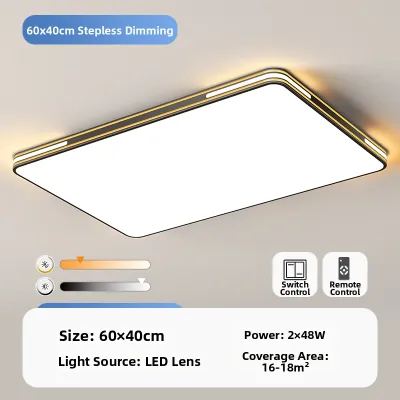
Prices are valid at publication and may change. Please refer to the product page for the latest price.
Physical panel sizes must align directly with your ceiling type. For example, standard commercial and modern residential spaces in the Philippines frequently use T-bar drop ceilings, which are designed to seamlessly accommodate 60x60cm (2×2 feet) or 60x120cm (2×4 feet) panels. If you have a solid drywall or concrete ceiling, you will need to plan for surface-mounted frames or specific recessed cutouts, making the physical footprint of the panel a critical structural constraint.
Beyond aesthetics, physical size influences how light behaves. Larger panels have a broader surface area, which naturally provides a wider, more diffuse beam angle. This diffuse distribution is excellent for reducing harsh shadows and minimizing glare, making larger panels highly desirable for open-plan living areas, study rooms, and home offices where visual comfort is a priority.
Matching LED Panel Sizes to Room Areas
As a general rule, larger physical panels distribute light more uniformly across expansive areas, whereas smaller panels are better suited for targeted illumination in compact or partitioned spaces. If you install a single small panel in a large room, you will likely end up with a bright spot directly underneath and dark, shadow-filled corners. Conversely, putting an oversized panel in a tiny room can overwhelm the space with intense, uncomfortable glare.

Room function dictates both the physical footprint of the fixture and the number of panels required. A bedroom, which is meant for relaxation, demands a different lighting density than a kitchen or home office where detailed tasks are performed.
Small Spaces (Bathrooms, Hallways, Small Kitchens)
For compact areas under 8 square meters, such as bathrooms, entryways, and narrow hallways, smaller physical panel sizes are highly recommended. Fixtures measuring 30x30cm (1×1 foot) or slim rectangular profiles like 15x60cm are ideal for these tight layouts. They provide sufficient ambient light without dominating the ceiling visually.
To prevent glare in confined spaces, it is best to select panels equipped with high-quality frosted diffusers. These diffusers soften the light, ensuring that the illumination does not reflect harshly off bathroom mirrors or polished kitchen tiles. Keep the wattage moderate—typically between 9W and 12W—to maintain a comfortable brightness level.
In narrow hallways, placing slim rectangular panels in a linear sequence helps guide movement safely while making the space feel longer and more open. For bathrooms, always verify that the panel has an appropriate Ingress Protection (IP) rating, such as IP44, to withstand the high humidity levels common in Philippine households.
Medium Rooms (Bedrooms, Home Offices, Standard Kitchens)
Medium-sized rooms ranging from 9 to 15 square meters require a more balanced approach to ambient and task lighting. For these spaces, mid-sized panels such as 60x60cm (2×2 feet) serve as the industry standard. They offer a clean, professional look and deliver a generous spread of light.
In a standard bedroom, a single centrally mounted 60x60cm panel of moderate wattage can easily provide all the necessary ambient light. However, in a home office or a standard kitchen, shadow reduction is critical for working or food preparation. In these scenarios, opting for two smaller 30x60cm panels spaced evenly across the ceiling can provide superior coverage and eliminate annoying shadows over your desk or countertops.
Large Areas (Living Rooms, Open-Plan Spaces, Garages)
Expansive areas exceeding 16 square meters require a strategic layout to prevent dark corners and ensure uniform light distribution. For these spaces, large-format panels like 60x120cm (2×4 feet) or a calculated grid of multiple 60x60cm panels are the most effective solutions.
Using a single large panel in a spacious living room is rarely sufficient. Instead, designing a symmetrical grid of four 60x60cm panels ensures that the entire floor area receives consistent light. This layout maintains visual balance and prevents the “cave effect,” where the center of the room is bright but the perimeter remains dim.
When planning a grid, space the panels evenly. A common guideline is to keep the distance between panels roughly equal to the distance from the panels to the walls, ensuring seamless overlapping of light beams.
Calculating Wattage and Lumens for Proper Illumination
To ensure your room is neither under-lit nor blindingly bright, you must transition from looking at physical dimensions to calculating actual light output. Wattage measures the electrical power consumed, whereas lumens measure the actual amount of visible light emitted. Modern LED panels are highly efficient, meaning they deliver high lumen output while consuming very little wattage.
To calculate the required brightness for your room, you can use a straightforward three-step framework based on square meters and lux (lumens per square meter):
- Step 1: Calculate Room Area. Multiply the length of the room by its width in meters to find the total square meters (e.g., a room that is 4m by 3m has an area of 12 sqm).
- Step 2: Determine Required Lux. Different room activities require different light intensities. Use these standard residential guidelines:
- Bedrooms and Living Rooms: 100 to 150 lux
- Kitchens and Home Offices: 300 to 400 lux
- Bathrooms and Hallways: 150 to 200 lux
- Step 3: Calculate Total Lumens. Multiply your room area by the required lux. For a 12 sqm home office, the calculation is: 12 sqm × 300 lux = 3,600 lumens.
Once you know your total lumen requirement, check the product specifications of your chosen LED panels. Look for the luminous efficacy rating, which is expressed as lumens per watt (lm/W). A panel with high efficacy (such as 100 lm/W) will produce 1,800 lumens using only 18W of power, helping you keep your monthly electricity bills manageable.
Additionally, always verify that the LED panels you purchase are compatible with local electrical standards in the Philippines. The standard residential voltage is 220V to 240V at a frequency of 60Hz. Ensure the product packaging features valid safety certifications, such as the Philippine Standard (PS) mark or the Import Commodity Clearance (ICC) sticker, to guarantee safe operation.
Installation Clearances and Ceiling Constraints
Before finalizing your purchase, you must evaluate the physical structure of your ceiling. Recessed LED panels require a specific cavity depth behind the ceiling board to accommodate the fixture’s thickness and its external LED driver. Standard recessed panels typically require a clearance depth of at least 5 to 10 centimeters.
While drop ceilings with T-bar grids allow panels to lay directly into the framework, solid concrete or drywall ceilings present different challenges. For concrete ceilings, recessed installation is generally impractical without constructing a secondary false ceiling. In these cases, you must purchase surface-mount frames or suspension kits designed specifically for your panel size.
Heat dissipation is another critical factor, particularly in the warm, humid climate of the Philippines. Although LEDs run much cooler than old fluorescent tubes, their electronic drivers still generate heat. Trapping a driver in a tight, unventilated ceiling space can cause it to overheat, leading to flickering, dimming, or premature failure. Always leave at least 5 centimeters of free air clearance around the panel and driver to allow for natural ventilation.
For your safety, always isolate the power supply by turning off the main circuit breaker before starting any installation work. Fixed electrical wiring, structural ceiling modifications, and installations in damp environments like bathrooms must be handled or verified by a qualified professional electrician to ensure compliance with the Philippine Electrical Code and to preserve your product warranties.
Common Sizing Mistakes to Avoid
One of the most frequent errors is purchasing an oversized panel for a small room. Homeowners often assume that bigger is always better, only to find that a 60x120cm panel in a small bedroom creates an uncomfortably intense environment that causes eye strain and headaches.
Another common mistake is ignoring the ceiling height. If your room has high ceilings (above 2.7 meters), standard ambient panels may not push enough light down to the floor level. For high ceilings, you will need panels with higher lumen outputs or tighter beam angles to ensure the light reaches your living space effectively.
Many buyers also fail to account for the physical dimensions of the external LED driver. They measure the ceiling cavity to fit the slim panel perfectly, only to realize during installation that there is no room left to safely tuck away the bulkier driver box.
Finally, do not assume that all panels of the same physical size deliver identical brightness. A budget 60x60cm panel might only emit 2,000 lumens, while a premium model of the exact same size might produce 4,000 lumens. Always read the packaging specifications carefully, focusing on lumens and efficacy rather than physical size alone.
Frequently Asked Questions (FAQ)
Can I use multiple small LED panels instead of one large one?
Yes, using multiple small panels is an excellent way to achieve more uniform light distribution. Spacing out several small fixtures helps eliminate shadows and dark corners, which is highly beneficial in long kitchens or home offices. However, this configuration requires cutting multiple holes in your ceiling and running more complex wiring. A single large panel offers a cleaner, more minimalist aesthetic and is generally simpler to install.
Does ceiling height change the LED panel size I need?
Ceiling height primarily affects your required lumen output and beam angle rather than the physical size of the panel. Higher ceilings require more powerful lights (higher wattage and lumens) to project sufficient illumination down to the floor. While larger physical panels provide a wider beam angle that helps distribute light evenly, you must ensure they have high enough lumen ratings so the light does not dissipate before reaching your living space.

Community discussion
Share your experience or ask a question. Comments are reviewed before publication.