
Choosing the right size flush mount light for a compact condo bedroom requires balancing the room’s physical footprint with its vertical clearance. A fixture that is too large dominates the ceiling and makes the room feel cramped, while one that is too small fails to provide adequate ambient light. By using simple sizing formulas based on room dimensions and verifying vertical clearance, you can select a modern design that enhances your space without overwhelming it.
In typical urban condominiums, where ceiling heights often hover around 2.4 to 2.7 meters, selecting a low-profile fixture is essential to maintain comfortable headroom and a balanced visual aesthetic. The goal is to find a fixture that blends seamlessly into the ceiling while providing efficient, glare-free illumination.
Assessing Your Bedroom's Proportions and Ceiling Height
Before browsing online catalogs or visiting a lighting showroom, you must gather precise measurements of your bedroom. Start by measuring the length and width of the room from wall to wall. Even a minor miscalculation can lead to buying a fixture that looks disproportionately large once installed.
Products mentioned in this guide
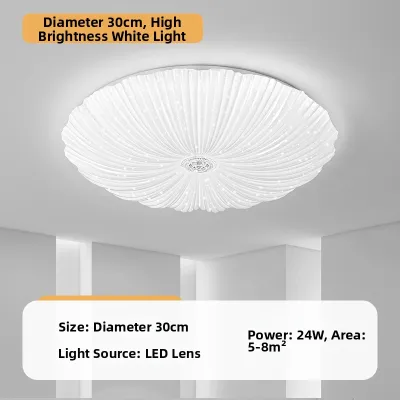
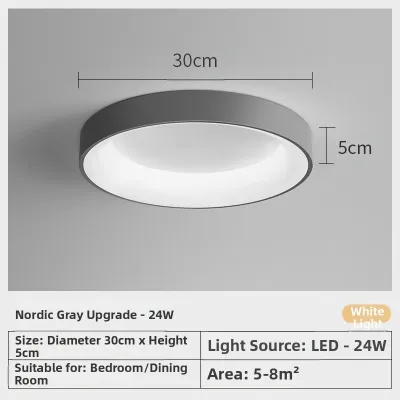
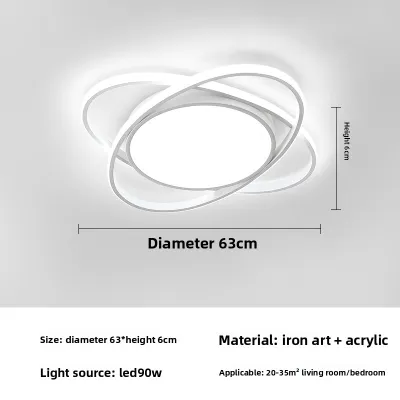
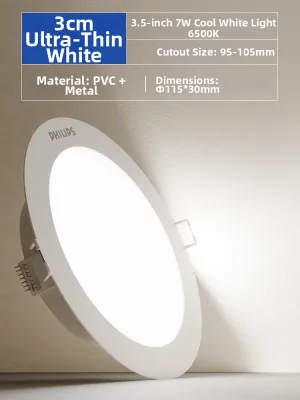
Prices are valid at publication and may change. Please refer to the product page for the latest price.
Next, measure the exact ceiling height. Many modern condominium developments feature concrete slab ceilings, often paired with dropped gypsum board sections designed to conceal utility pipes, electrical conduits, or central air conditioning ducts. These architectural elements can significantly reduce your actual vertical clearance, sometimes leaving you with a ceiling height of 2.4 meters or less.
Standard safety and design guidelines dictate that the bottom of a ceiling fixture should hang no lower than 2.1 meters (7 feet) from the floor. This clearance ensures that residents and guests can walk freely beneath the light without any risk of head contact. If your ceiling is exceptionally low, your options will be strictly limited to ultra-thin flush mounts.
Finally, inspect the ceiling for physical obstructions. Take note of the location of concrete structural beams, fire sprinkler heads, split-type air conditioner indoor units, and wardrobe doors. A flush mount light with a wide diameter must not block the swing path of closet doors or sit too close to a sprinkler head, which could interfere with its heat sensor or water distribution path.
Calculating the Ideal Flush Mount Light Diameter and Profile
To find a fixture that looks proportional to your bedroom, you can use a classic interior design rule of thumb. First, convert your room’s dimensions from meters to feet. Add the length and the width of the room together; the resulting sum in inches represents an ideal diameter for your ceiling light. For example, if your compact condo bedroom measures 9 feet by 10 feet (approximately 2.7 meters by 3 meters), adding those numbers gives you 19. Therefore, a fixture with a diameter of roughly 19 inches (about 48 centimeters) will fit the space beautifully.

If you prefer to work entirely in metric measurements, you can calculate a suitable size by adding the room’s length and width in meters, then multiplying the sum by 8 to 10. Using the same 2.7-meter by 3-meter room, the sum is 5.7. Multiplying this by 8 gives you approximately 45 centimeters, which serves as an excellent baseline diameter for your search.
While diameter determines the horizontal footprint, the fixture’s profile—or height—determines how much vertical space it consumes. For standard condo ceilings, look for flush mounts with a profile of 5 to 10 centimeters (2 to 4 inches). An ultra-shallow profile keeps the light source close to the ceiling, which helps distribute light outward rather than casting harsh downward shadows.
If your bedroom has an irregular layout, such as an L-shaped floor plan or an integrated study nook, avoid trying to light the entire space with a single massive fixture. Instead, calculate the ideal size based on the main sleeping area, and use secondary lighting sources like wall sconces or slim desk lamps to illuminate the auxiliary zones.
Integrating Modern Design Elements Without Overcrowding
When shopping for room lights modern design principles favor simplicity, clean lines, and high functionality. In a small condo bedroom, heavy, ornate, or highly decorative fixtures can create visual clutter. Instead, look for minimalist frames, slim profiles, and integrated LED designs that sit flush against the ceiling surface.
Integrated LED flush mounts are particularly suited for compact spaces because they do not require bulky bulb sockets or large glass domes. This technology allows manufacturers to create incredibly thin fixtures that deliver bright, even light distribution. Furthermore, high-quality acrylic diffusers help soften the light, preventing harsh glare when you are lying in bed.
Visual weight is another critical factor to consider. A fixture with a dark, thick metal frame will appear heavier and draw the eye upward, which can make a low ceiling feel even lower. To make the room feel more spacious, opt for fixtures with white, light gray, or soft metallic finishes that match or complement your ceiling color. This allows the fixture to visually recede into the ceiling when turned off.
Consider how the light interacts with your room’s surfaces. Fixtures that offer a subtle halo effect—where a small amount of light is directed upward or outward against the ceiling—can make the ceiling appear higher than it actually is. Pair this with a warm to neutral color temperature (typically 2700K to 4000K) to create a cozy, inviting atmosphere that is perfect for a resting environment.
Electrical Compatibility and Safe Installation Boundaries
Before finalizing your purchase, you must verify that the fixture is fully compatible with your condo’s electrical infrastructure. In the Philippines, the standard residential electrical supply is 220V to 230V at 60Hz. Many imported fixtures are designed for 110V systems; installing these without a transformer or ensuring they have a wide-voltage driver can damage the fixture or pose a safety hazard.
Check the weight capacity of your ceiling’s junction box. While lightweight plastic or thin metal flush mounts are easily supported by standard boxes, heavier fixtures require a heavy-duty, securely anchored junction box. If your condo has a concrete ceiling slab, mounting a new fixture may require drilling anchor holes directly into the concrete, which must be done carefully to avoid hitting embedded conduits.
Always prioritize safety when dealing with electrical installations. Before removing an old fixture or installing a new one, isolate the power at your condo’s main circuit breaker panel. Use a non-contact voltage tester to confirm that the wires are completely dead before touching them.
If your installation requires running new wiring, modifying structural concrete, or working with complex dimming systems, do not attempt a DIY installation. Always consult a licensed electrician to handle the fixed wiring. A professional installer will ensure that all connections are secure, properly insulated, and compliant with the Philippine Electrical Code, protecting your home from potential electrical faults.
Frequently Asked Questions (FAQ)
Can I use a semi-flush mount instead if my ceiling is very low?
Semi-flush mounts, which hang down slightly to leave a small gap between the fixture and the ceiling, are generally not recommended for ceilings lower than 2.4 meters. However, if you want to use one, position it directly over the bed. Because this area is not a walking path, the risk of bumping into the fixture is minimized, though you must still ensure sufficient clearance when sitting up or changing bed linens.
How many lumens do I need for a small condo bedroom?
For a typical small condo bedroom measuring between 9 and 12 square meters, a total light output of 1,500 to 2,500 lumens is usually sufficient for general ambient lighting. If your bedroom features dark accent walls, heavy drapes, or limited natural light, you may want to aim for the higher end of this range or supplement the central fixture with bedside lamps.
Do modern flush mount lights require special dimmer switches?
Yes, if you choose an integrated LED flush mount and plan to dim the light, you must verify that both the fixture and your wall switch are compatible. Standard incandescent dimmers often cause LED fixtures to flicker, buzz, or fail prematurely. Look for fixtures labeled as dimmable and pair them with a compatible LED-rated dimmer switch as specified by the manufacturer.

Community discussion
Share your experience or ask a question. Comments are reviewed before publication.